
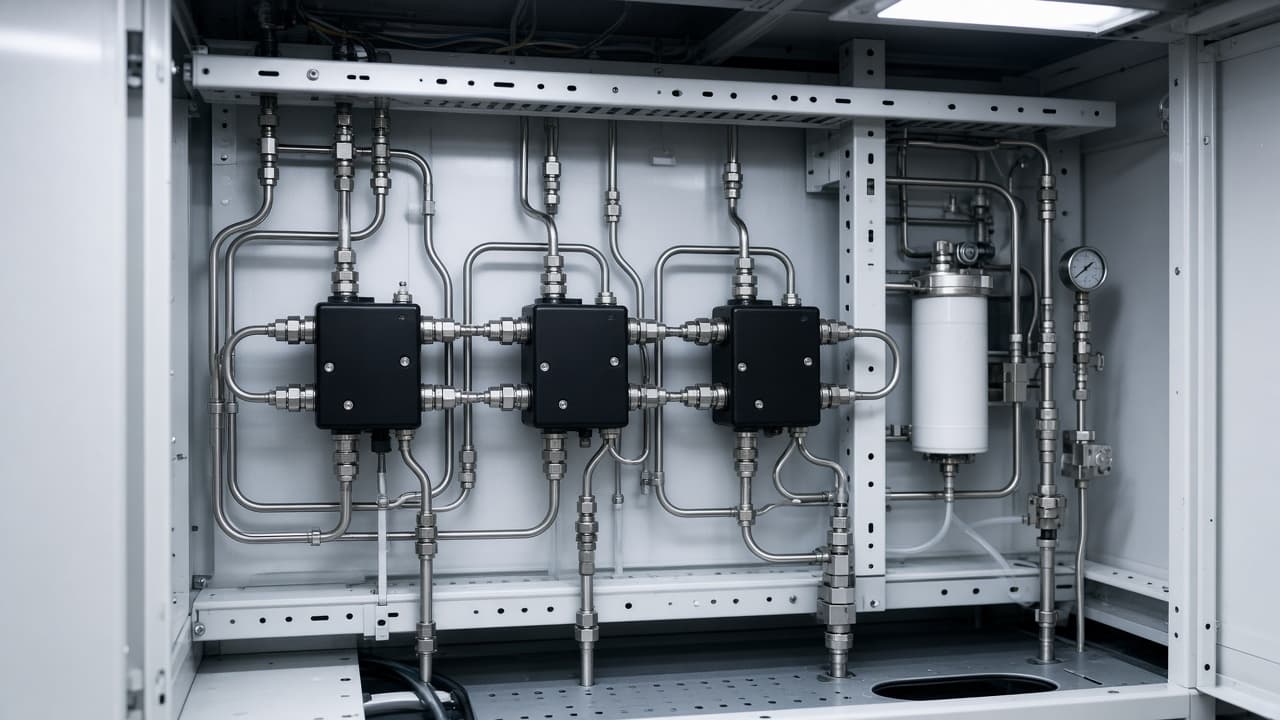
Process engineers argue about RF hours, chamber seasoning, and precursor purity. Less glamorous, and often earlier: the mass flow controller that still shows a confident set point while the actual molecules arriving at the showerhead have wandered.
Ion implant dose maps and cryopump regeneration capacity belong to other modules. Here the subject is MFC zero, span, and gas-factor honesty on etch, CVD, and related gas boxes.
What an MFC actually measures
Most fab MFCs are thermal or pressure-based devices trained on a reference gas, then scaled with gas correction factors for the process gas. A wrong factor, a zero that climbed after a pressure surge, or a span that aged since the last metrology check means the tool can hit “green” while the wafer sees a different partial pressure. Multi-gas recipes amplify the error: one drifted channel skews ratio even when every other MFC is perfect.

Drift signatures worth trusting
Watch for:
- Thickness or etch-rate shifts that track one gas channel after a gas-box service, not after a chamber wet clean.
- Zero readings that no longer sit at true zero when the valve is closed and purge is stable.
- Disagreement between tool-reported flow and an independent verification meter during PM.
- Sudden “need” to tweak recipe set points after MFC replacement without a formal gas-factor review.
Calibration is not a sticker
Vendor intervals are starting points. Dirty filters upstream, valve leak-by, and thermal environment around the gas box change response. After any MFC swap, verify zero, apply the correct gas factor, and run a span check against a reference before releasing the chamber to production lots. Document which gas, which factor table version, and which reference standard—tribal memory is not a metrology record.
A recipe that “never changed” can still change at the wafer if the MFC’s idea of a sccm has moved. Fix the flow truth before you rewrite the process.