
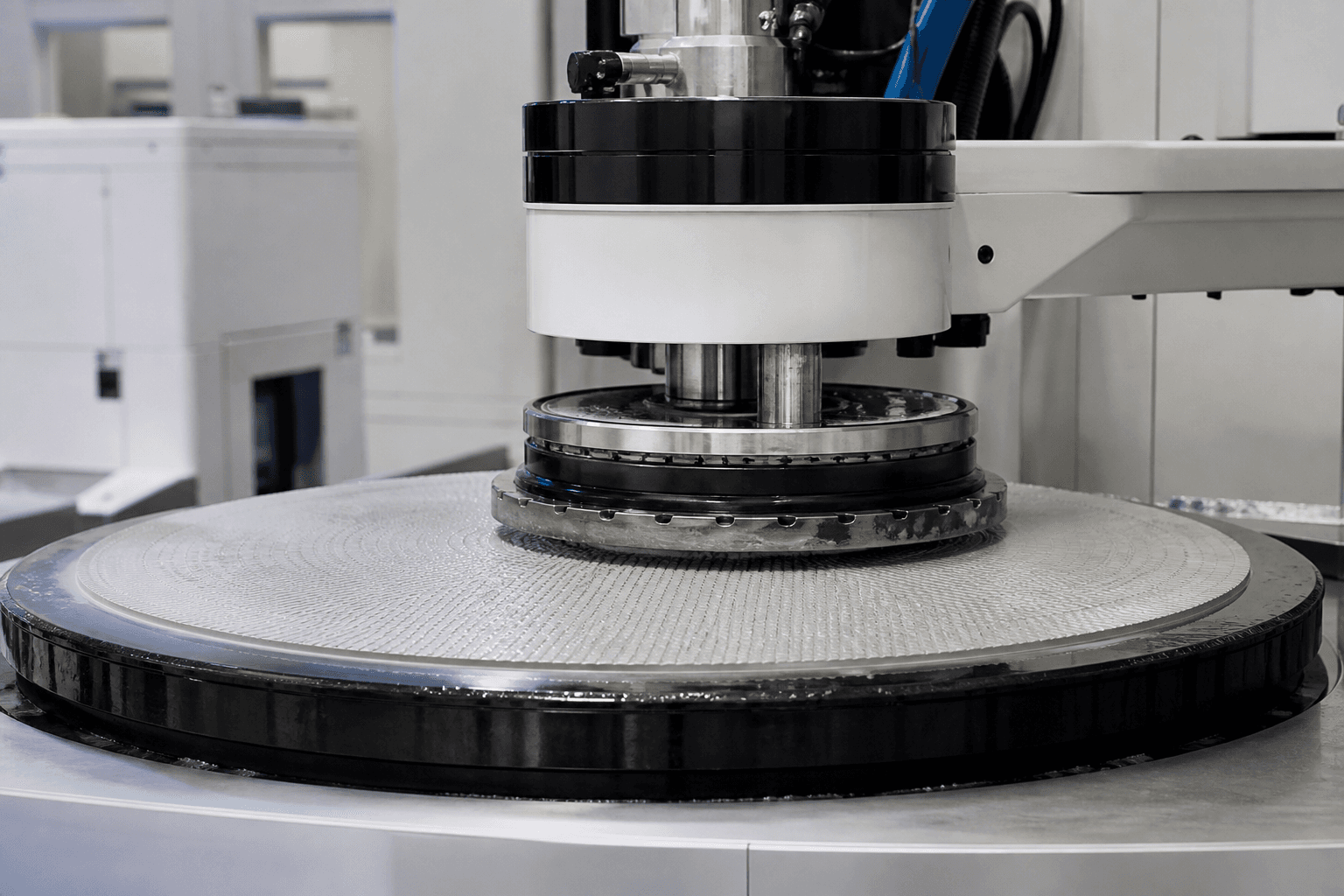
Chemical mechanical planarization is sold as slurry chemistry and downforce. On the tool, the wafer sees a polymer pad whose grooves carry slurry and whose asperities do the mechanical work. Those grooves fill. The surface glazes. Removal rate drifts. Edge-fast or center-fast signatures appear that look like a head or slurry problem in the matching meeting—until someone measures groove depth and finds the pad is finished.
This is adjacent to slurry cold-chain and particle-size stories, not a repeat of them. The consumable here is the pad–conditioner pair.
What the pad is doing
Grooves are a hydraulic network. When they shallow, local slurry refresh collapses and temperature and friction rise. Glaze is a compacted, less abrasive skin that cuts removal rate and can raise scratch risk when conditioner then digs aggressively to "recover" rate. Pad life in wafer count is a starting guess; the real gate is geometry and texture against a metrology or coupon baseline from qualification.
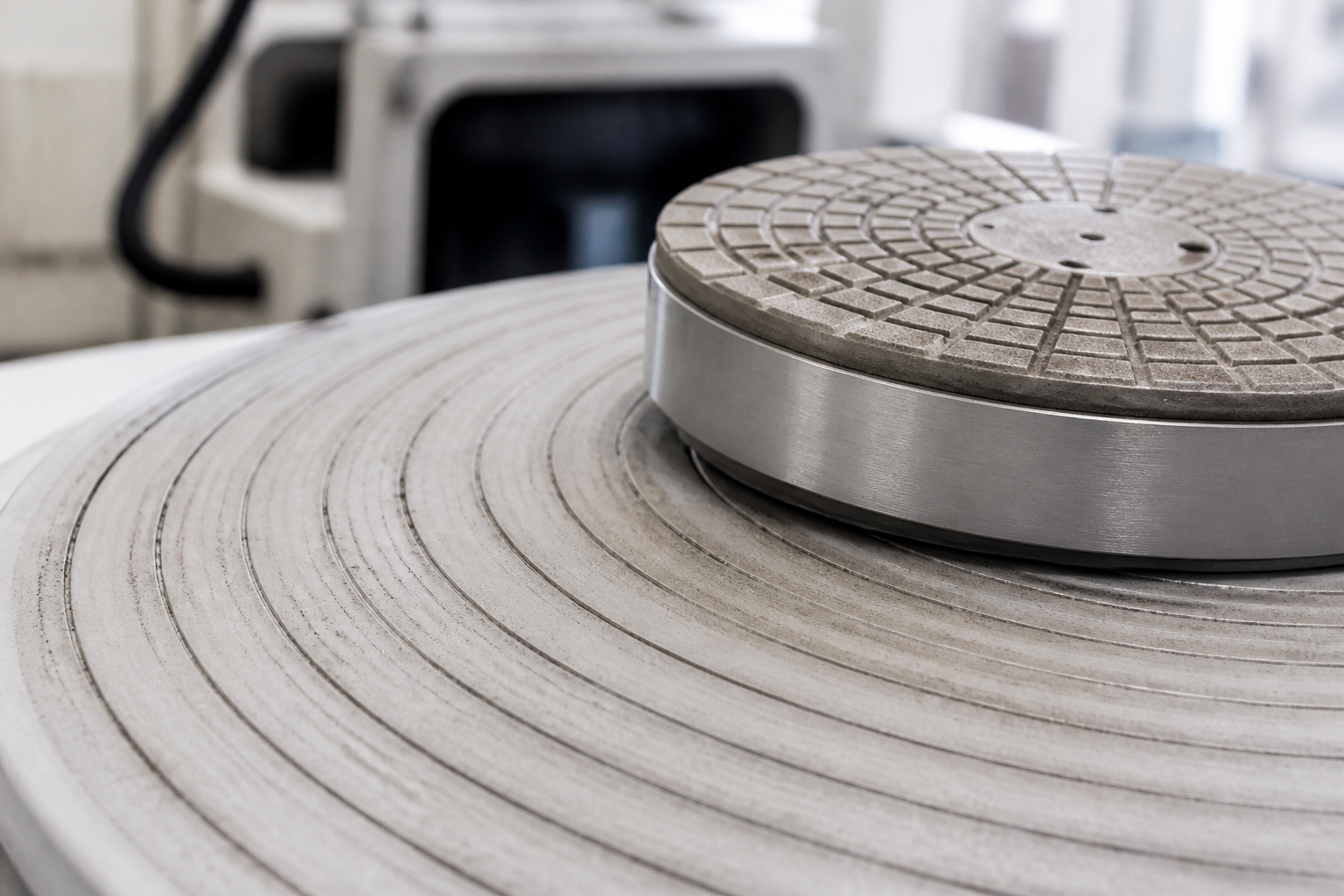
Conditioner disks are not free-running furniture. Diamond size, downforce, RPM, and sweep pattern set how fast grooves are restored versus how fast the pad is consumed. Under-condition and you polish on glaze. Over-condition and you eat pad life and throw debris into the slurry path.
Numbers that belong on the tool report
Track: removal rate on monitors versus hours or wafer count since pad change, conditioner hours, and periodic groove or pad-surface metrics if the fab has them. A step change after a conditioner swap—with slurry lot unchanged—is a conditioner or sweep issue, not a mystery process drift.
Break-in after pad change is part of the POR. Skipping break-in wafers to "save capacity" is how the first production lot of a new pad becomes the excursion lot.
Pairing and change control
Pad and conditioner are a qualified pair. Swapping only the conditioner brand because procurement found a cheaper disk is a process change. So is changing conditioner recipe to chase rate without re-checking scratch and uniformity.
Slurry lot holds and pad changes should not be confounded in the same shift without a designed split. When both move, the matching team will argue for a week.
What yield meetings should ask first
Before a slurry dual-source is blamed for a rate cliff, ask pad serial, groove state, and conditioner hours. Before chamber matching on CMP rate, ask whether the pads are at comparable life.
The wafer does not see the tote certificate. It sees the pad face under the head. Maintain that face as a measured consumable, or keep explaining "slurry variation" that follows pad age.