
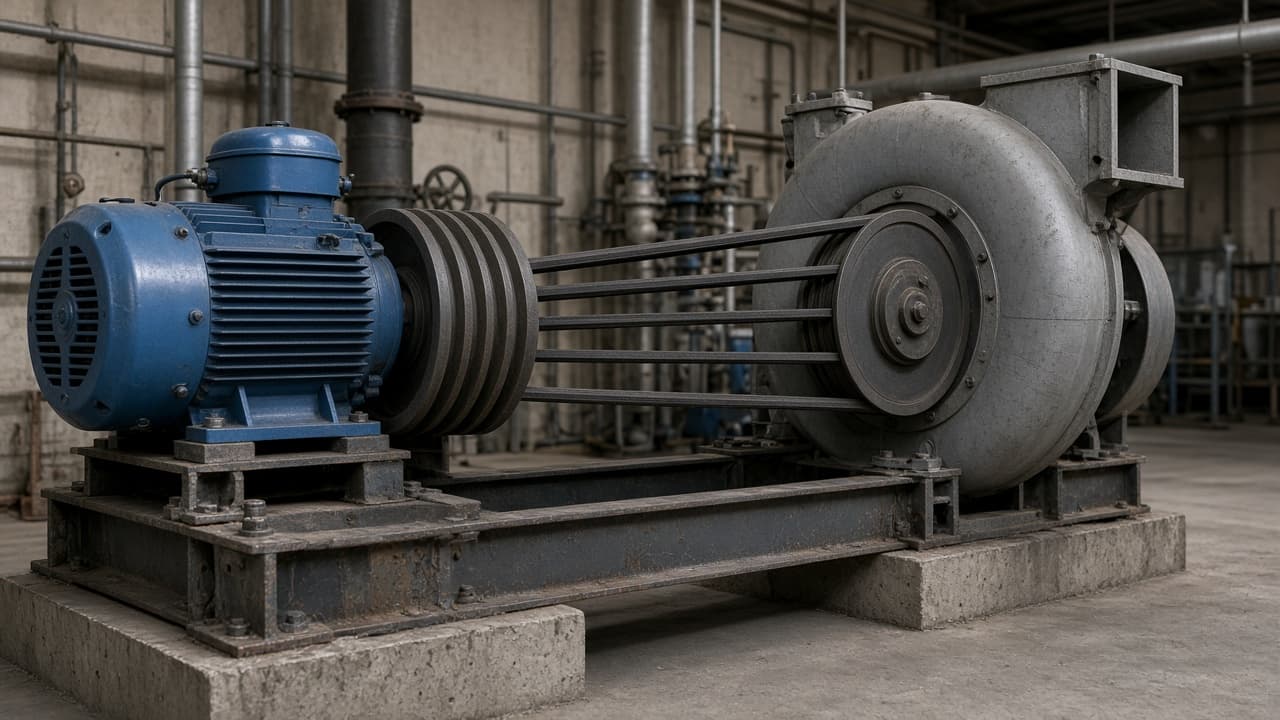
When a fan or pump motor keeps eating belts, the default story is “cheap belts” or “bad luck with the last matched set.” Sometimes the belts really were wrong. More often the sheaves are not in the same plane, one groove is worn deeper than the others, or someone tightened the motor base until the belts stopped squealing—and kept going.
This note is a field check sequence. It is not a design treatise on belt selection, and it is not about soft-foot laser alignment of the motor shaft to a coupling. The subject is the V-belt drive between two sheaves.
Start with what you can see
Look at the belt sidewalls and the sheave grooves under decent light. Glazing and polished groove walls usually mean slip from low tension or overload. Frayed edges and cut shoulders often mean the belt is riding against a flange because the sheaves are offset. Dust packed only on one side of the guard is another cheap clue.
If the set is mismatched—new belts mixed with old, or different brands in one drive—stop there. Matched sets exist for a reason on multi-belt drives.
Alignment before tension
Place a straightedge across both sheave faces (or use a laser belt-alignment tool if you have one). The faces should be coplanar within the maker’s limit; many plant drives tolerate only a couple of millimeters of offset before edge wear accelerates. Shim or slide the motor, not the belts.
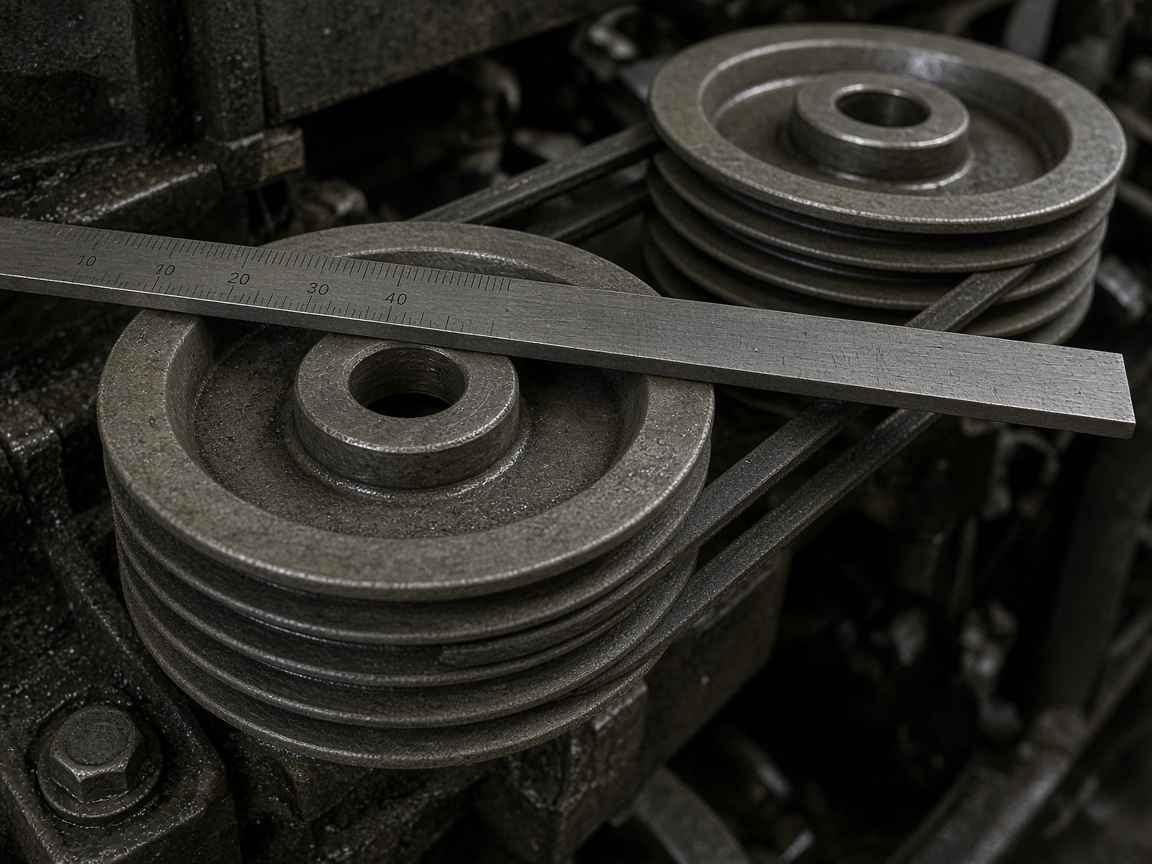
Check groove wear with a profile gauge or by comparing belt seat depth across grooves. A deep groove on one belt path will steal load from the others even when center distance looks fine.
Tension without guessing
Use the tension gauge the belt manufacturer specifies for the cross-section and span, or the deflection method in their table—not “thumb pressure until it feels right.” Over-tension destroys bearings; under-tension cooks belts. Re-check after a short run-in; new belts settle.
Record center distance, belt part numbers, and as-left tension on the work order. The next failure investigation needs those numbers more than another opinion about brand quality.
When vibration or heat still looks wrong
If alignment and tension are within range and belts still die early, look at overload (damper stuck, filter plugged, process density change), sheave runout, and bearing play on the driven machine. Belts are often the messenger.
Keep guards on for the run check. A drive that only “looks fine” with the guard off is not a finished job.