
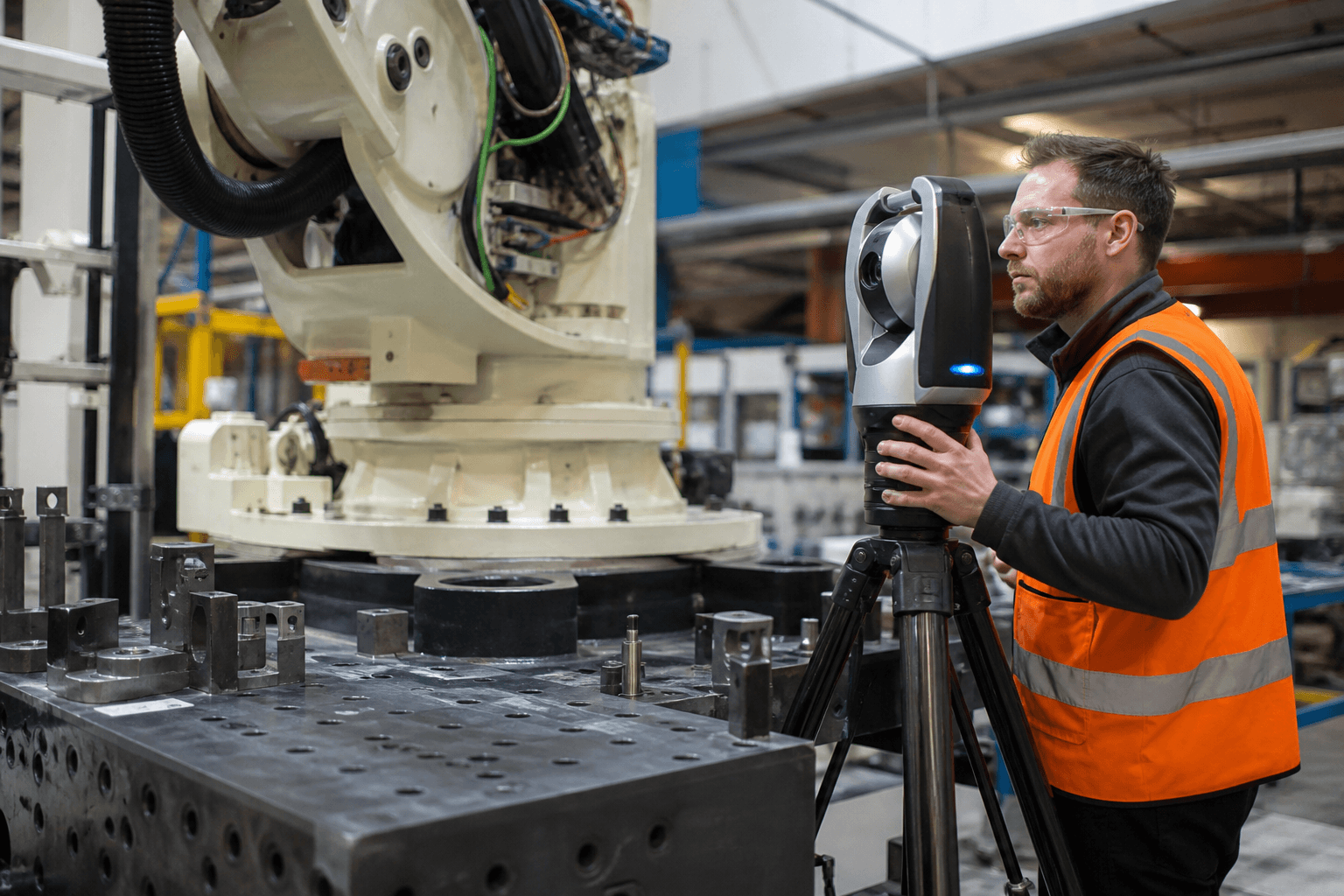
After a floor pour cures, a press lands next door, or a winter heave season passes, large robot cells start missing holes that “never missed.” The first response is usually re-teach and TCP polish. Sometimes path is guilty. Often the world moved: pedestal baseplates settled, tooling monuments shifted, and the laser-tracker network that locked the cell to the building was treated as a one-time commissioning photo. Relative mastering looks fine. Absolute position to the fixture does not.
This is not dress-pack cable management, not tool-changer coupler seals, and not recommissioning checklists that stop at axis grease. It is survey control for large-envelope cells.
What the tracker is for
A laser tracker (or equivalent large-volume metrology) ties robot bases, fixtures, and global monuments into one frame. That frame is how offline programs and multi-robot coordination stay honest. If monuments move and nobody re-measures, every “perfect” joint angle aims at a ghost.
Periodic surveys after civil events—and on a calendar for critical cells—are the control. Waiting for scrap to announce settlement is late.
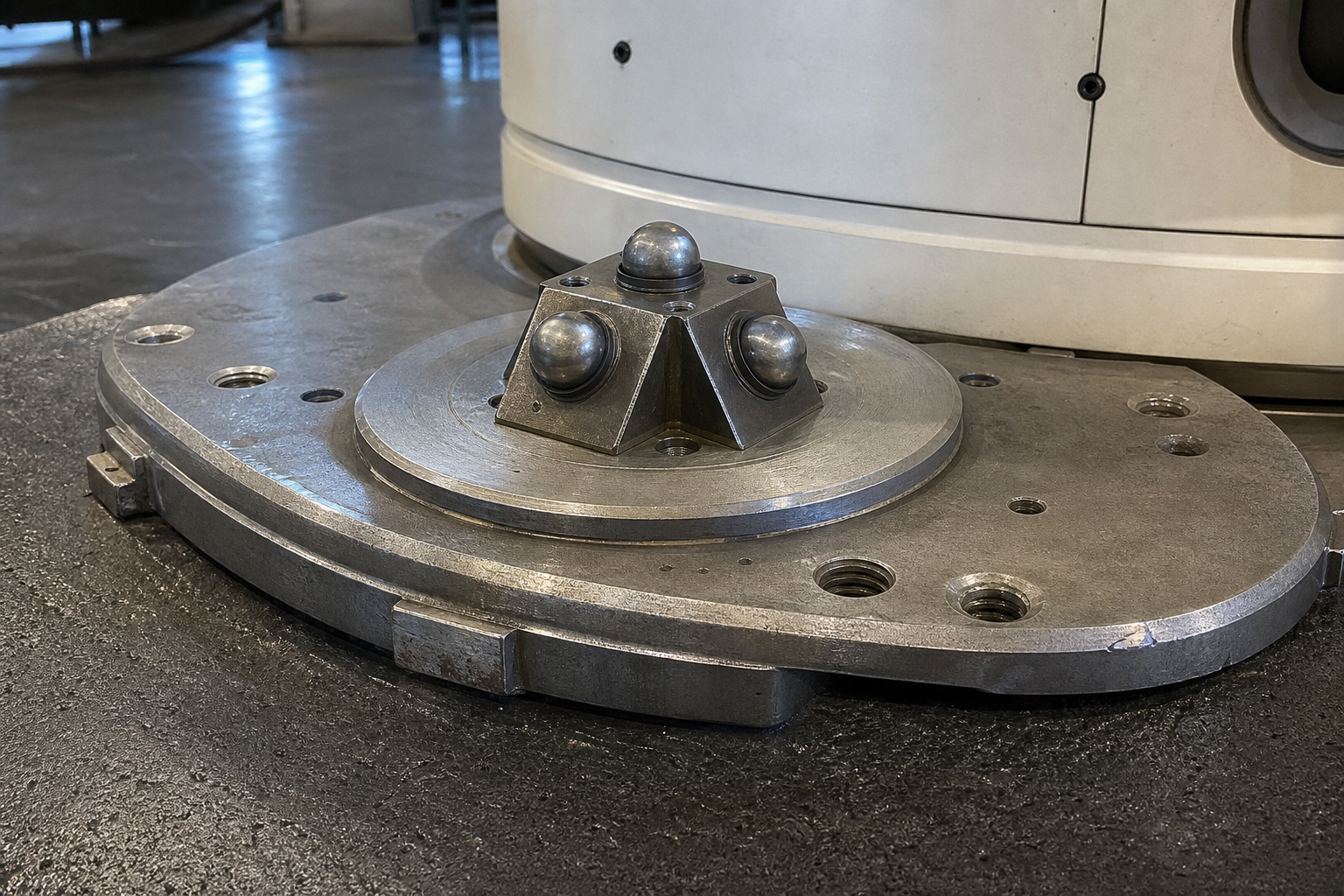
What to verify after a floor or fixture event
Re-establish monuments, measure base and fixture transforms, compare to commissioning baselines, then decide whether to update frames or re-teach. Logging only “robot remastered” without a delta to the building frame hides the civil problem inside a robot ticket.
Thermal growth of long fixtures deserves the same honesty: measure hot if you run hot.
What production meetings should stop doing
Stop paying for endless spot re-teaches on a cell whose pedestal survey is years old. Stop blaming vision offsets for a systematic miss that follows the season or a neighboring foundation pour.
The robot repeats joint space. The part lives in building space. Keep those frames tied with a tracker, or keep teaching ghosts.