
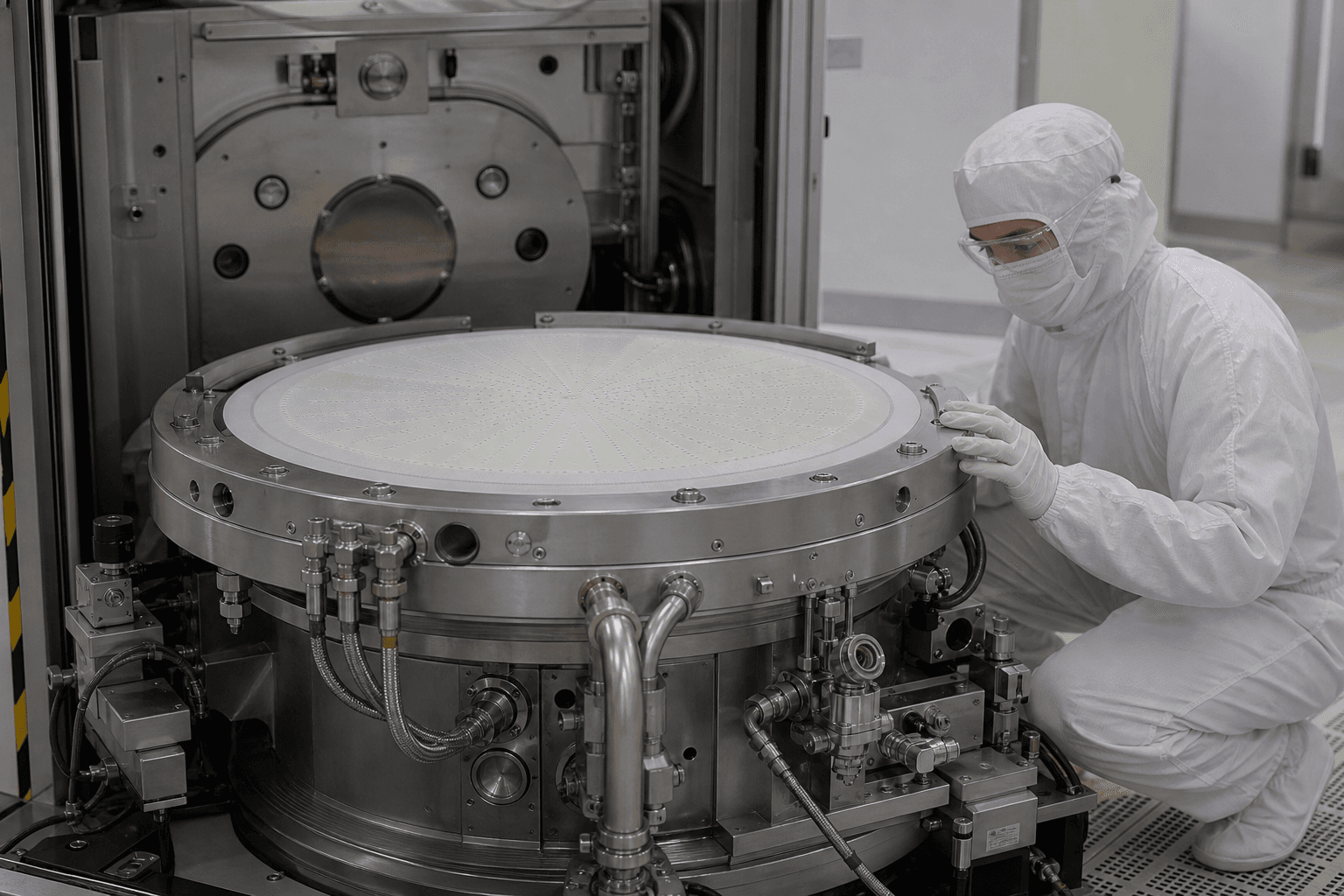
Plasma etch and CVD recipes assume the wafer sits at a known temperature. That assumption is not a pyrometer reading on the chamber wall. It is the electrostatic chuck (ESC) holding the wafer, and a few tens of torr of helium flowing in a pattern of grooves on the ceramic face to couple heat to the cooled pedestal. When helium delivery is honest, within-wafer temperature is a controlled variable. When it is not, the tool still reports "wafer clamped" and the lot still completes.
The failure is quiet. Helium flow at the mass-flow controller looks normal because the controller is feeding a leak as well as the intended grooves. Leak-up after clamp looks marginally high and gets waived. Edge dies run hot or cold. CD bias walks. The chamber-matching meeting debates RF hours and showerhead age. Nobody has sniffed the chuck.
What the helium circuit is for
Backside helium is not a process gas in the recipe sense. It is a thermal fluid with a leak path by design: a small, specified flow that vents around the wafer edge into the plasma volume and is pumped away. The specification is a pressure at the chuck (often in the 4–15 Torr range depending on tool family) and a flow that stays inside a window. Too little flow means poor thermal contact and hot spots. Too much flow means a leak that is no longer "around the edge"—it is through a cracked ceramic, a failed O-ring at a lift-pin, a damaged helium line fitting, or a wafer that is not sitting flat because of backside particles.
Dechuck is the second half of the same system. Residual charge and residual helium pressure decide whether the wafer leaves the chuck cleanly. A sticky dechuck that needs extra pin force or extra time is not only a throughput tax. It is often the same leak or the same ceramic wear that already ruined temperature uniformity on the previous wafers.
The numbers that belong on the daily tool report
Three traces earn a permanent place next to RF hours.
Helium MFC flow at clamp, once pressure has settled. A slow climb in flow at constant pressure is a leak growing, not a recipe change.
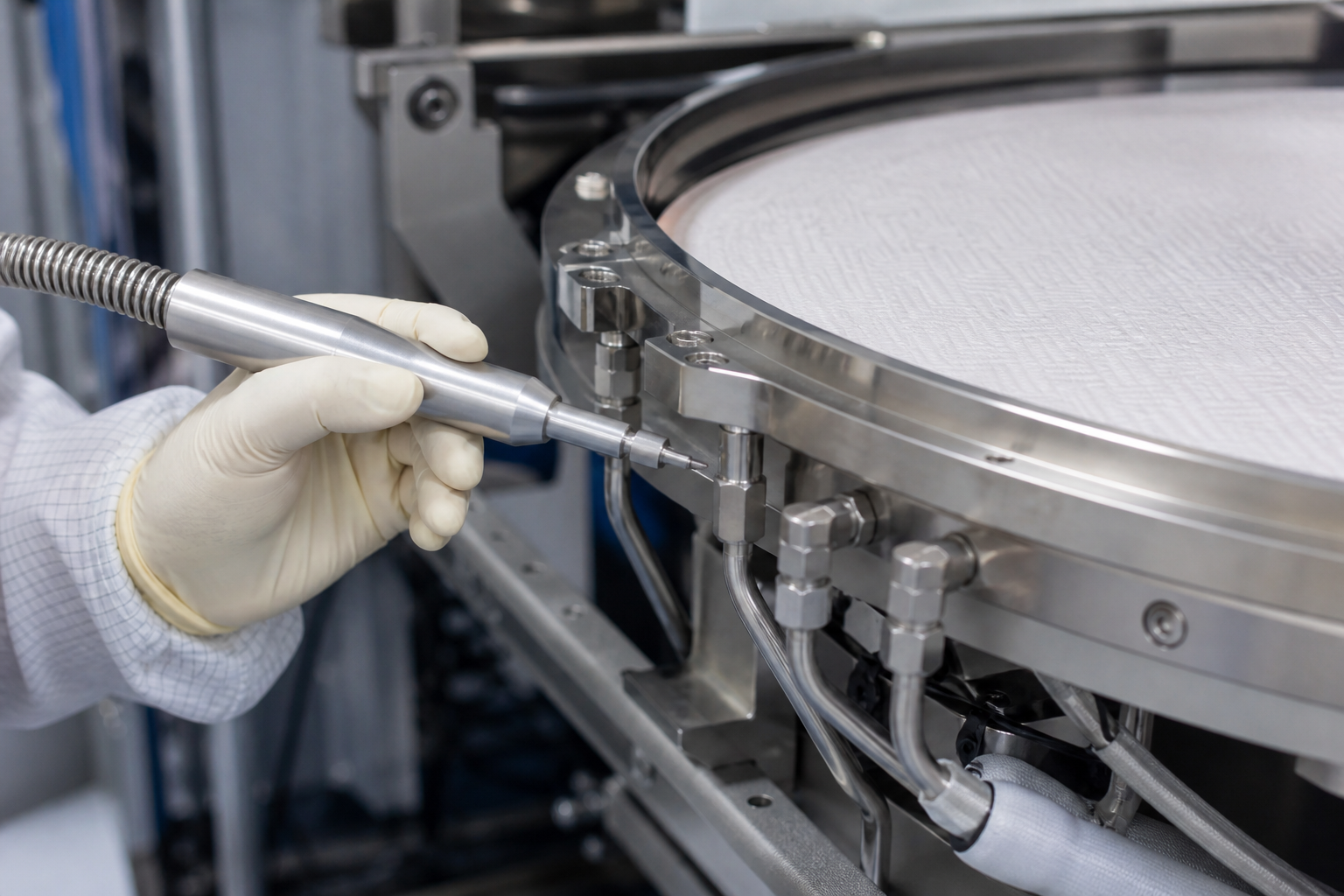
Leak-up rate with a dummy wafer or a sealed test wafer, in a PM window. This is the measurement that distinguishes "edge vent as designed" from "chuck circuit open to atmosphere or to the chamber."
Dechuck time and pin-current or pin-force signature. A step change after a wet clean or after a wafer-break event is a reason to inspect lift-pin bellows and ceramic before the next production lot, not after the next excursion.
Fabs that log these three and set tool inhibits on them stop treating ESC helium as a utilities footnote. Fabs that only alarm on "helium pressure low" catch the catastrophic leak and miss the 15% flow creep that already biased a week of edge yield.
Particles, ceramic, and the wrong spare
Backside particles are a helium problem dressed as a contamination problem. A particle under the wafer lifts a local region, opens a helium short, and creates a cold or hot island that looks like an etch artifact on the overlay or CD map. The correct response is not only a chuck clean. It is a particle source hunt: lift-pin tips, transfer arm pads, and the last tool in the cluster that touched the backside.
Ceramic ESC replacement is expensive and slow. It is also frequently delayed because the symptom was attributed to RF match drift or to a mass-flow controller that was "in spec" at the gas box. The MFC can be in spec and the chuck still leaking. Spec at the gas box is not spec at the wafer.
What matching meetings should ask first
Before a chamber is declared mismatched on etch rate or CD, ask whether helium flow-at-pressure and leak-up are still on the commissioning curve for that chuck serial number. If they are not, matching the RF recipe to a leaking ESC is fitting a model to a broken heat sink.
The etch chamber is a plasma tool. The wafer temperature contract is a helium-and-ceramic tool. Those are different maintenance jobs. Mixing them is how a leak becomes a "process issue" for a quarter.