
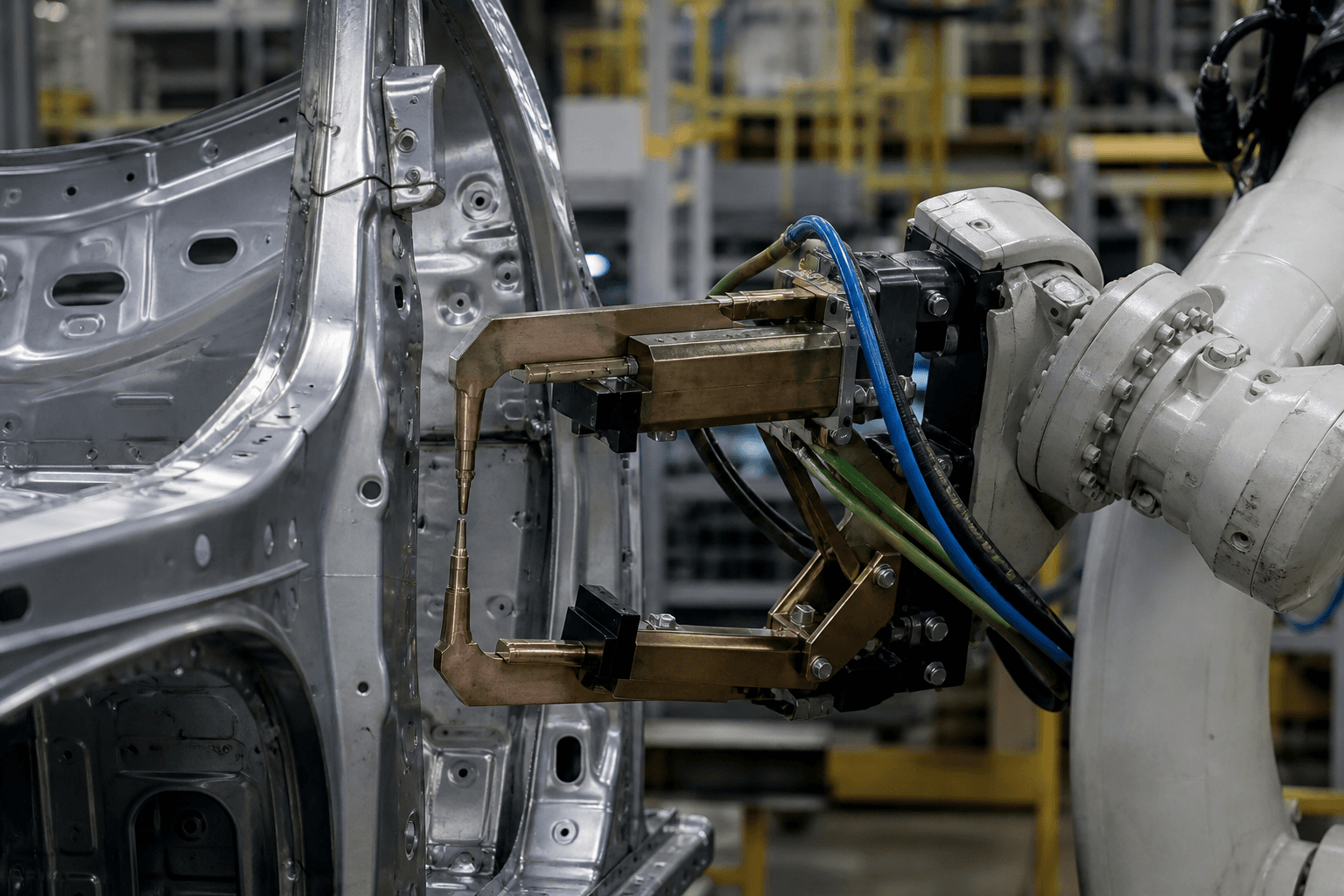
A resistance spot-weld gun is a thermal machine bolted to a robot. Current, force, and time are the recipe. The recipe assumes a known contact diameter on the copper cap and a known cooling rate in the gun body. Caps mushroom. Water scales. Hoses kink behind the dress pack. The robot program does not notice. Destructive peel tests start failing on one gun in a twelve-gun line, and the first hypothesis is "robot path" or "sealer on the flange."
Path and sealer matter. They are not the first things to measure when nugget size dropped on a gun that just skipped two dress cycles.
Caps are geometry, not a count
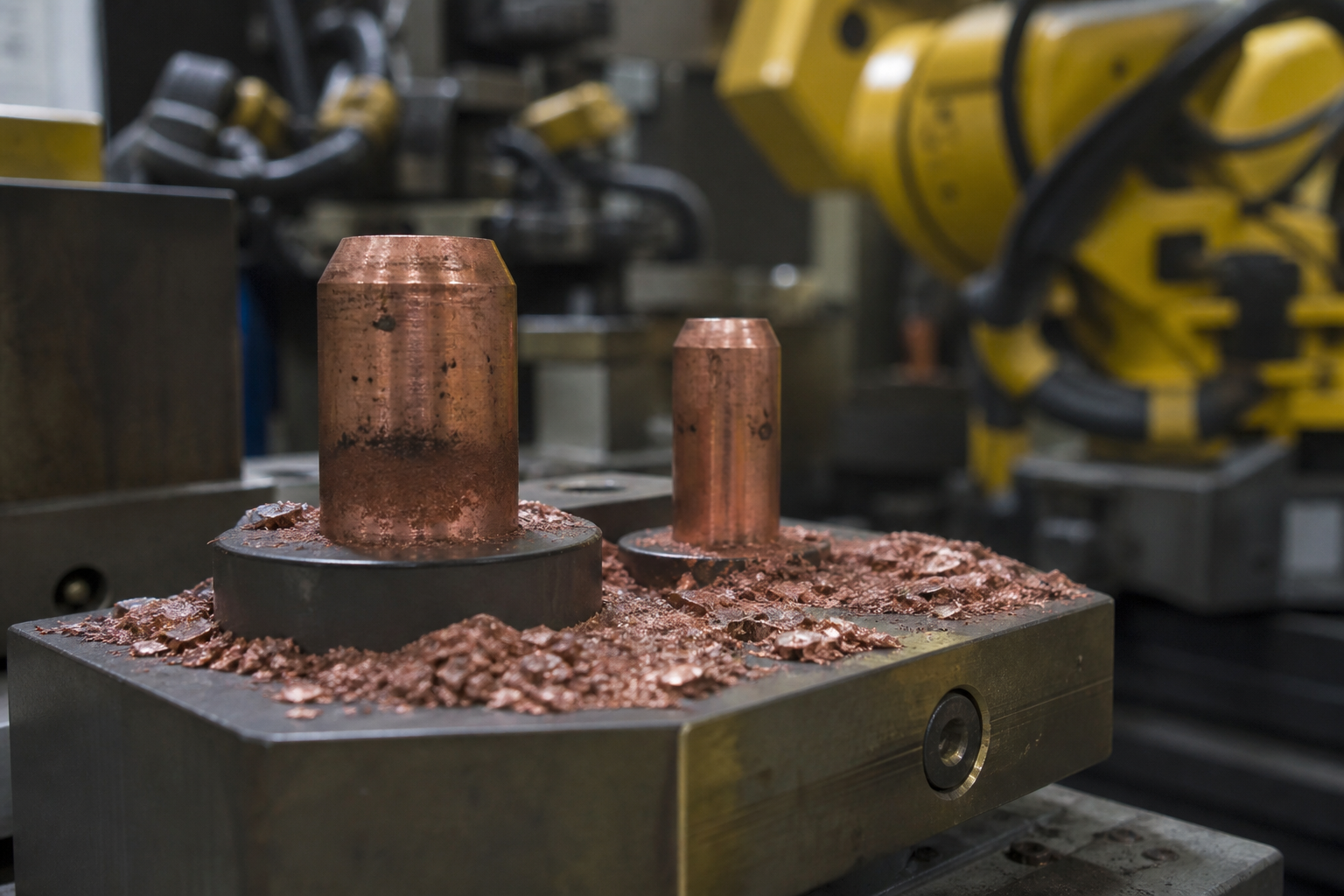
The weld current density depends on the face diameter that actually touches the sheet. A dressed cap with the specified dome or truncated cone holds that diameter. An over-dressed cap is too small and overheats. An under-dressed cap is too large, current density falls, and the nugget shrinks or the splash increases. Dress interval in welds—not in hours of robot motion—is the control. Counting "we dress every shift" is not a control if that shift's volume doubled.
Cap material and cooling together set how fast the face degrades. A gun that runs hotter because cooling flow is low mushrooms faster, which the team reads as "we need to dress more," which hides the water problem.
Water is a process variable
Closed-loop gun cooling is a miniature cooling tower with a dirty history. Flow at each gun, inlet temperature, and filter differential belong on the cell HMI, not only on a facilities schematic. A millimetre of scale in a waterway is a heat-transfer failure that looks like a weld-timer problem.
Check flow with the gun in production posture, not with the robot at home. Hoses pinch at full extension. A flow switch that was set on the bench does not see that pinch.
Water quality—hardness, inhibitor, biological growth—decides whether the passages stay open. Treating gun cooling as "plant water" without a spec is how one gun in the cell becomes the chronic peel-test failure.
What to verify after a cap change
Force at the tips with a load cell, alignment so the faces meet square, and a short coupon matrix at production current. Skipping the coupon because "we only changed caps" is how a cross-threaded adapter becomes a week of undersize nuggets.
The cell is a robot. The weld is physics at two copper faces and a water jacket. Maintenance that only services the robot will keep a beautiful path around a bad weld.