

Six-axis arms lose a degree of freedom when wrist axes align into a singularity. Controllers still try to follow a Cartesian path; joint speeds climb, motion looks jittery, and the cell faults on speed or torque. Operators call it “the robot went crazy.” The teach pendant usually saw the warning first.

Offline programming and path review should keep wrist configurations away from singular alignments through the work zone—especially near reach limits and during linear moves that force a wrist flip. If a path only works after “joint jogging until it looks fine,” the singularity margin is hope. Add configuration constraints, split the linear segment, or shift the TCP approach angle.
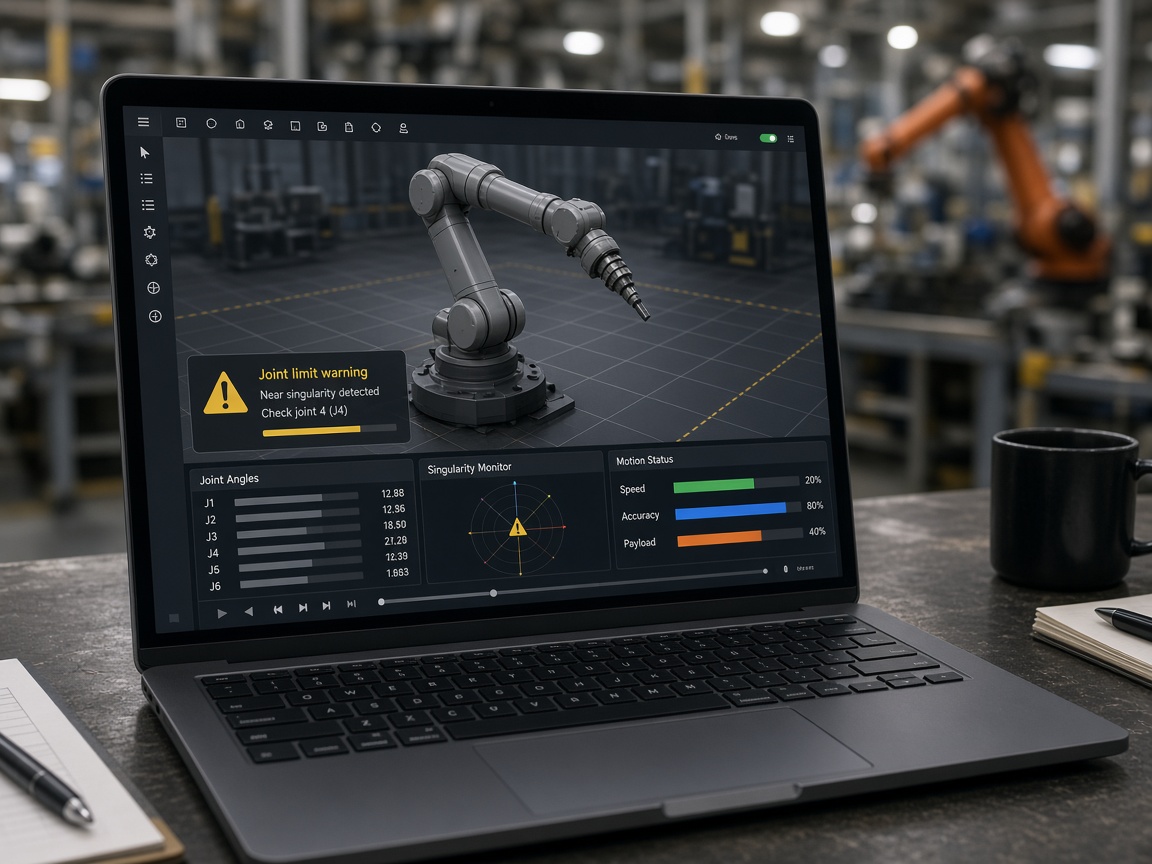
After a tooling change that moves TCP length, re-check the same paths. A former safe pose can become singular with a longer tool. Treat singularity faults as path geometry, not as a random servo failure.