
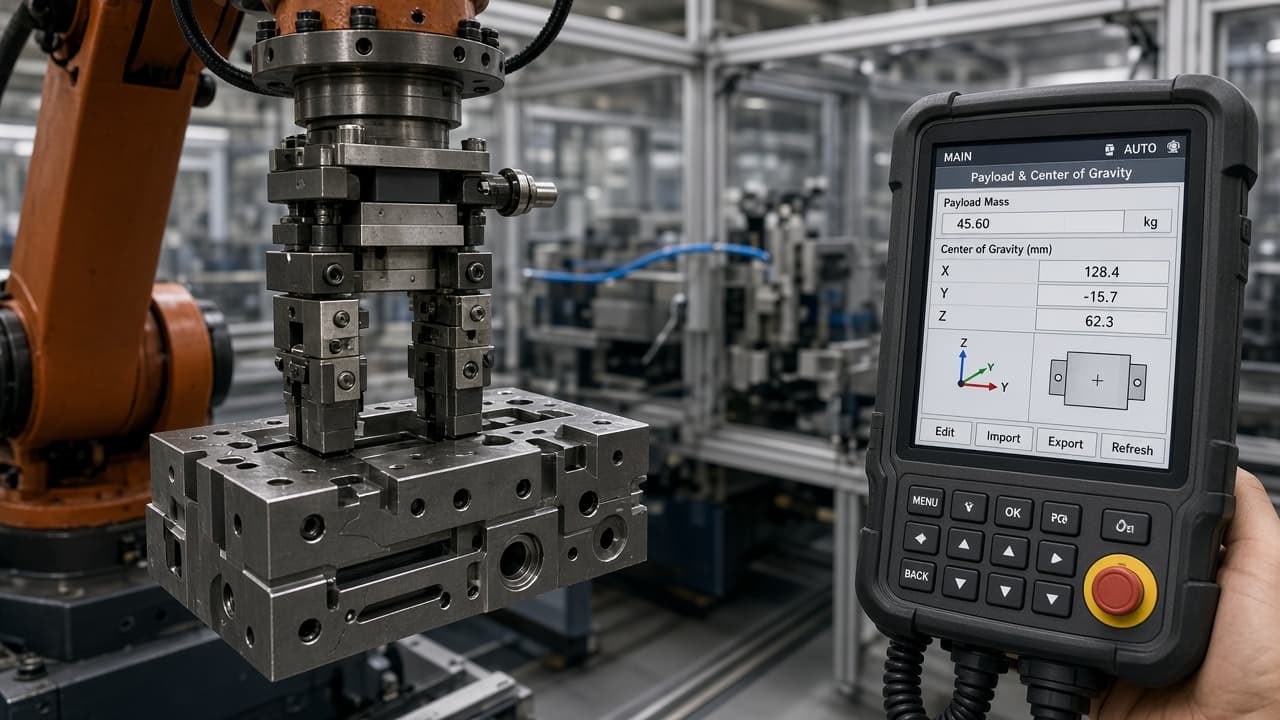
The cell ran fine in dry cycle. First production pick: following error, soft stop, or a wrist that feels “heavy” on a long reach. The integrator swears payload was entered. It was—for the bare gripper.
Robot documentation and EOAT practice treat payload as the moving load: tool plus part, with CoG resolved from the flange and inertia about the relevant axes. A light tool with a long offset can violate moment or inertia limits even when the kilogram rating looks comfortable. Tool changers multiply the problem: every docked tool and every load case (empty, part present, dual-grip asymmetries) needs its own mass/CoG/inertia set, updated in the program when the state changes—not left at commissioning defaults.
Payload-inertia pendant logs already dramatize bad tensors. Collision-sensitivity notes own trip thresholds versus mass. This note is narrower: switching CoG (and mass) on pick, place, and tool change.
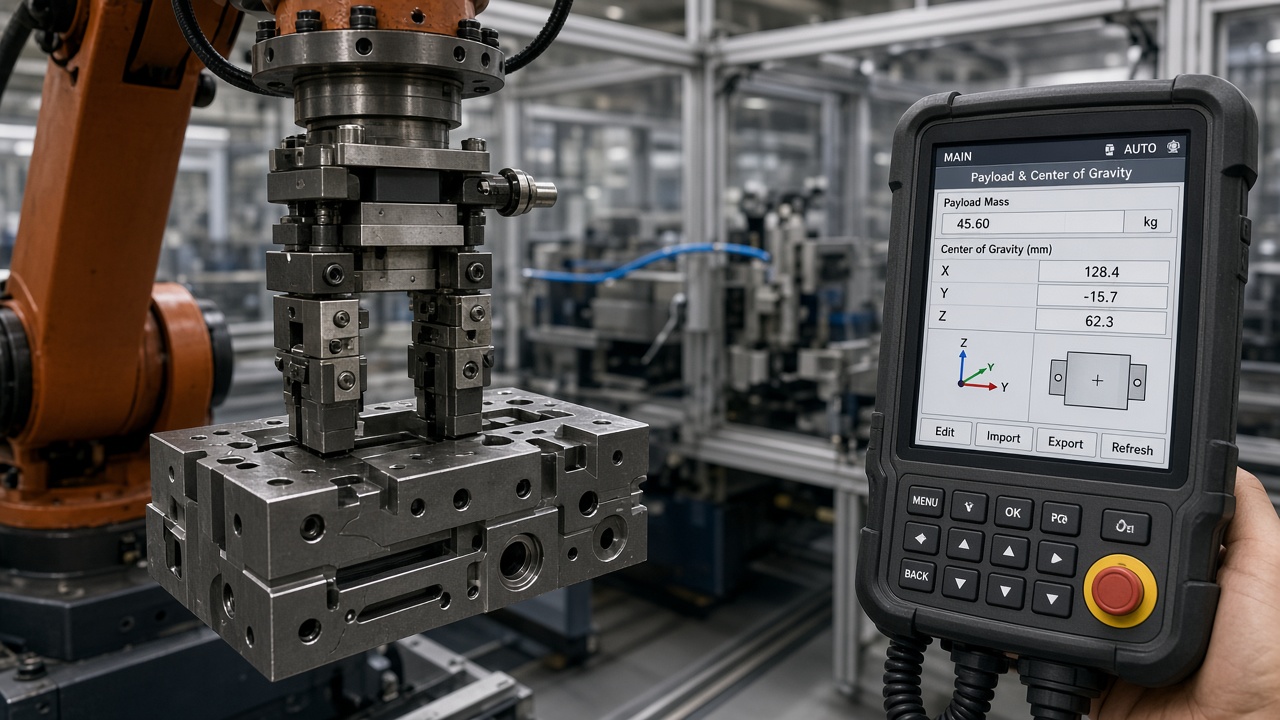
Weigh and locate adapters, valves, dress contributions, and the heaviest part in the family. Compute composite CoG; check static moment and inertia at the worst pose, not the convenient teach point. In the program, call the payload update when jaws close on a part and again when they open—or when the tool changer docks a new EOAT. Re-run the envelope check after any sensor, jaw, or hose change that moves mass outward.
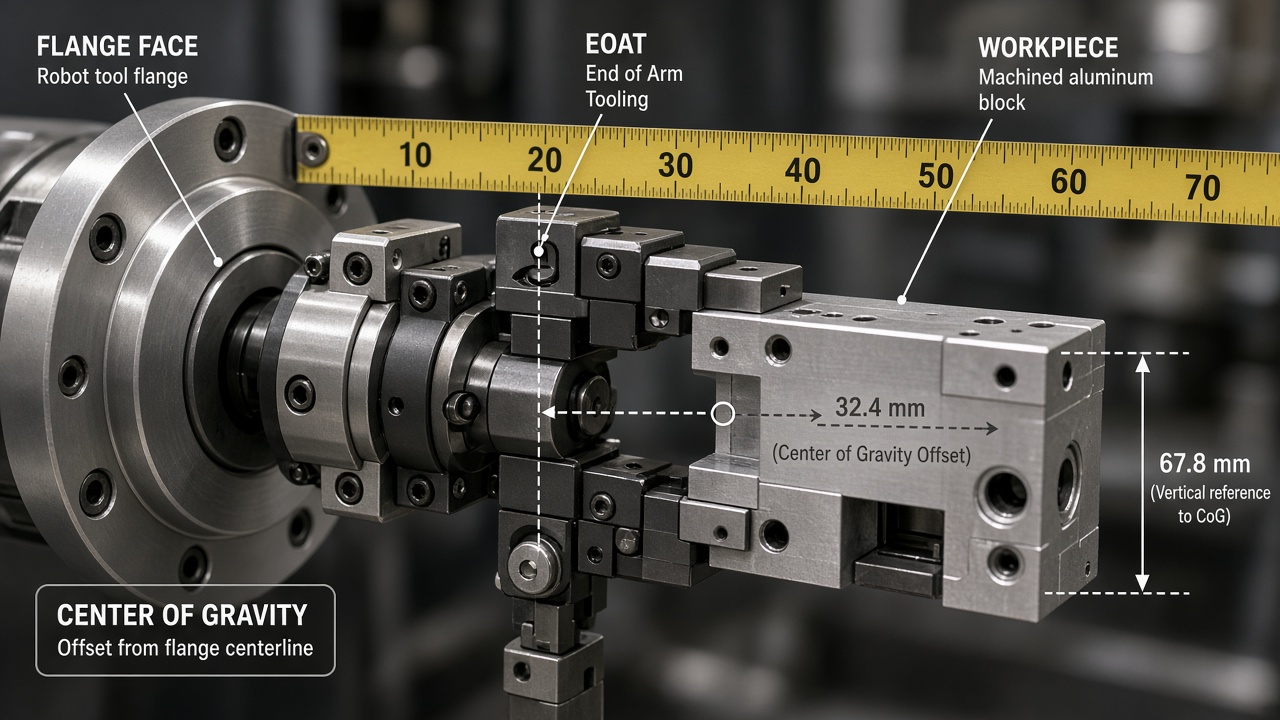
If the pendant still shows the empty-tool mass mid-carry, the path planner is solving the wrong physics. Fix the load case before you detune the gains.