
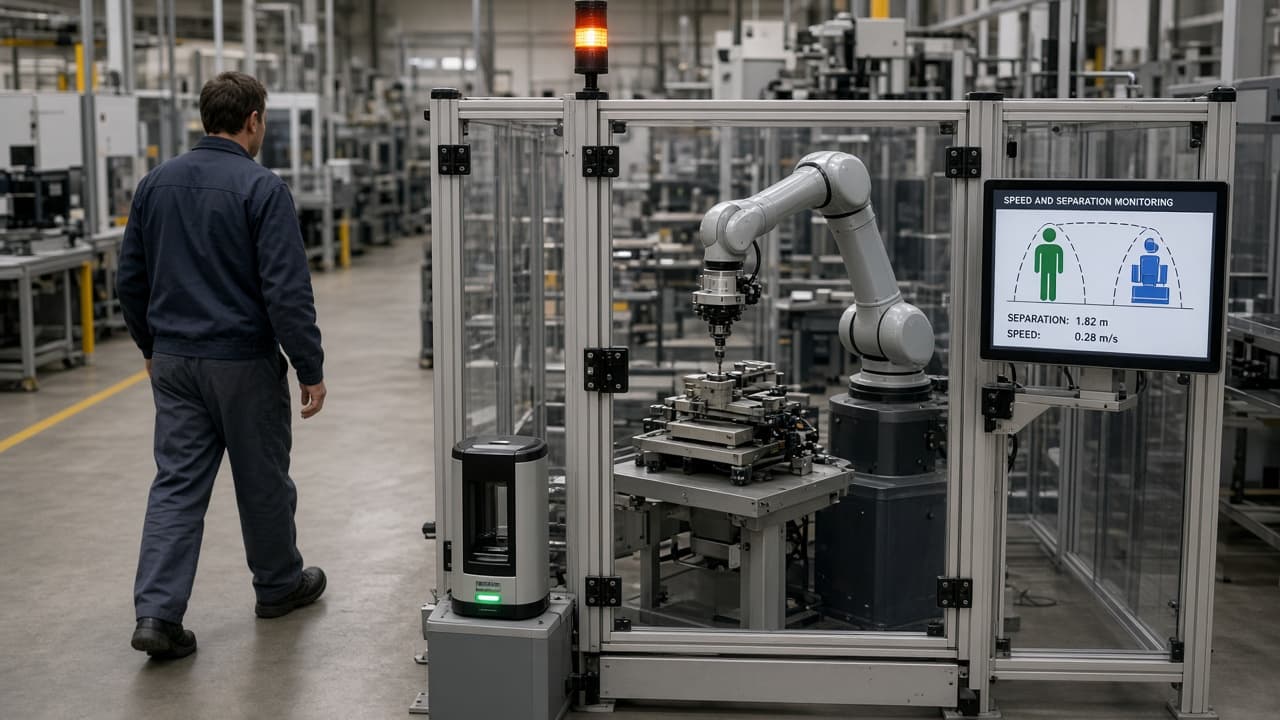
Power-and-force limiting asks whether contact stays inside biomechanical limits. Hand-guiding owns enabling devices at the EOAT. Speed and separation monitoring (SSM) is the collaborative mode where people and robots share space without intended contact: the system maintains a minimum protective distance; if intrusion closes that distance, the robot initiates a protective stop and may resume only when separation is restored.
ISO/TS 15066 frames the required distance as a sum of terms—human approach, robot reaction and stopping travel, intrusion detection latency, positioning uncertainty, and additional margins from the risk assessment. Safety-rated monitored speed and stop functions from the ISO 10218 family sit underneath. Change the EOAT mass, the path speed, or the scanner mounting, and yesterday’s zone map is fiction.
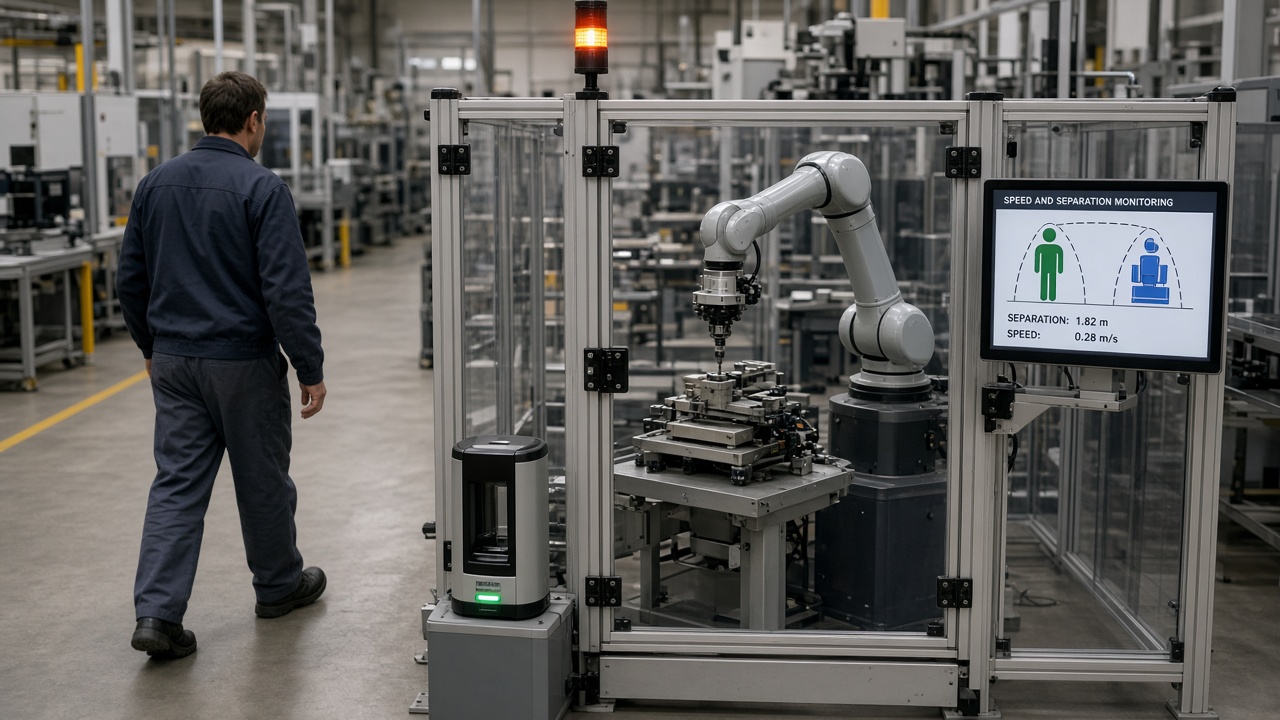
Validate SSM as a system: sensor field of view without blind spots at human height, latency under load, robot stop performance at the actual payload and pose, and documented protective distance for each collaborative zone. Re-test after layout, tool, or speed changes. Do not mix “PFL at full speed” folklore into an SSM cell—different modes, different proofs. Log stop events; a scanner that chatters into nuisance stops will be muted by the shift that needs takt.
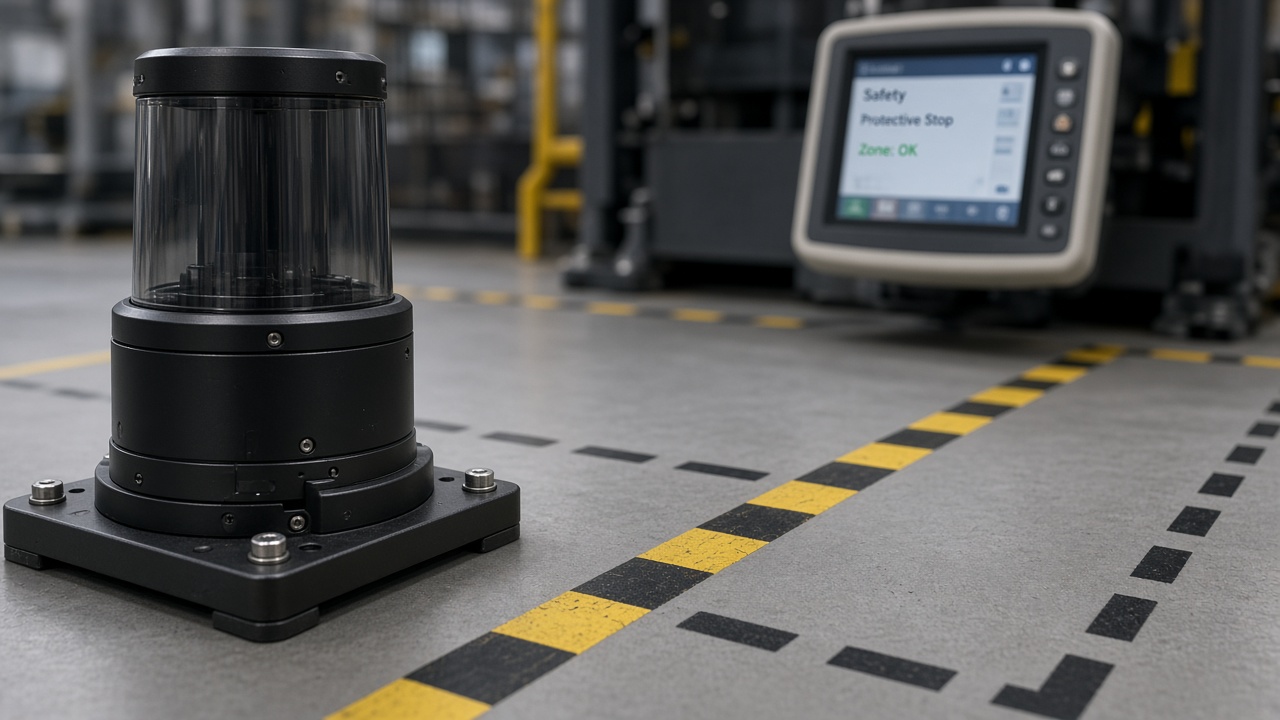
If the safety case cannot show the distance equation and the stop performance behind it, the cell is not in SSM. It is in optimism with a yellow scanner.