

The servo is replaced. The brake is reseated. The robot powers up and runs the old program. Picks miss by millimeters that grow with reach. Weld seams walk. Nobody changed the points—they changed the relationship between the joint’s mechanical reference and the encoder count that used to mean “zero.” Until each affected axis is remastered to the OEM procedure (dial gauge, electronic mastering tool, or equivalent), Cartesian jogging and stored poses are guesses wearing taught-point numbers.
TCP verification sheets own tool frame checks. Laser-tracker briefs own cell drift and absolute accuracy campaigns. Hand-eye notes own camera-to-flange transforms. This page is joint mastering after service—the zero that every other calibration assumes is still true.

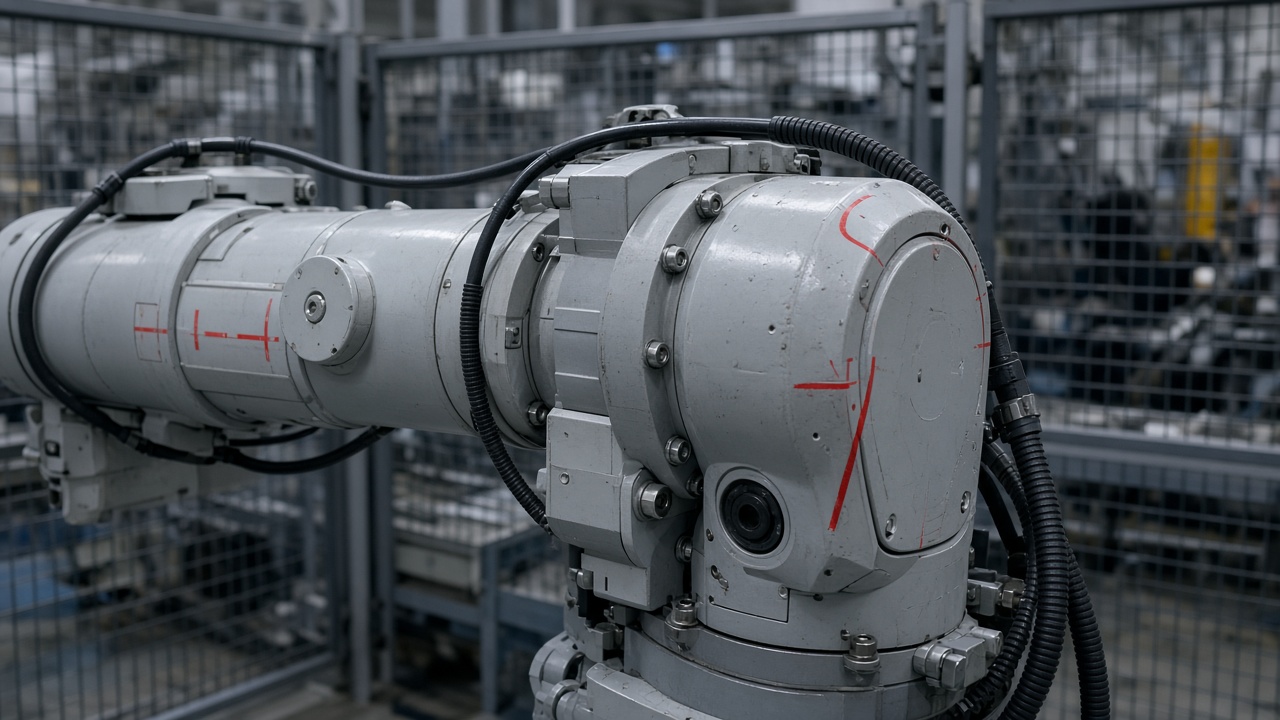
Mastering finds the mechanical zero—typically the bottom of a reference notch—and writes the matching encoder reference. It is required before reliable Cartesian motion. It is not the same as a full absolute-accuracy calibration with a laser tracker; it restores the manufacturer’s joint zero so programs and TCPs can be trusted again. After encoder battery loss, motor exchange, resolver work, or any procedure the OEM lists as requiring remastering, treat production paths as inhibited until mastering is logged against axis ID and software revision.
Technique matters. Approach the notch in the prescribed direction at low jog override. Do not leave a mastering pin extended during long travels. Wrist axes often need to stay near their zeros while other axes are mastered—follow the controller manual, not tribal muscle memory. Save mastering data per plant escrow rules the same way you escrow robot images.
If the recommissioning checklist says “program restored” but never says “axes remastered,” the checklist and the kinematics disagree. Fix the checklist before the next “mysterious TCP drift” work order.