
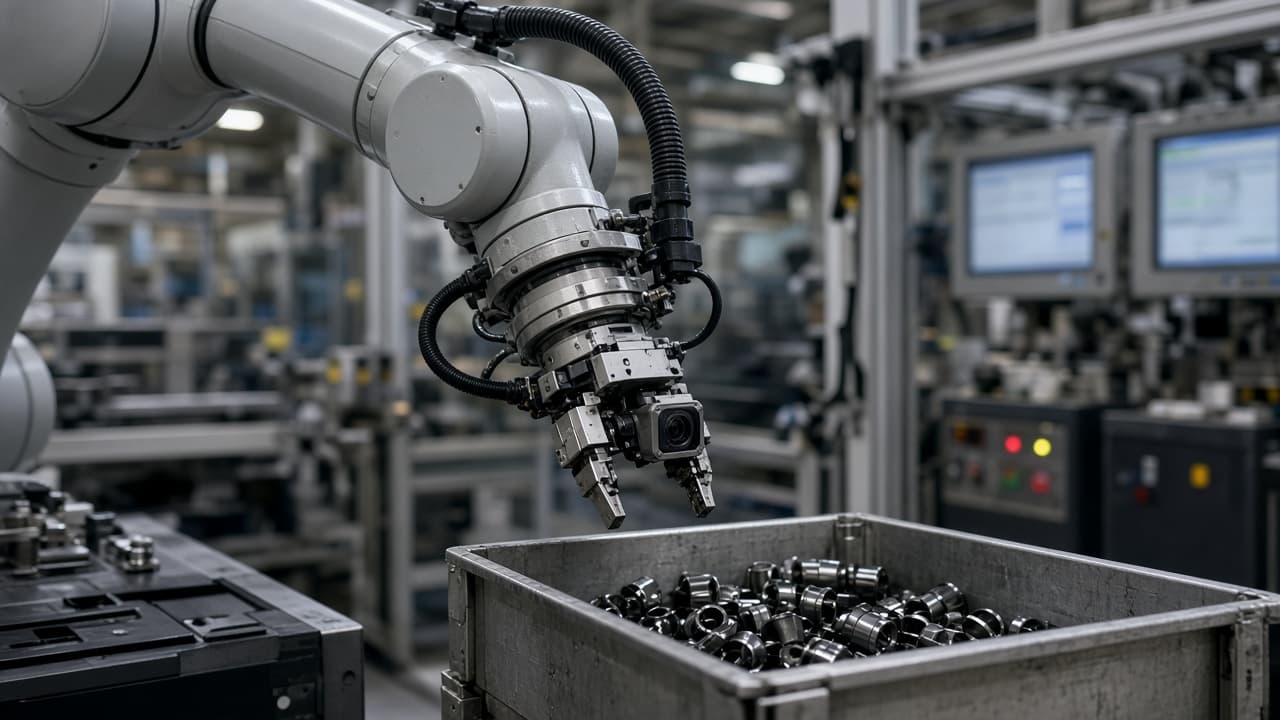
Cell note — guided picking
The robot still goes to the pose the vision system requested. The part is 8 mm off. Gripper tips skim the bin wall. Someone retunes the pick offset in the HMI for the third time this month and calls it “camera noise.”
Often it is not noise. It is an extrinsic calibration—the rigid transform between camera and robot—that no longer matches the metal.
TCP sheets and payload inertia logs own tool center point and mass. Vacuum EOAT wear owns cup seals. This note owns hand-eye (camera–robot) calibration as a living process parameter.
What calibration actually stores
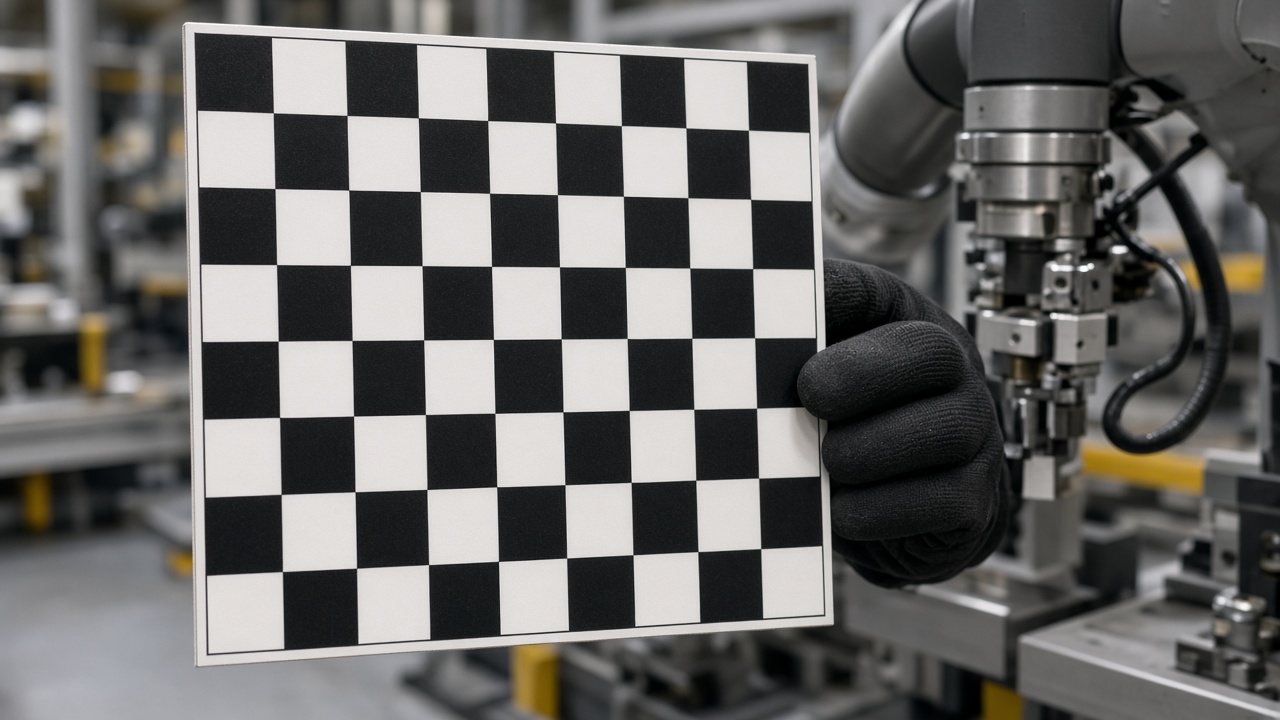
Whether the camera sits on the flange (eye-in-hand) or fixed above the work (eye-to-hand), the system needs a repeatable relationship between image coordinates and the robot base (or tool) frame. That relationship is measured with a target—checkerboard, dot pattern, or calibrated artifact—moved through a set of poses. The result is a transform, not a feeling.
What breaks it
EOAT length change without a new TCP and a new hand-eye run. Camera remount after a collision. Fixture plate bolts that were loosened for cleaning. Thermal growth on a long reach. A different lens or working distance after a “temporary” optic swap. Any of these can leave the old transform looking almost right—wrong enough to scrape, right enough to pass a casual watch.
Cadence that belongs in MoC
After tool change, camera service, fixture move, or crash recovery: verify with the same target routine used at commissioning, or at least a known-position pick gauge. Log the calibration ID next to the vision recipe version. If operators can edit a permanent pick offset, treat that offset as a smell that calibration or TCP is stale—not as a normal dial.
Vision tells the robot where the part is in camera space. Hand-eye tells the robot what that means in joint space. Keep both current, or keep teaching offsets that fight yesterday’s metal.