
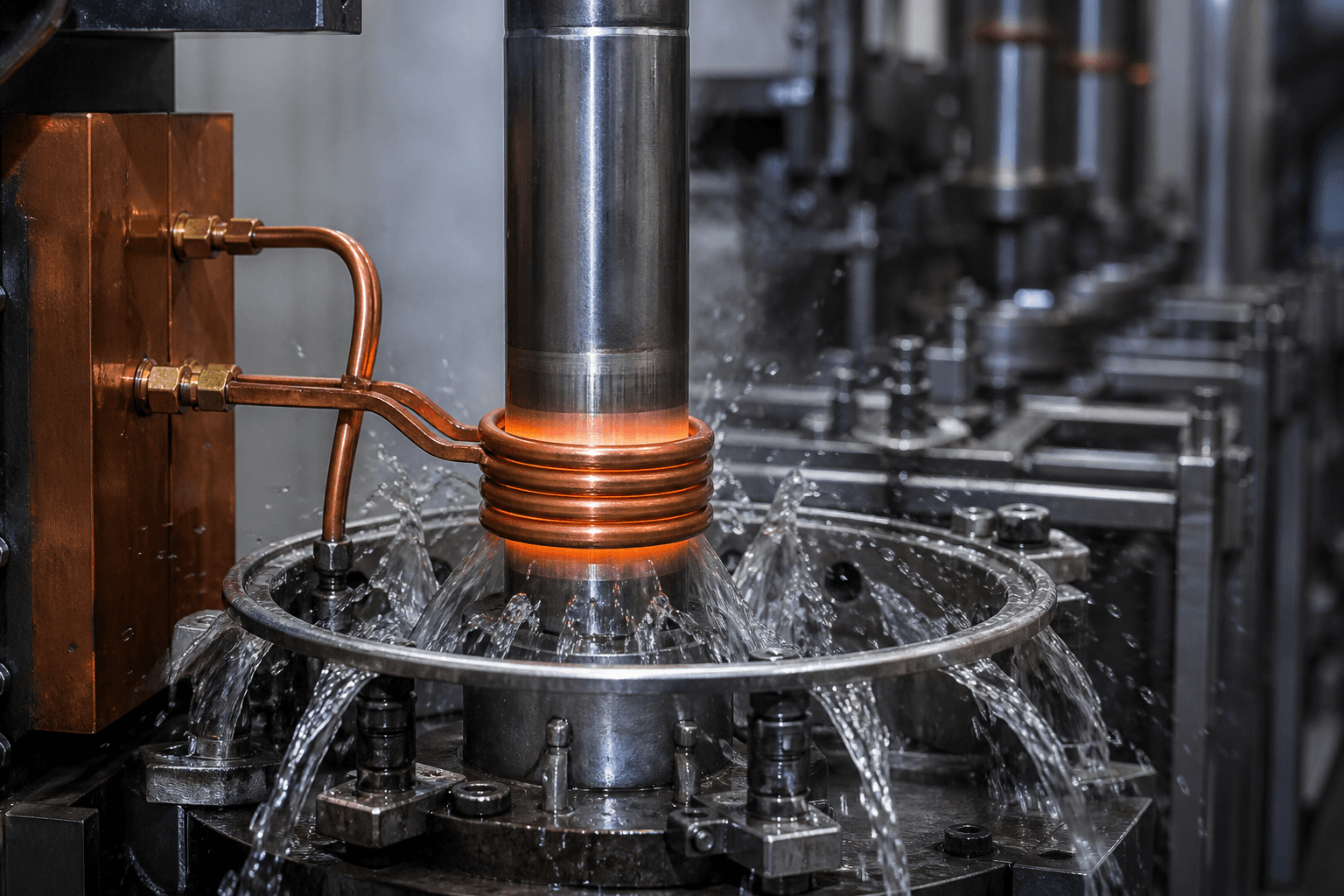
Operators chase power and frequency when Rockwell slips. Often the quench ring is plugged, aimed past the heated band, or starved for pressure—so austenite transforms slowly in the transition zone and you get soft spots or quench cracks at the edge.
Induction owns heating fast. Quench ring hydraulics own whether that heat becomes martensite where the drawing says.
Symptoms mapped to quench, not coil
| Reading | Likely quench issue | First action | |---------|---------------------|--------------| | Soft band at start/stop of scan | Spray lag or drain before quench hits | Time quench onset vs. power off | | Spidery surface cracks at edge | Uneven impingement, hot spot quenched too hard | Map nozzle flow, clean orifices | | Depth OK on coupon, soft on part | Coupon geometry unlike production mass | Match mass and scan on witness | | Rising power, stable hardness | Quench water warming or flow down | Check temperature, filter, pump |
Discipline
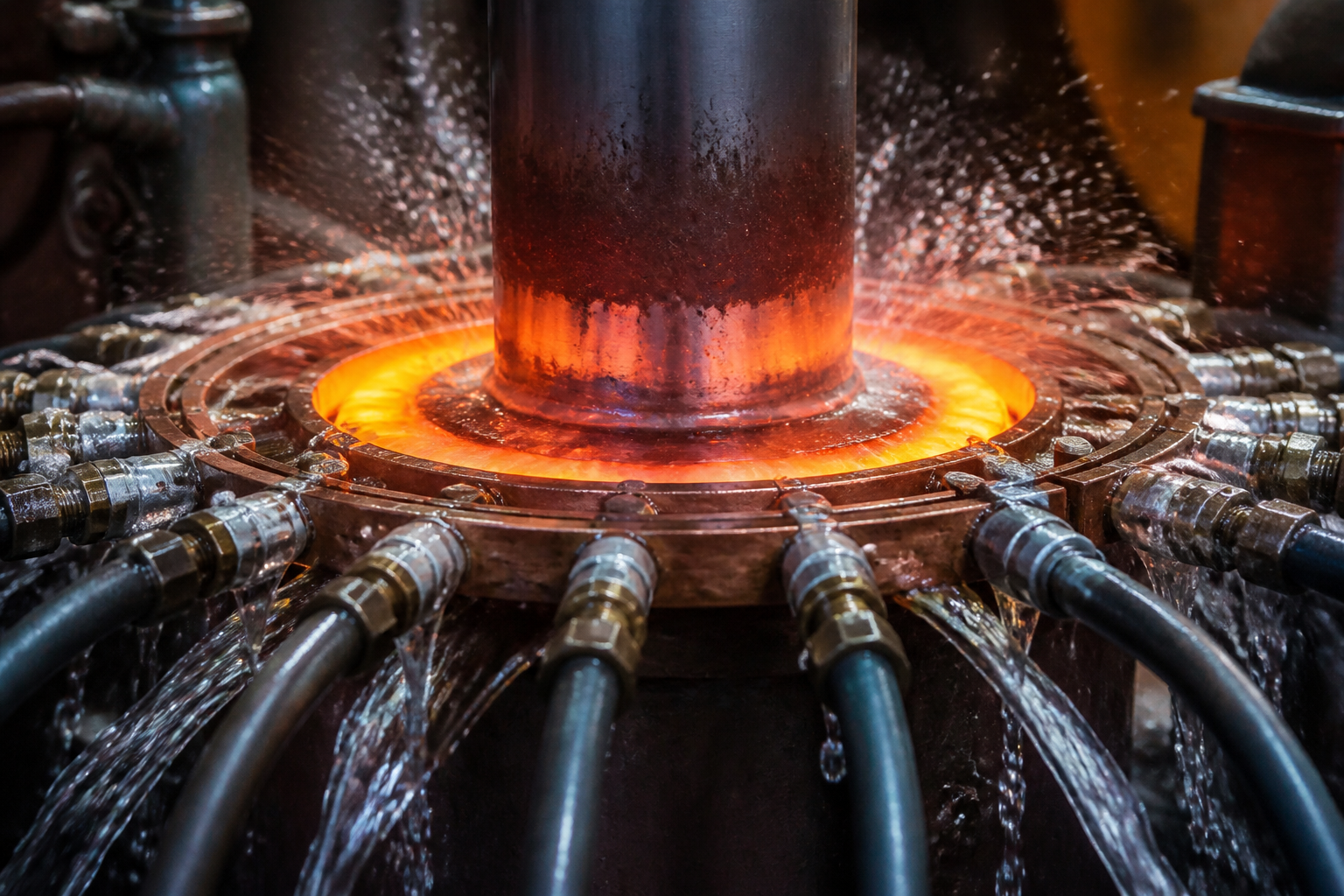
Log quench pressure, water temperature, and filter DP at shift start. Map spray pattern when coil or part family changes—MoC item. Do not approve scan speed increases without verifying transition zone hardness on the actual profile.
The coil brings the austenite window. The ring decides if it survives as case hardness.