

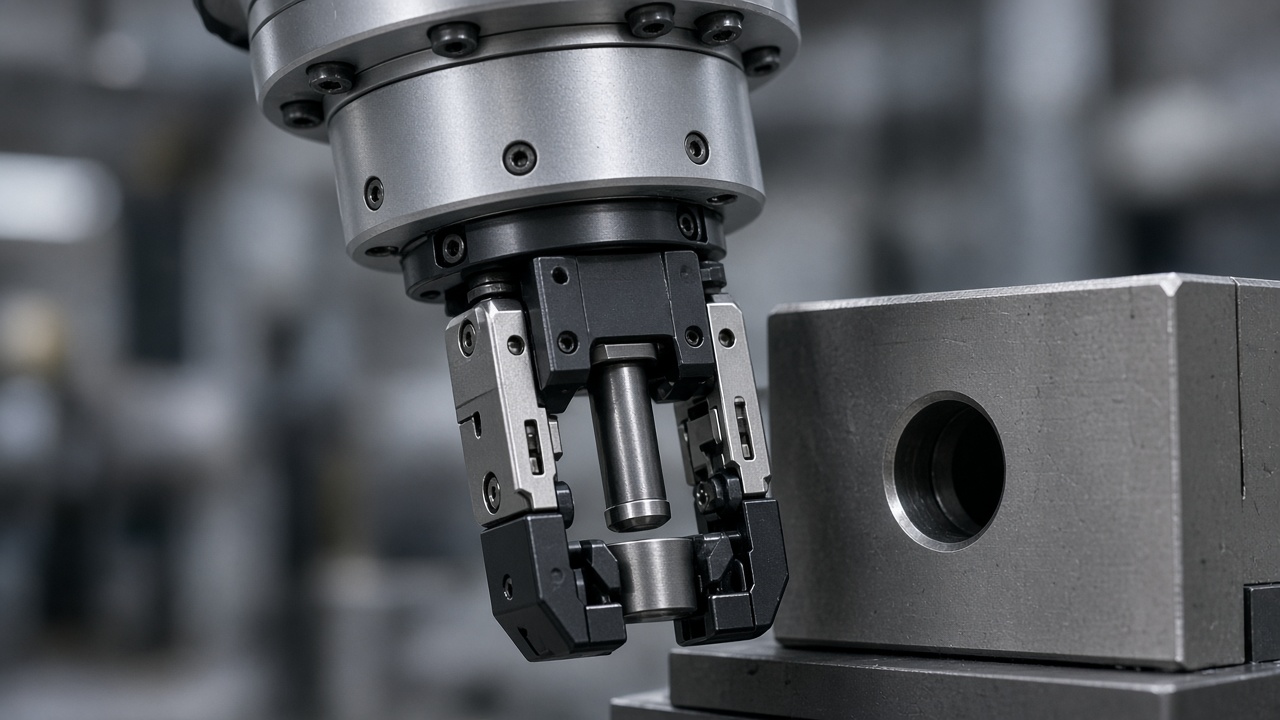
Position paths get the peg above the hole. Contact finishes the job. Impedance or admittance control maps measured force and torque into pose corrections so the robot complies instead of wedging. Copy the integrator’s demo gains onto a stiffer fixture, a tighter H7/g6 class fit, or a heavier EOAT and the cell either chatters, stalls in search, or rams past the force limit the QMS thought it owned.
Force-torque precision briefs own the sensor-as-quality-evidence story. Collision-sensitivity notes own payload vs. trip thresholds. Mastering briefs own joint zeros after service. This note is phase-specific impedance for peg-in-hole—search, chamfer entry, insertion—with sensor hygiene first.

Calibrate out sensor bias and tool gravity so “external force” is contact, not the gripper’s weight vector as the wrist rotates. Split the recipe: a soft, searching phase (spiral or small orbital motion is common) that hunts the chamfer without high axial force; a firmer insertion phase once alignment is proven; clear abort thresholds on Fx/Fy/Fz and moments that dump to a hold—not a silent deepen. Log force–pose curves per serial the same way a servo press logs force–displacement. When scrap clusters after an EOAT change, re-validate gravity compensation and TCP before blaming the part print.
A green “force control enabled” bit is not a process. Named gains per phase, a held-out tolerance coupon, and a reject curve library are. Without them the pendant is still teaching hope—only now with Newtons attached.