

Ask a fab what gates advanced-node polish capacity and you will hear tools, pads, and head counts. Ask a materials planner during a constrained quarter and you will hear something quieter: slurry SKUs with qualified particle distributions, filtration specs, and pot life that do not substitute one-for-one when a primary plant hiccups.
CMP slurry is sold in totes and tankers. It behaves like a process chemical with metrology: agglomeration, settling, temperature history, and pad chemistry pairing. Treating it as a commodity drum is how polish excursions become “mystery” defectivity.
Week −6 to Day 0: how a shortage actually unfolds
Week −6. A primary slurry plant flags a filtration yield issue. The fab’s MES still shows green inventory because min/max logic assumes historical lead times.
Week −4. Merchant distributors allocate. The secondary qualified source can cover ~40–60% of the SKU volume on paper; changeover requires a new incoming QC recipe and a short tool requal on critical layers.
Week −2. Engineering debates whether to stretch bath life. Stretching without particle monitoring trades today’s wafers for tomorrow’s scratches.
Day 0. A copper or oxide polish module runs dry of the preferred SKU. The line does not stop dramatically—it scrapes by on partial allocation while defectivity engineering works nights.
That timeline is why dual qualification is not “nice procurement hygiene.” It is capacity insurance with chemistry constraints. The same clock applies to tankers and bulk day-tanks: agitation, temperature excursions in transit, and filter change-outs mid-lot can move a “good” COA into an out-of-family particle tail before the first wafer sees the platen.

Incoming QC and filtration are process steps; the tote is only packaging.
What “qualified” has to mean
A second source is not a second barcode. It is a documented particle-size distribution window, impurity metals limits, pad and conditioner pairing, dispense stability on your day-tank and loop, and a scrap/rework playbook when the lot drifts. Fabs that skip loop metallurgy and only compare COAs learn the difference on the platen.
Pad–slurry–conditioner is a triad. Changing slurry while freezing pad type is still a process change; MOC that ignores consumable triad chemistry is paperwork cosplay. Module owners who treat slurry SKUs as facilities SKUs—reorder point only, no process owner—discover during allocation that nobody is chartered to approve the alternate on a production layer.
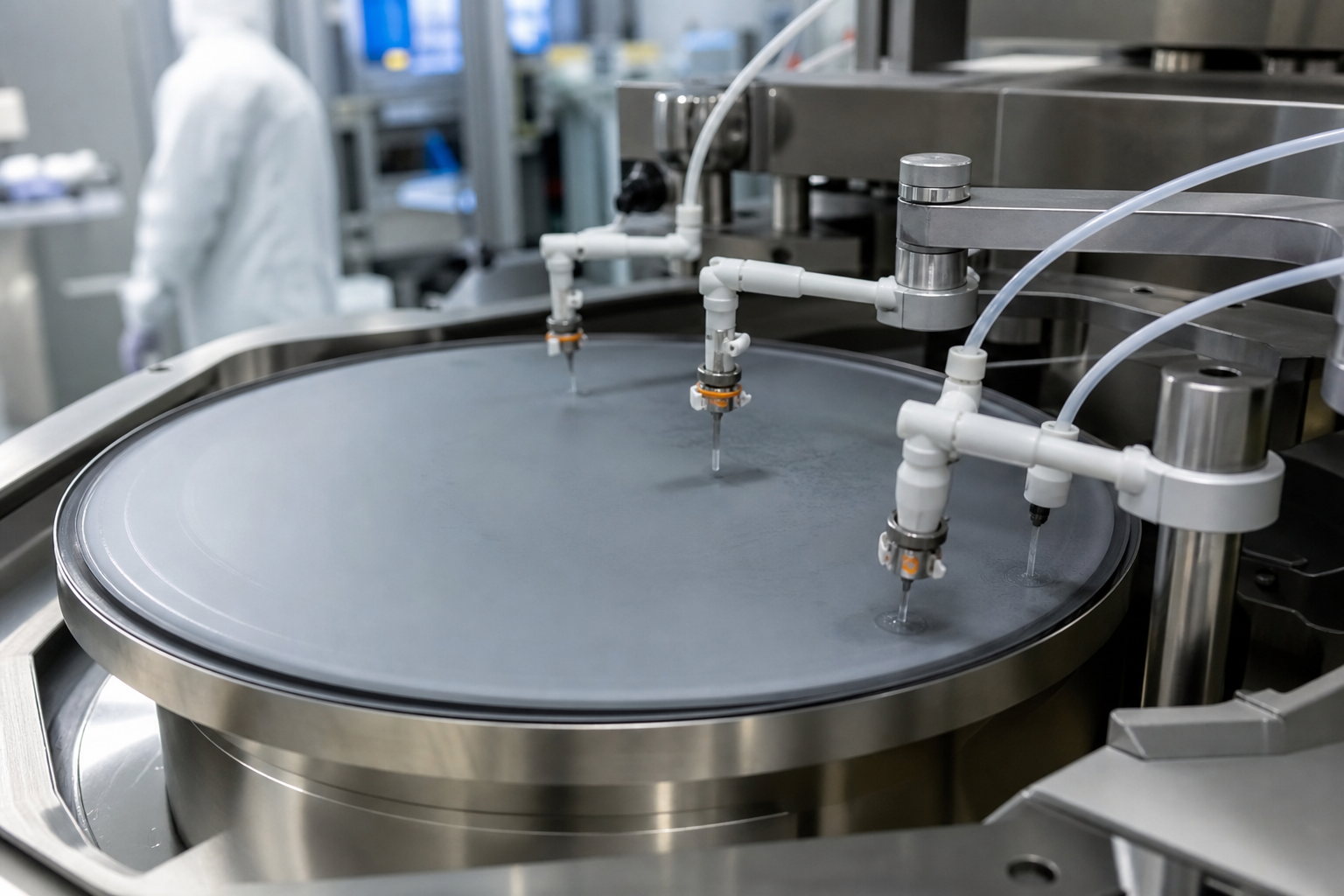
Dispense stability on the tool is the last meter of the supply chain.
Scorecard for materials and module owners (not a generic buyer list)
| Decision | Weak signal | Strong signal | | --- | --- | --- | | Dual source | Second COA on file | Both SKUs ran on your critical layers with SPC | | Inventory | Days of cover on average mix | Cover by SKU + aging/pot-life rules | | Logistics | Single port, single plant | Documented allocation playbook | | Quality | Paper COA only | On-site PSD / large-particle counts gated to release |
Adjacent topics this is not
Substrate warpage metrology owns carrier flatness. EUV mask and pellicle supply owns reticles. SiC wafer boules own power-device starting material. ABF capacity owns organic substrates. Slurry owns the wet polish consumable that turns those wafers into planar surfaces. Different factory, different buyers, different failure mode (scratch and dishing, not reticle delay).
Closing the loop after the scare
The fabs that sleep better after an allocation event usually did three unglamorous things: freeze a living dual-source matrix by layer family, put large-particle monitoring in the dispense loop (not only at receiving), and tie slurry lot genealogy to wafer lots so a bad tote is a bounded recall, not a rumor.
CMP will keep looking like facilities logistics from the loading dock. On the platen it is process control. Plan it that way before Week −6 writes your schedule for you.