
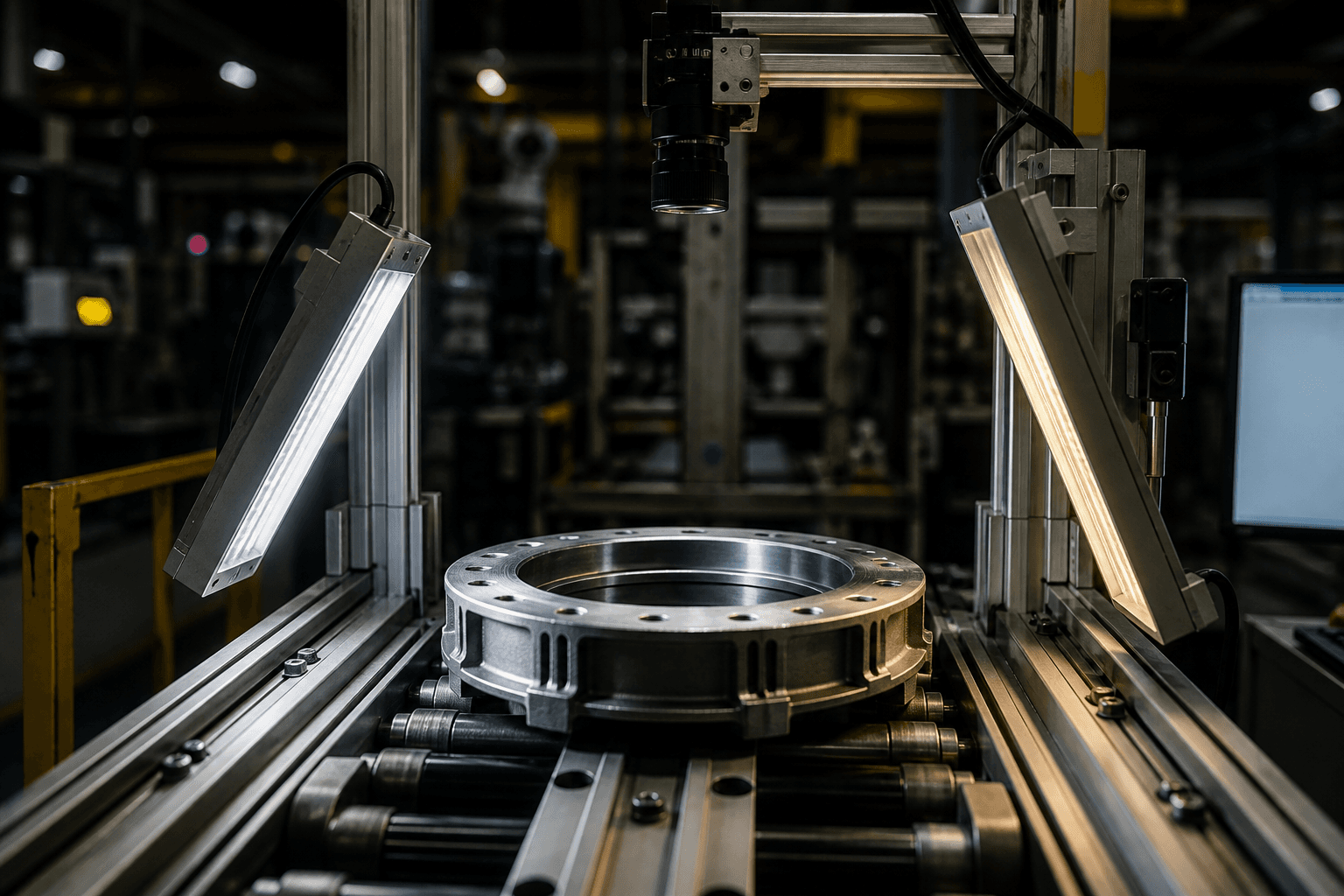
A vision cell that was stable for eight months does not usually fail because the model forgot how to see a scratch. It fails because the photon budget changed. A LED bar that has yellowed, a diffuser filmed with oil mist, a fixture that was nudged during a weekend mechanical job: any of those moves the intensity and color temperature of every pixel. The network still outputs a class. The threshold that used to sit in a quiet valley now sits on a slope. False rejects climb. Someone opens a retraining ticket.
Retraining is the expensive way to absorb an illumination problem. It also cements the new lighting as the new normal, so the next lamp change looks like another model failure.
What actually moved
Industrial inspection lighting is a process variable. Intensity at the part, angular distribution, and spectrum all drift. High-CRI white LEDs lose output over thousands of hours; cheap bars lose it faster and unevenly across the strip. Diffusers collect dust and coolant haze. Polarizers rotate if a clamp is loose. A bar that was 300 mm from the part and is now 280 mm after a conveyor guard was reinstalled is not a "same cell."
The model does not know any of this. It sees a shift in brightness histograms and in the contrast of edges it was trained to treat as defects. Dark-field scratches get louder. Specular highlights on machined faces look like pits. A label-print inspection that depended on a red channel now runs on a warmer spectrum and reads ink density as out of spec.
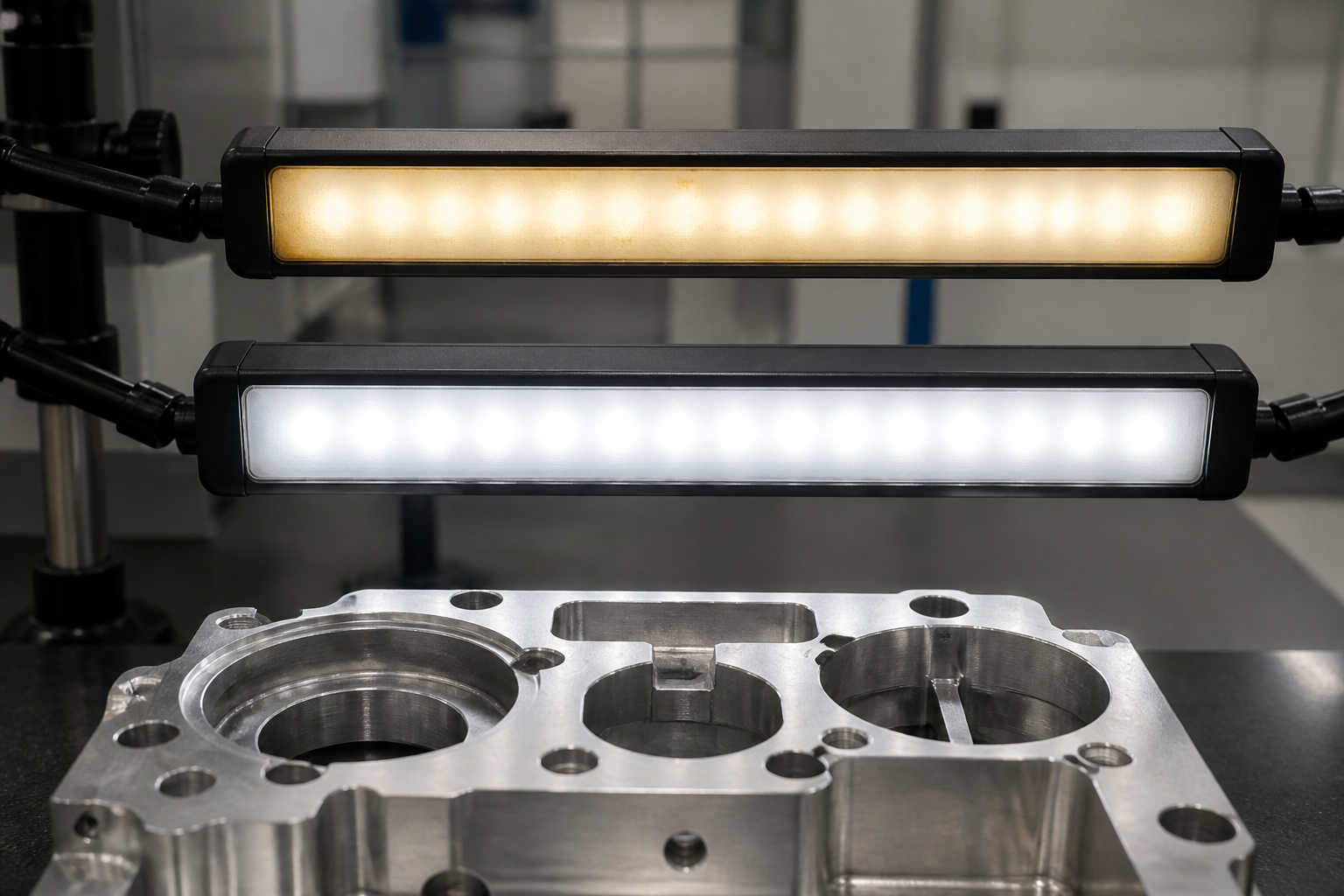
A useful diagnostic is cheap: photograph a matte grey card and a known-good part at a fixed pose, weekly, with the same camera settings locked. If mean grey and the defect-channel histogram move outside a band you set at commissioning, stop calling it model drift. Call it lighting.
Do not retrain first
The sequence that works is mechanical, then optical, then statistical.
First, lock camera gain, exposure, and white balance. Auto-exposure is a silent saboteur on cells that "look fine" on the HMI. Second, clean or replace the diffuser and confirm bar-to-part distance against the commissioning sketch—not against memory. Third, measure illuminance at the inspection plane with a meter, not with a phone camera. Fourth, only then compare a frozen golden-sample set against current rejects.
If the golden set now fails at the same rate as production, the model is not the patient. If the golden set still passes and production fails, look at part presentation: pose, oil, and surface finish—not at a new dataset collected under the drifted lights.
What to put on the cell's nameplate
A vision cell should carry an illumination spec the way a CMM carries a probe spec: LED part number, hours at last replacement, target lux at the plane, bar height, and the date of the last grey-card capture. None of that belongs in a data-science backlog. It belongs in PM.
The teams that keep false-reject rates boring are not the ones with the newest backbone. They are the ones who treat light as an asset that ages, gets dirty, and gets moved—and who refuse to retrain until those three have been ruled out.