
Heat pumps reclaim mid-range process heat. Electrode boilers electrify steam where heat pumps stop. Thermal storage shifts multi-hour loads. What still bleeds boiler fuel every hour of every day is a quieter failure mode: steam traps that stick open, stick closed, or cycle so badly that condensate never returns as designed.
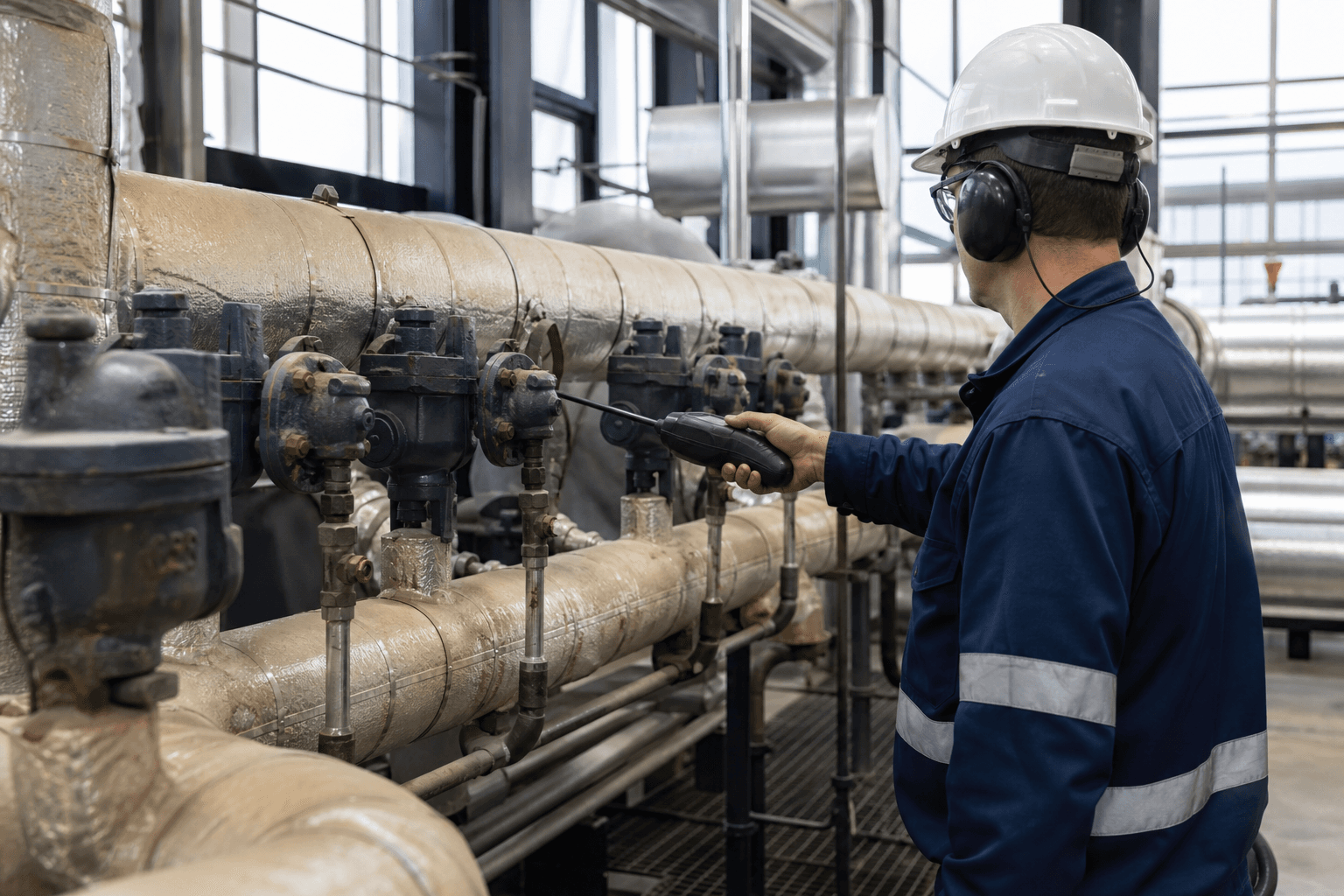
A modern trap program is not a clipboard walk with an infrared gun once a year. Plants that treat traps as a living asset class—tagged, surveyed on a risk cadence, and tied into work orders—recover measurable steam and cut the hammer events that damage valves and heat exchangers.
The industrial point is population health. A perfect survey of twenty “critical” traps while five hundred unknown traps scream live steam into condensate headers is theater.
Why trap failure is an energy and integrity problem at once
Industry surveys repeatedly place failed trap rates in the 15–30% range on plants that have not run a continuous program; best-in-class sites often drive sustained failure below 5% with quarterly or continuous monitoring on high-duty traps. Each failed-open trap on a medium-pressure header can dump tens to hundreds of kilograms of steam per hour—fuel and make-up water that never show up as a single dramatic alarm.
Failed-closed traps are worse for integrity than for the energy dashboard. Condensate backs up into tracing and exchangers, cold spots form, and water hammer follows. Reliability engineers then chase “random” flange leaks while the root cause sits in a strainer and a stuck float.
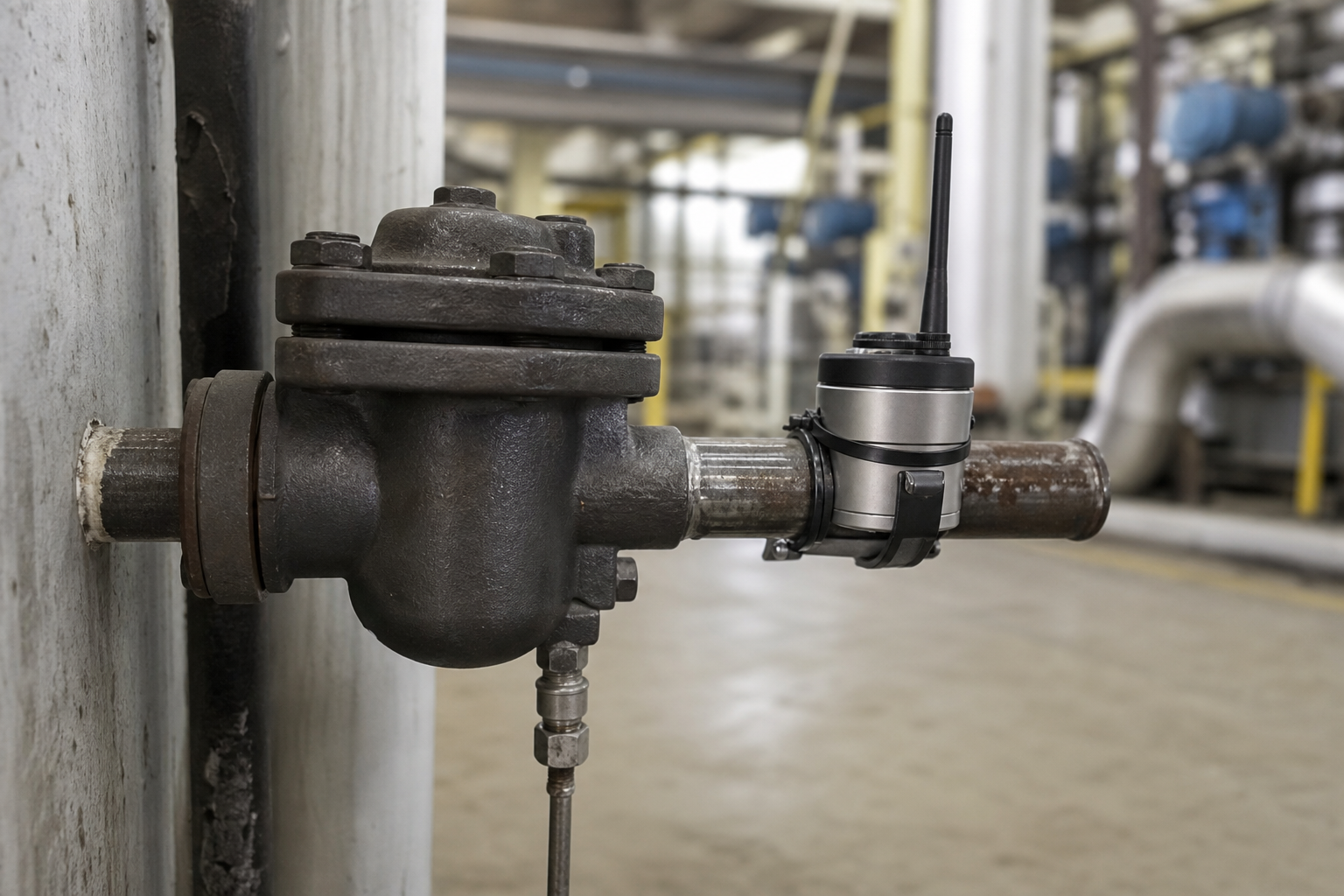
A sensor that only trends temperature without acoustic context will mis-call blow-through as “healthy hot.”
An anonymized food-process site with roughly 1,200 traps cut estimated steam loss by more than 8% of boiler steam mass after eighteen months of ultrasonic route surveys plus wireless sensors on the top 10% duty traps. The saving was not a new boiler; it was closing the gap between nameplate heat balance and what the headers actually delivered.
What a serious trap program actually controls
- Identity — Every trap has a tag, service, orifice size, and failure mode history linked to the asset hierarchy—not a handwritten route list in a binder.
- Survey method — Ultrasonic/acoustic listening plus temperature differential, with clear failed-open vs failed-closed criteria. IR alone is not enough on insulated lines.
- Cadence by consequence — Critical tracing and turbine drains surveyed more often than low-duty space heaters.
- Condensate return as the KPI partner — Return-rate and make-up water trend with trap health; if return falls while traps “pass,” your method is lying.
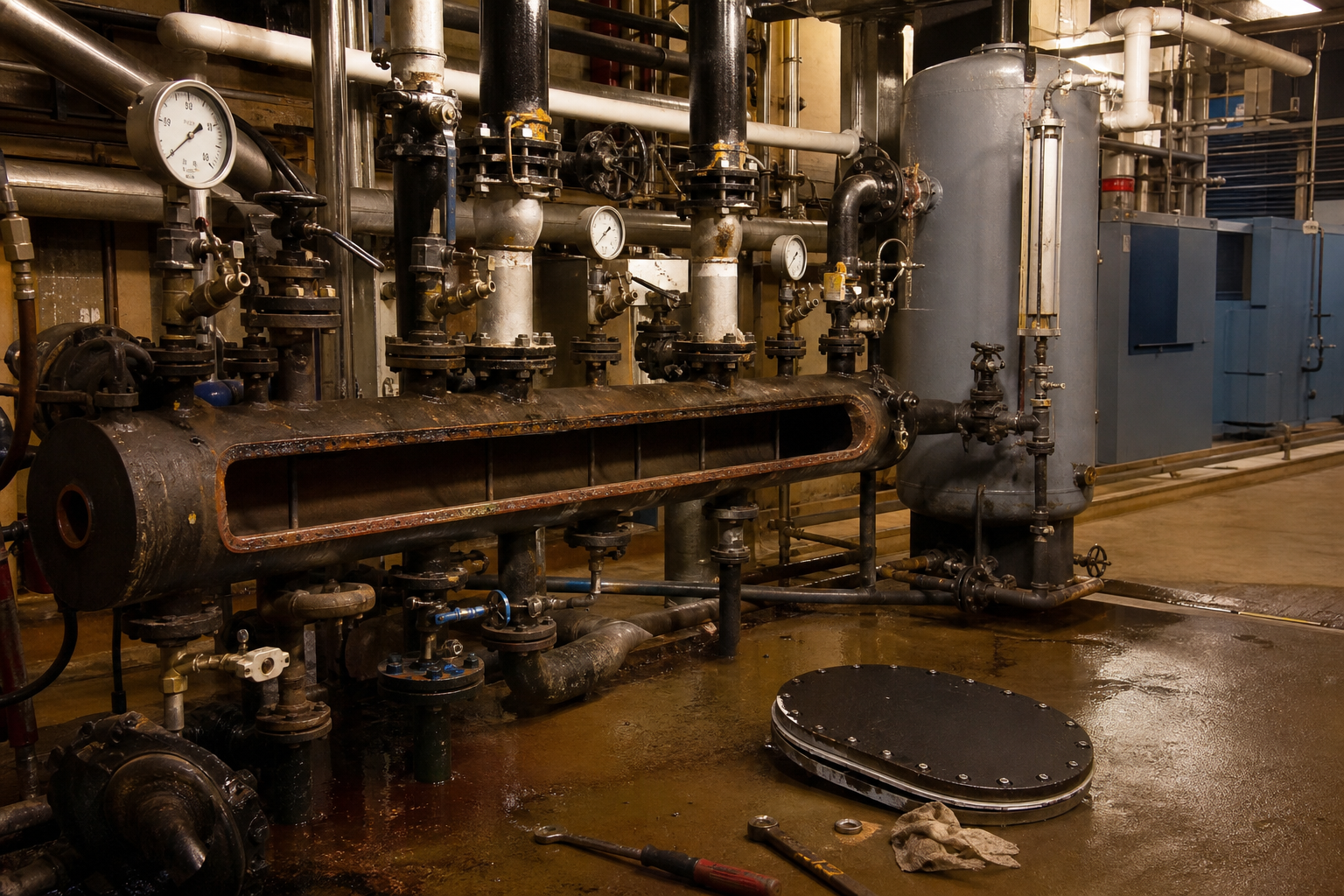
Returned condensate is heat and treated water; traps are the valves that decide whether it comes back.
Situation: the annual “trap blitz” that changes nothing
A chemicals plant ran a contractor blitz every spring, replaced a few dozen failed traps, and filed an energy credit. By autumn the failure rate looked familiar. Root causes were predictable: wrong trap type for modulating service, strainers never cleaned, and no ownership between utilities and area maintenance. The fix that stuck was a named trap owner, a CMMS failure code taxonomy (open / closed / oversized / undersized), and permanent acoustic nodes on headers that had repeated blow-through.
What this is not
This is not industrial heat-pump selection, not electrode-boiler CapEx, not demand-response load shed, and not power-quality harmonics. Those topics own different constraint surfaces. Trap monitoring owns the installed steam distribution population and the condensate loop that makes boiler efficiency real.
Numbers worth putting on the buyer slide
| Signal | Practical range plants discuss | | --- | --- | | Unmanaged failed-trap share | Often 15–30% at program start | | Target sustained failure | Often <5% with living surveys | | Survey interval (critical) | Monthly to continuous; low duty quarterly | | Payback on sensor + route programs | Commonly 6–24 months where fuel is priced and return is metered |
Exact economics depend on steam cost, hours, and orifice sizes—treat vendor “one trap saves X” claims as inputs to your own orifice math, not as gospel.
Failures that still look like a digital utilities win
Mounting sensors without trap IDs in the historian. Alerting on raw temperature without state logic. Replacing traps without checking orifice and differential pressure. Celebrating a pilot on one building while the tank farm tracing stays invisible.
Buyer checklist
- Population baseline — Do you know how many traps you have, by type and pressure class?
- Method — Acoustic + thermal criteria documented, or IR theater?
- Work-order loop — Failed trap → WO → as-found/as-left in under an agreed SLA?
- Condensate metering — Can you prove return-rate movement after the program?
- Ownership — Utilities, reliability, or area maintenance—who signs the KPI?
Steam cost shows up on the fuel invoice. Trap programs show up when that invoice and the hammer incidents both move—because someone finally treated traps as plant assets, not seasonal chores.