
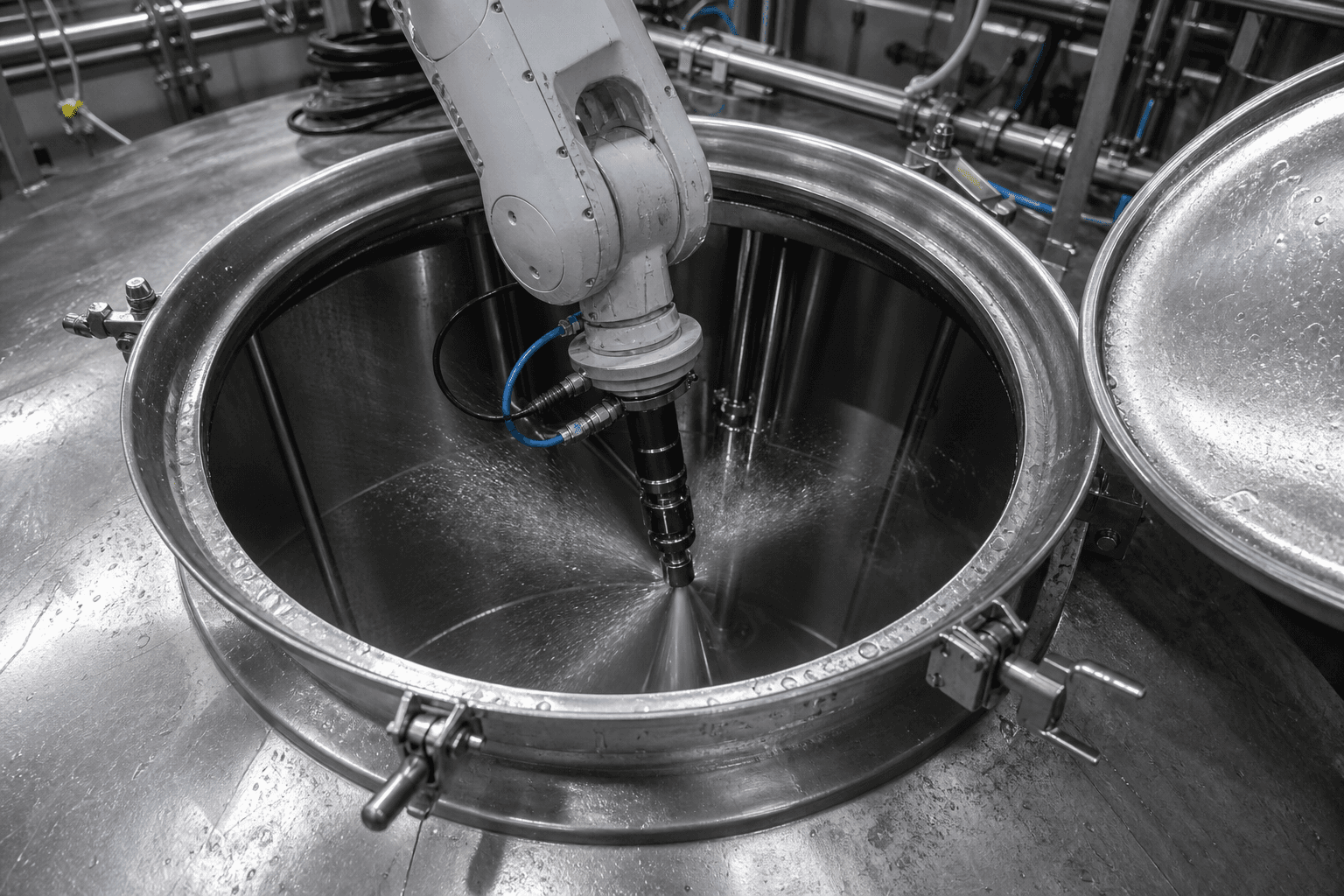
Confined-space vessel cleaning is where industrial robotics stops being a cycle-time story and becomes a permission story. The arm is the visible part. The cell is a stack of subsystems that have to agree before a human stays on the platform instead of climbing through the manway.
Below is an anatomy—not a vendor bake-off, and not a repeat of ultrasonic NDT, spray coating, or wire-harness cells. Those move probes, paint, or connectors. This cell moves energy, chemistry, and waste while the vessel’s atmosphere stays hostile.
1. Access geometry and the arm that fits it
Manway diameter, internal baffles, and heel geometry decide whether a snake arm, a mast-deployed lance, or a track-mounted crawler is even eligible. Reach charts from a six-axis on a clean floor demo are almost useless here. The first engineering deliverable is a collision-checked path in the as-built vessel model, including nozzle standoff that actually cleans shadow zones behind dip pipes.
If the integrator cannot show a digital clean of your drawing (or a laser scan of the vessel), you are buying optimism.
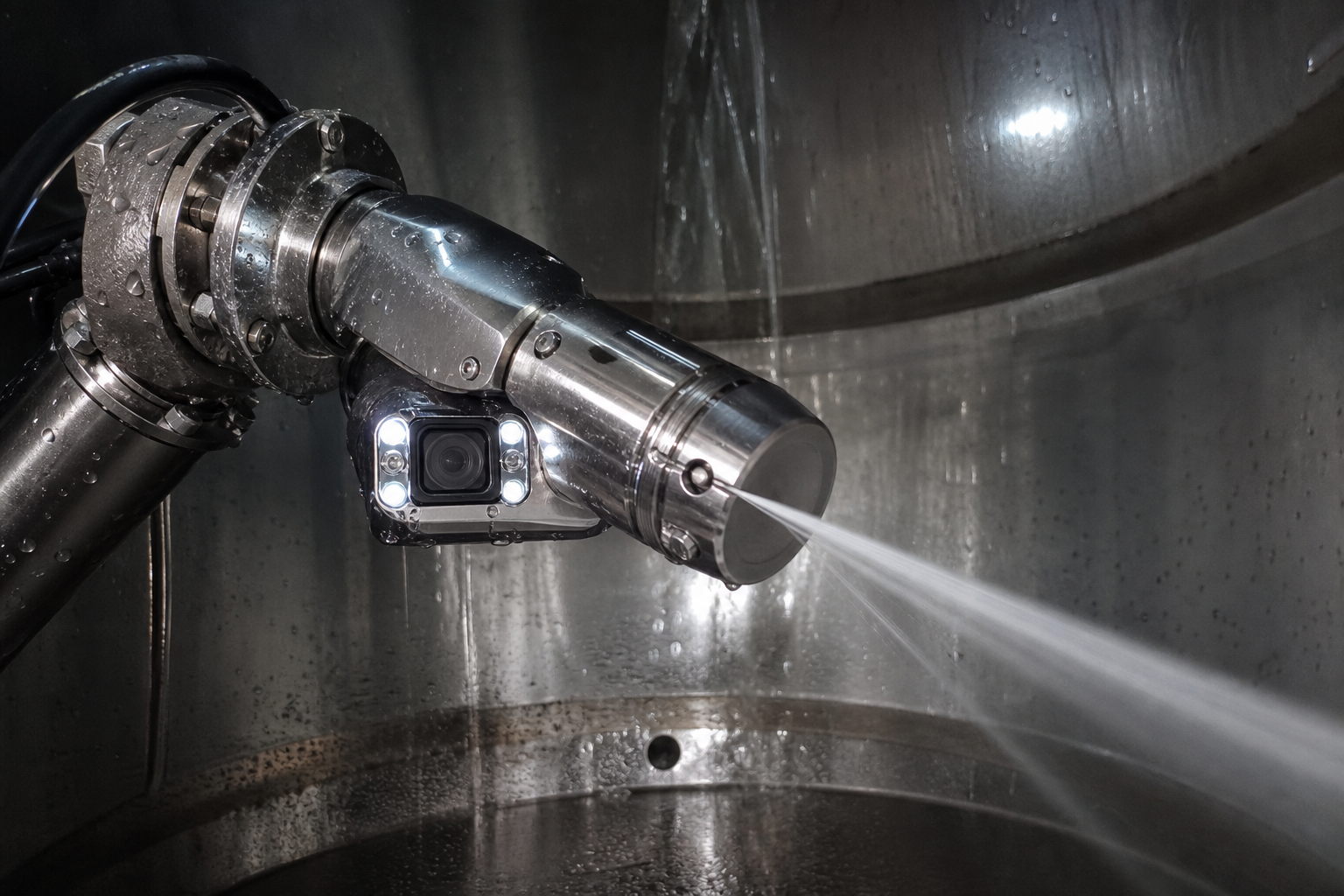
Camera confirmation of wet coverage matters as much as pump pressure on the datasheet.
2. Process recipe: pressure, chemistry, dwell
Cleaning is a recipe: detergent or solvent choice, temperature, pressure, flow, and dwell mapped to residue type (polymer heel, oil film, powder cake). A robot that only “washes harder” will erode seals and drive effluent costs without proving residue limits. Plants that succeed treat the recipe like CIP validation—sample points, acceptance criteria, and a fail path that does not default to “send a person in.”
Typical high-pressure mobile systems discuss hundreds of bar at the nozzle for some residues and much gentler flows for others; the number that matters is the one tied to your coupon tests, not the brochure maximum.
3. Atmosphere, permits, and the human who still decides
Even with a robot inside, gas testing, isolation, and permit-to-work remain. The cell should consume permit state—LOTO confirmed, atmosphere readings in range—before motive power is enabled. If the robot can start while the ePTW is still “draft,” you have automated a violation.
Quadruped inspection robots walk past vessels. This cell enters them. Different risk register.
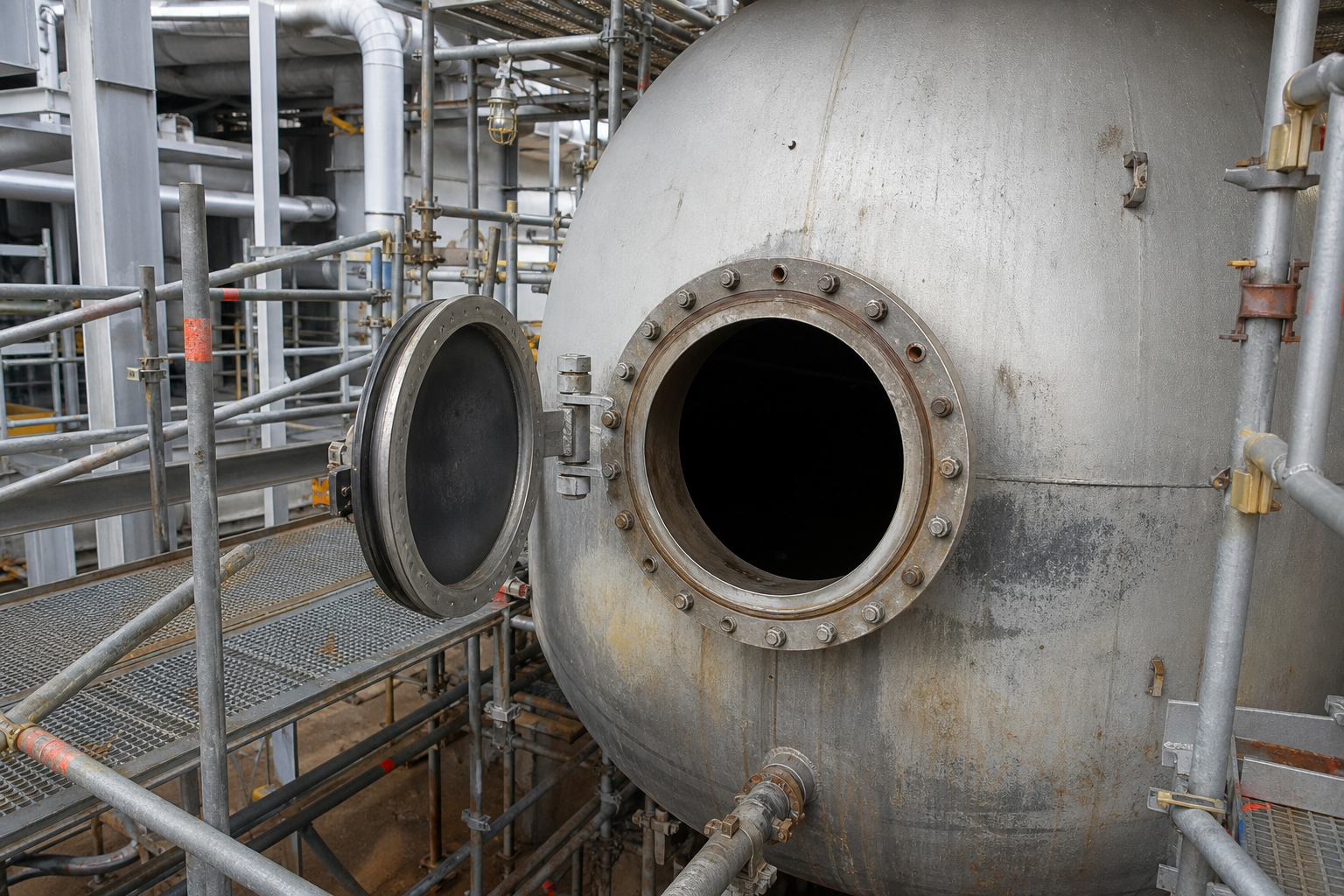
The manway is still a controlled opening—even when the cleaner is a machine.
4. Effluent, filtration, and house utilities
Dirty fluid has to go somewhere without flooding the bay or violating sewer permits. Filtration, knock-out, and recycle loops are part of the cell boundary. So are water and power availability on turnaround peaks when every vessel wants service the same week. A beautiful arm with a garden hose to the trench is not a cell.
Turnaround planners who forget effluent capacity create a second queue: clean vessels waiting on wastewater. Size the dirty-side hold-up and trucking/treatment path with the same seriousness as nozzle bar. If solvent is in the recipe, explosion-proof zoning and vapor recovery stop being “EHS footnotes” and become cell design inputs.
5. Proof: cleanliness you can show
Operations will ask what “done” means. ATP, solvent wipe, visual with recorded video, or analytical samples—pick criteria before FAT. The strongest programs store coverage video + recipe ID + vessel ID as the turnaround record, the same way mechanized NDT stores encode files. Different evidence, same audit instinct.
An anonymized resins plant cut confined-entry hours on a family of twelve polymer vessels by roughly 60% after the first year of a mast-lance cell—but only after they froze residue coupons and refused “looks clean on camera” as the sole accept criterion. The robot did not remove the need for occasional human entry; it removed routine entry for the recipes that had proven coverage.
How this cell fails in practice
Path planned on a generic tank. Chemistry copied from another product family. Permit bypass “just for the demo.” No effluent plan. Success declared on a shiny interior photo while heel behind a baffle stays untouched. Another quiet failure: teaching one vessel and declaring the fleet done while heel geometries differ by product campaign.
Reading an integrator proposal
Ignore the slow-motion nozzle reel first. Ask for: as-built path evidence, recipe-to-residue matrix, permit interlocks, effluent P&ID, and a cleanliness proof method. If those five are thin, the arm brand will not save the outage.
Tank-cleaning robotics earns its keep when it removes human entry hours without removing engineering rigor. The manway can stay closed more often—but only when the anatomy above is real, not slideware.