
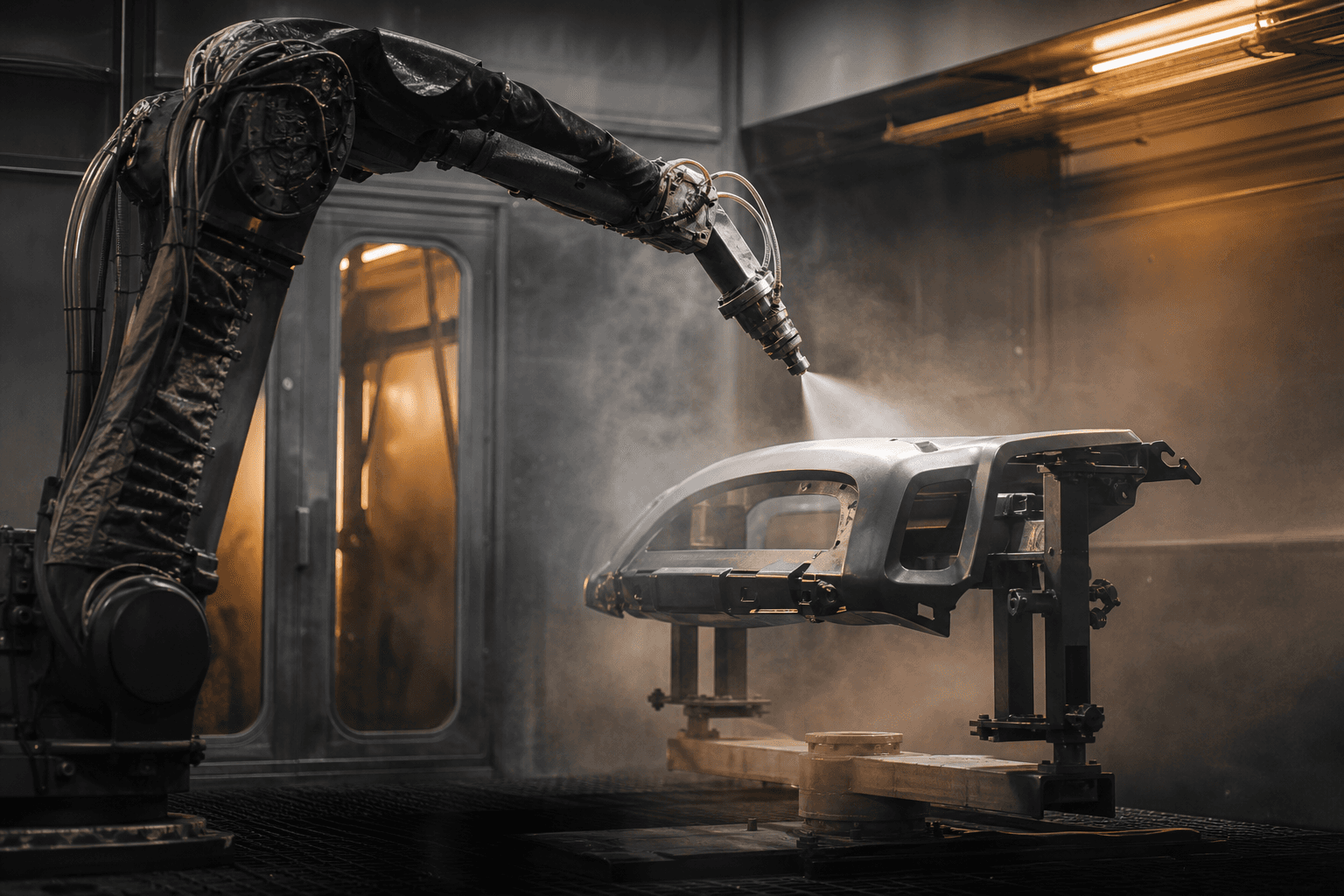
Adhesive cells meter beads and potting. Welding closes seams. Deburring finishes edges. CNC tending feeds machines. What still ties labor and VOC compliance on many lines is spray coating: path, atomization, film build, and flash-off that turn into scrap when booth conditions drift.
Robotic spray cells with offline programming, viscosity control, and in-line film metrology are moving from paint-booth demos into body shops, appliance lines, and protective coating cells where inconsistency is expensive.
The industrial point is stable film thickness and first-pass yield—not a glossy marketing loop of a waving gun.
What spray robots change
- Path and fan recipes — Speed, overlap, and atomization as controlled parameters.
- Film-build feedback — Wet/dry thickness gates before cure.
- Booth and VOC discipline — Capture, recovery, and material lot links inside the cell recipe.
What still fails
Open-loop spray that ignores humidity and viscosity drift. Cells without explosion-proof and air-quality engineering treated as afterthoughts. This is not adhesive bead dispense, not weld-path AI, not abrasive finishing, and not CNC load-unload.
What to watch next
- First-pass yield and rework cuts versus manual spray baselines.
- Whether vision film checks survive overspray mist long enough to trust.
- Standardized coating recipes reusable across sister plants.
Dispense owns the bond. Spray owns the surface that customers and corrosion see first.