
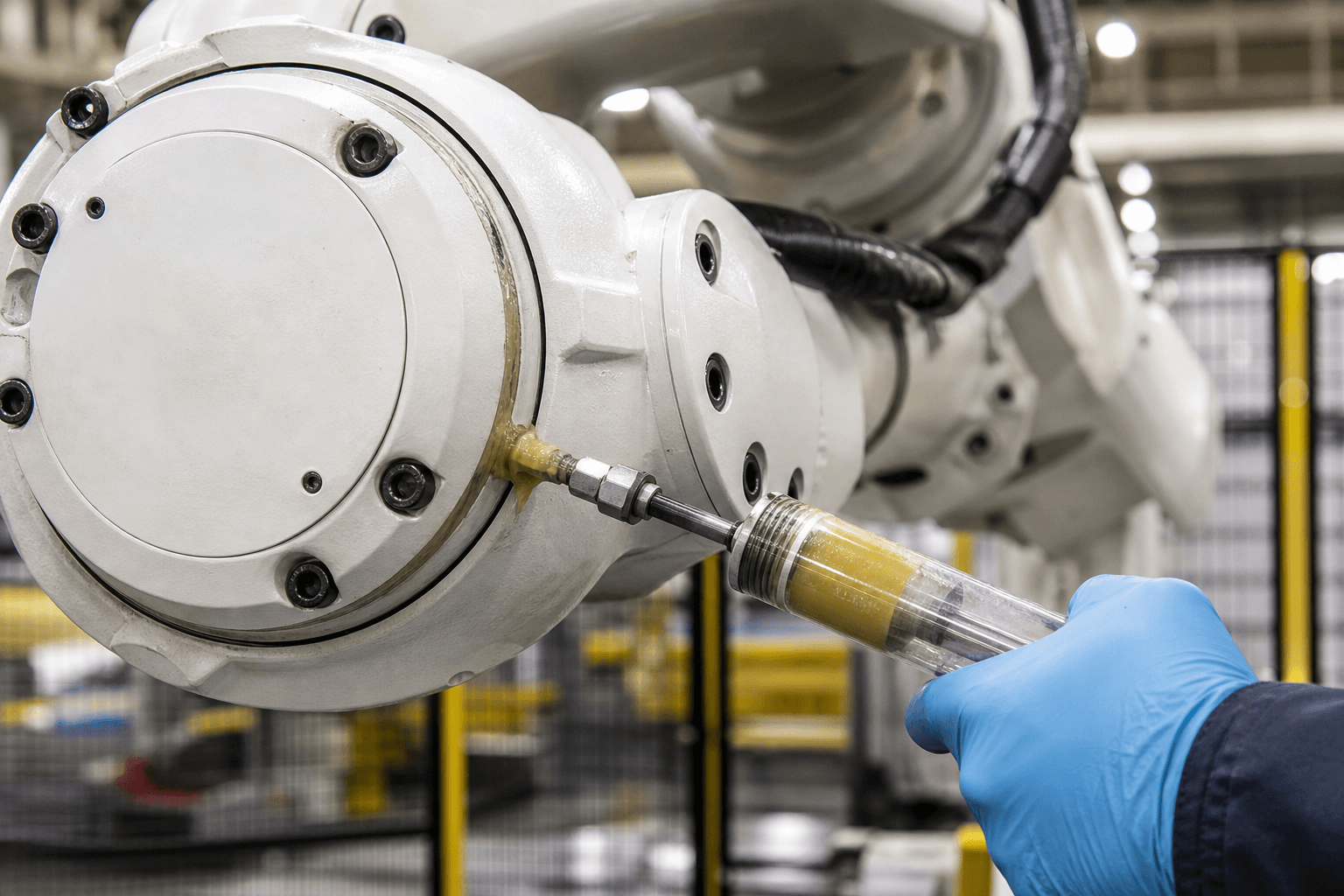
Pocket rule: if the axis environment changed and the grease interval did not, you are financing bearings with hope.
This is a field guide, not a CapEx essay. Use it on the floor. If you needed a dress-pack cable brief or a tool-changer dock brief, those stop at the carrier and the coupler—this one starts at the sealed joint.
How to use this guide (90 seconds)
- Identify the cell’s environment class (table below).
- Match the failure signature you actually see.
- Apply the first action—not a full teardown fantasy.
- Escalate only if the signature repeats after the action.
Environment class matrix
| Class | Typical cell | Grease / seal stress | First inspection cue | | --- | --- | --- | --- | | A — Dry packaging | Carton, pick | Low chemical, dust | Dust rings at seal lip | | B — Food / washdown | Protein, beverage | Water ingress, soap | Milky purge, rust blush | | C — Paint / solvent | Spray booth adjacent | Solvent thin-out | Thinned grease purge | | D — Weld / spatter | BIW, fab weld | Heat + metal fines | Spatter crust on covers | | E — Foundry / abrasive | Grind, blast near | Abrasive packing | Grit in purge grease | | F — Clean / electronics | ESD areas | Over-cleaning solvents | Dry seals, white dust |
Wrong class → wrong PM → “mysterious” axis current rise.
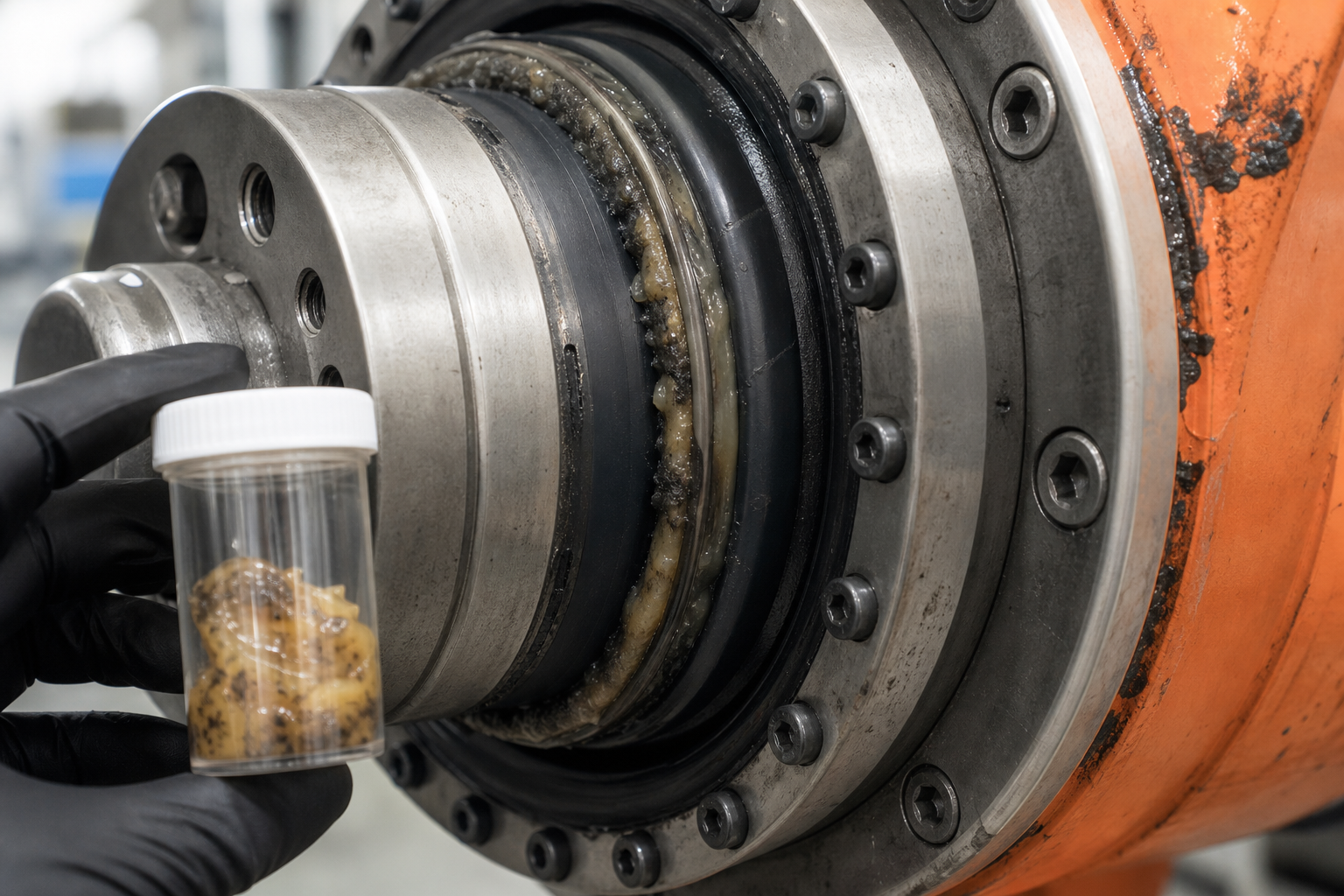
Purge color and texture are data—if you look.
Failure signatures → first actions
Signature: rising motor current on one axis, no collision
→ Check environment class drift (new process next door). Sample purge. Do not retune servo gains first.
Signature: grease purged thin / solvent smell (Class C)
→ Shorten interval; verify cover integrity; isolate solvent overspray. Dress-pack hose swell is a cousin, not the root.
Signature: water in grease / milky purge (Class B)
→ Seal and breathers; washdown angle; never “more grease” as the only fix.
Signature: spatter welded to covers (Class D)
→ Shields and cover geometry before bearing blame; heat soak after long welds.
Signature: repeat encoder faults after cable “fix”
→ Revisit joint contamination and dress-pack separately; do not conflate.
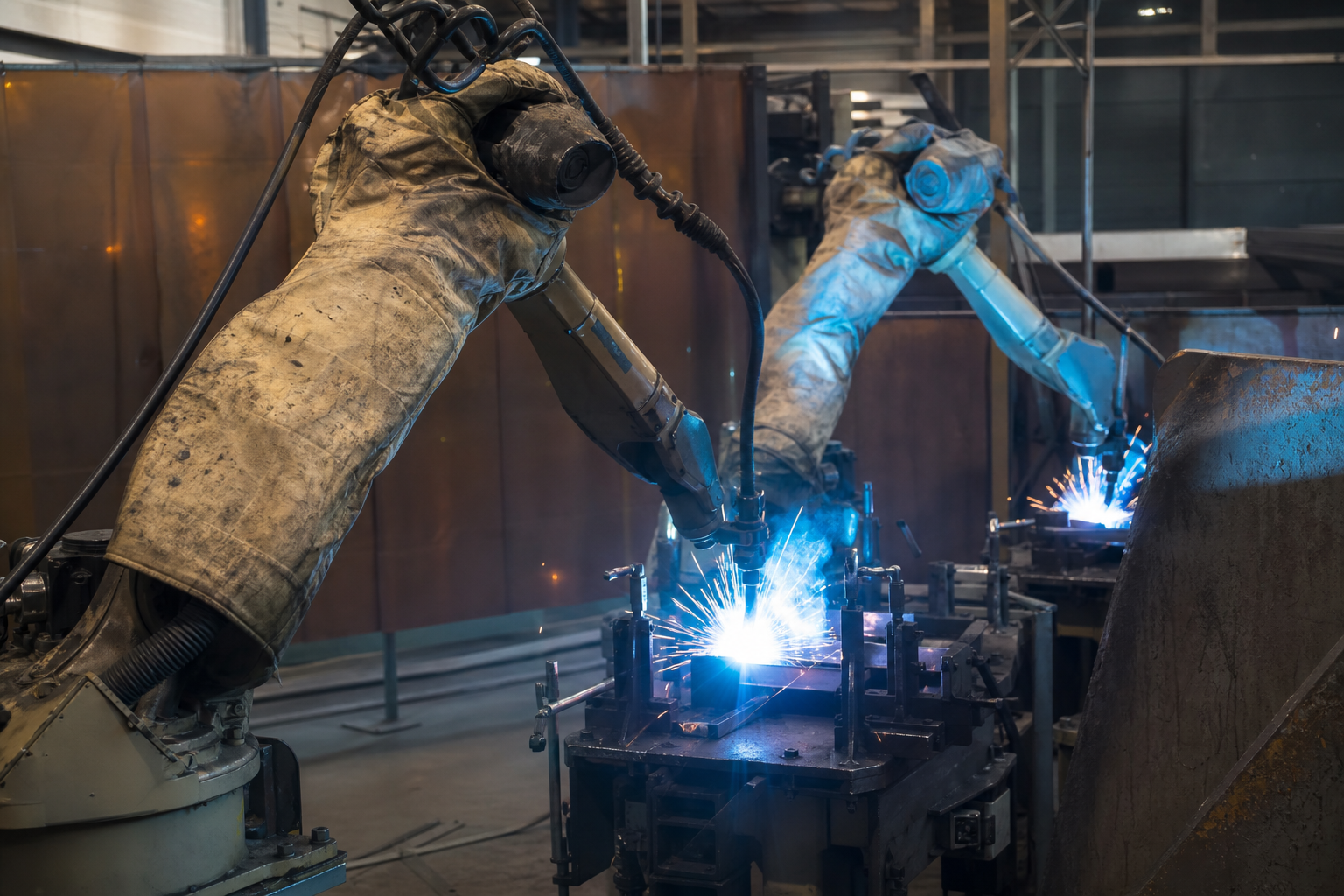
Spatter on covers is an environment tax invoice.
Interval logic (portable, not OEM-secret)
OEM hours matter. Environment multiplies them. A Class D cell that inherits Class A intervals is a bearing donation program. Write intervals as:
base OEM hours × environment factor × duty factor
Track factors in CMMS—not in a senior tech’s memory.
Contamination control checklist (print this)
- [ ] Environment class tagged on the cell placard
- [ ] Last purge sample dated (photo allowed)
- [ ] Cover fasteners torqued to spec after PM
- [ ] Adjacent process changes logged (new booth, new weld schedule)
- [ ] Grease part number matches axis family (no “close enough” tubes)
- [ ] Used grease disposed as contaminated waste where required
What this guide refuses to be
- Not dress-pack bend-radius engineering
- Not ATC coupler seal kits
- Not ISO cobot collaborative force theory
- Not humanoid battery hot-swap logistics
Those are sibling problems. Mixing them produces wrong parts on the wrong cart.
Mini case (one paragraph)
A paint-adjacent sealing robot “ate” wrist axes every seven months. Cable carriers were replaced twice. Tool changers were innocent. Purge samples were thinned with solvent mist from a booth balance change nobody filed under MoC. Class shifted C←A on paper still said A. Interval rewrite + shield + booth MoC ended the bearing charity.
Close
Robots do not live in OEM catalogs. They live in air, mist, heat, and grit. Tax the environment honestly—or keep paying in axes.