
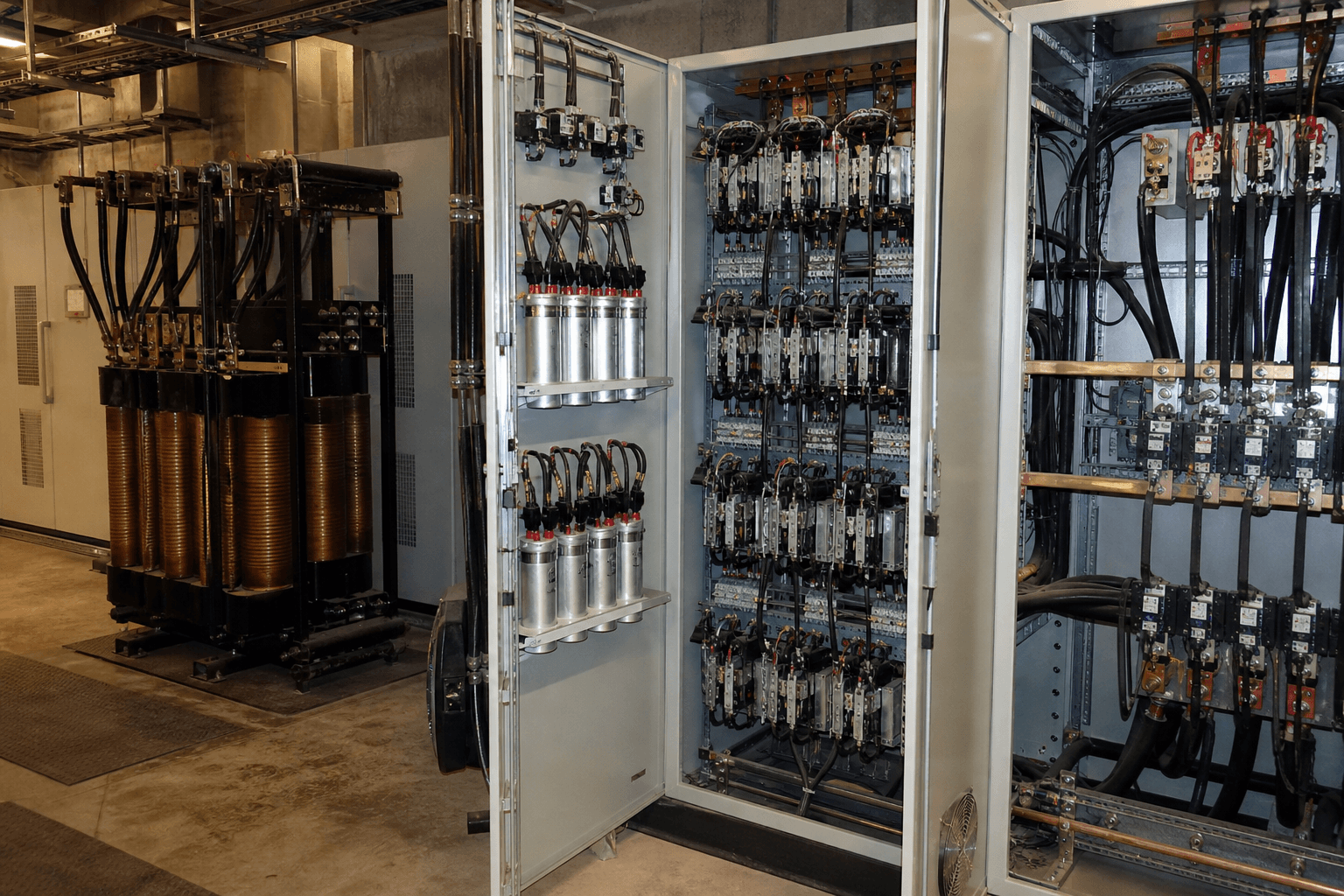
A plant that added VFDs, welders, and UPS gear still often runs the same power-factor correction (PFC) bank that was sized for a cleaner current decade ago. The utility still cares about displacement factor. The bank still switches steps. Cans still bulge, reactors still run hot, and fuses still open one phase at a time until the remaining cans take a current they were never meant to see.
This is not the same story as a harmonics study of a VFD, and it is not a demand-charge autopsy. It is the hardware that sits between those two: iron, film, and a resonance that was designed on paper and then drifted.
Why detuning is not optional
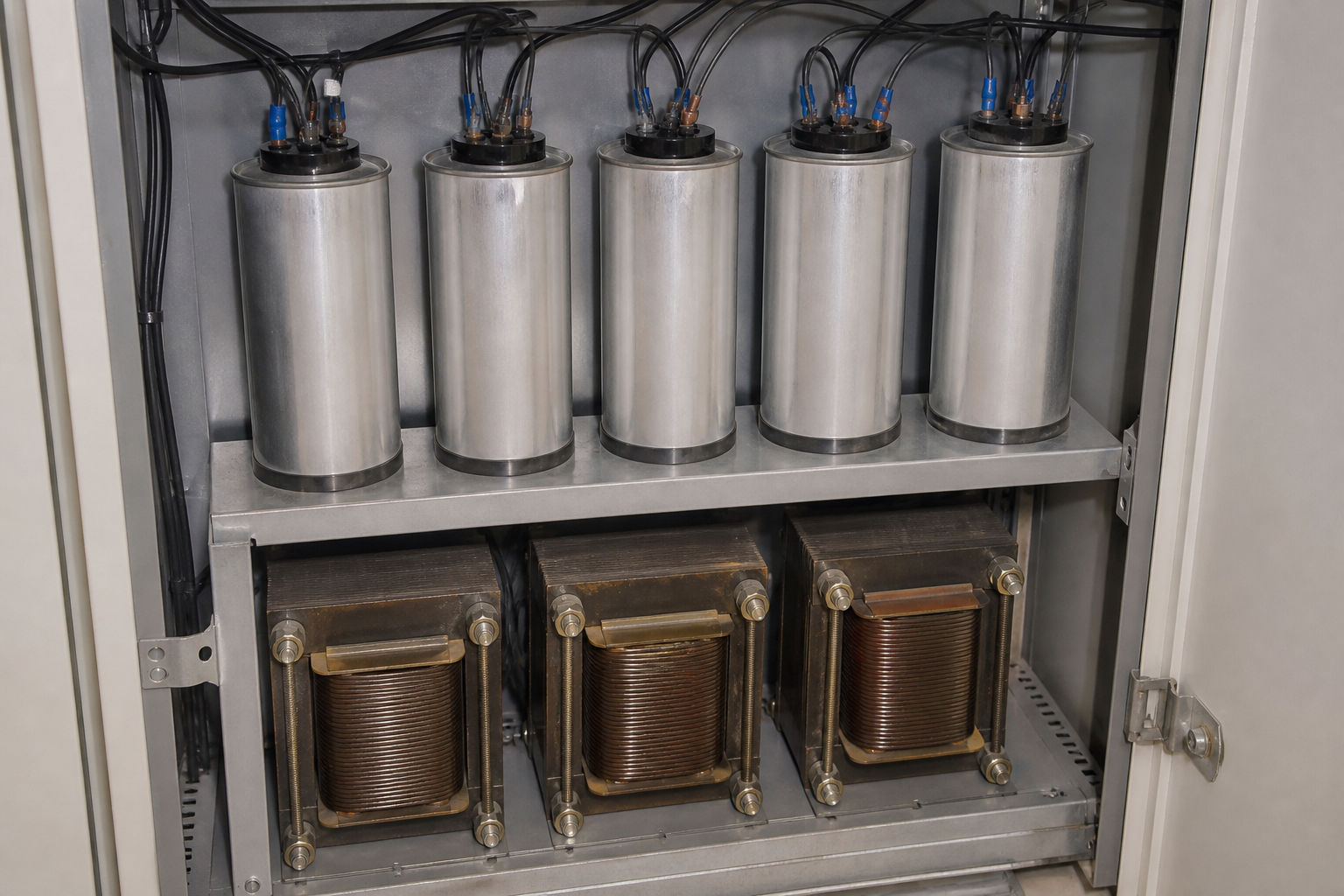
A capacitor bank looking into a network with VFDs is a resonant circuit waiting for a harmonic order. Detuning reactors shift the bank's natural frequency below the dominant harmonics—commonly 189 Hz or 210 Hz class reactors on 50/60 Hz systems—so the bank does not amplify 5th or 7th harmonic current. Remove a failed reactor, jumper it, or replace a can with a different µF without recalculating the step, and the "correction" becomes an amplifier.
Step switching matters. A controller that hunts, or that closes steps into a already-distorted bus, slams cans with transients. Thyristor-switched steps exist for a reason on rapidly changing loads. Contactors on a welding feeder are a different duty than contactors on a steady compressor house.
Heat is the inspection
Film capacitors die of temperature and overvoltage, not of a missed power-factor target. Infrared of can cases, reactor cores, and cable lugs during a typical production harmonic mix is the survey. A can that is hotter than its neighbors at the same step is already leaving the remaining-life curve.
Blown fuses on one phase of a three-phase step unbalance the remaining cans and the reactor. The controller may still show kVAr. The step is no longer the step in the study. Treat a single-phase fuse as a trip of the whole step until it is rebuilt as a set.
Measurements that belong next to the invoice
Power factor on the bill can stay acceptable while a subset of steps is dead and the rest are overloaded. Log: steps in service, bus THD(I) and THD(V) at the bank, can case temperature, and reactor temperature. When THD climbs after a VFD project, re-study the detuning before adding more kVAr. Adding cans to a resonant system is how plants buy a louder problem.
A PFC room is a power asset with a resonance design. Maintain it as one. The sticker on the door that says "0.95 lag" is a billing goal, not a condition assessment.