
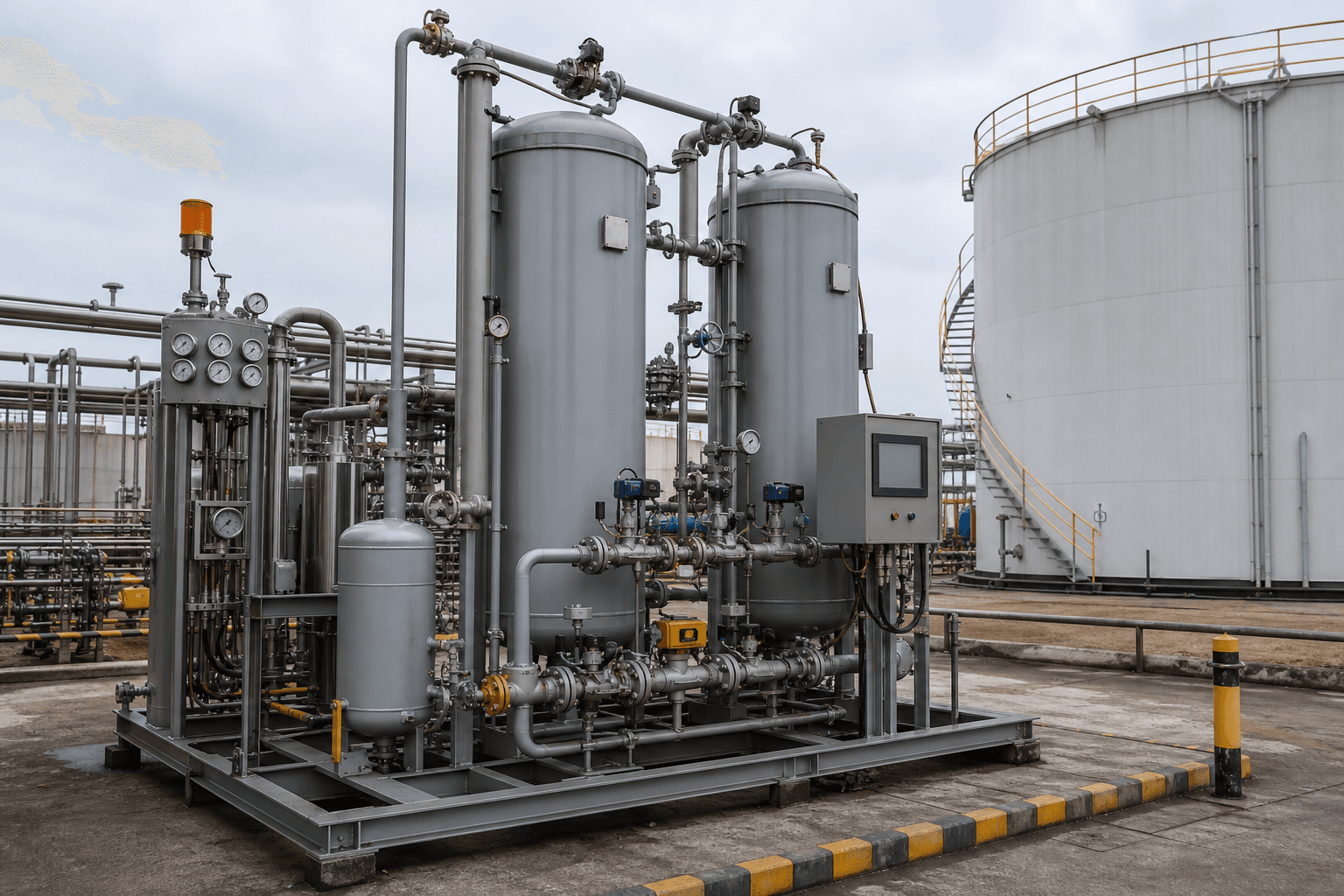
The first clue was not a purity alarm. It was a solvent tank that went “sour” after a weekend idling under supposed nitrogen blanketing: oxygen climbed, solvent oxidized, and a batch that should have been stable had to be reworked. The PSA skid still showed green. The header pressure was fine. Only the portable analyzer on the blanketing branch told the truth—oxygen in the double-digit ppm range where the contract promised single digits.
On-site nitrogen generation sits in the same ownership fog that once hid cooling-tower chemistry. Vendors commission purity. Operations watches tank pressure. Quality owns the spoiled batch. Reliability owns the compressor that feeds the PSA. Nobody owns the living chain from feed-air quality → adsorber health → analyzer truth → blanketing valve positions → headspace oxygen.
This brief is that chain—not a PSA brand catalog, and not another compressed-air leak program wearing a different molecule.
Saturday’s batch, rewritten without folklore
An anonymized specialty-chemicals site lost roughly two shifts of planned production after a blanketed intermediate oxidized. Post-mortem found the online purity analyzer sampling a dead leg that had not seen fresh product gas for weeks, while the actual blanketing branch was pulling from a manifold that mixed in a small instrument-air crossover left “temporary” after a turnaround. Pressure looked healthy because pressure does not equal purity.
The fix that stuck was organizational before it was mechanical. A named nitrogen utility owner (utilities, with quality veto on purity windows), continuous logging of product-N₂ oxygen into the historian at the skid and at the farthest blanketing drop, and a rule that any analyzer–portable mismatch opens a work order the same shift—not at the next vendor visit.
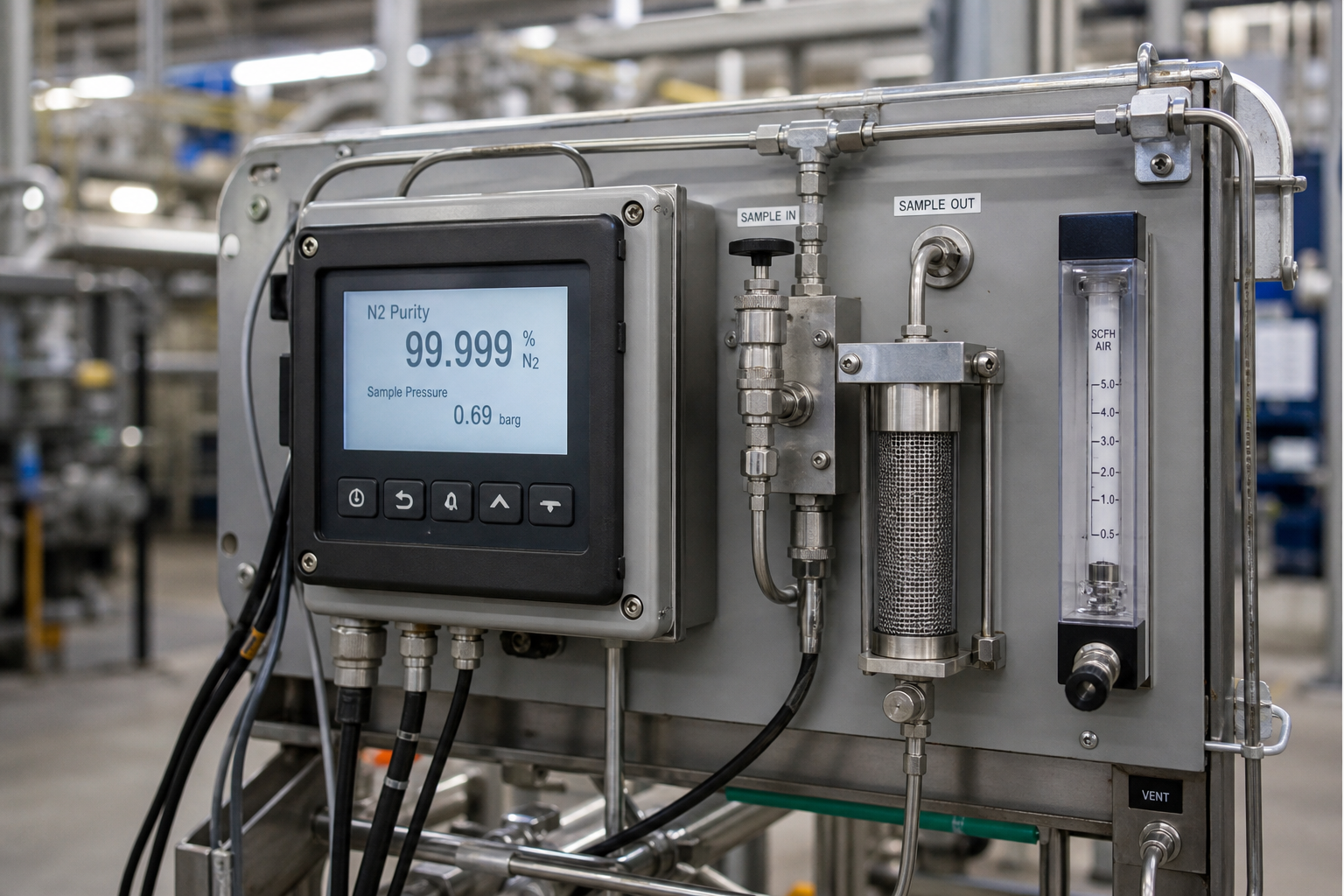
Green lights on a stale sample line are theater with a certificate.
What PSA nitrogen actually controls
Pressure-swing adsorption does not invent inertness. It separates oxygen and moisture from compressed feed air across molecular-sieve beds that age, foul with oil aerosol, and drift when feed dew point rises. Membrane systems trade lower purity ceilings for simpler mechanics; cryogenic liquid backup trades purity assurance for logistics and boil-off behavior. Plants that treat “we have a nitrogen skid” as a binary state miss the operating bands that matter: product oxygen (ppm), dew point, flow at peak simultaneous blanketing, and the buffer volume that keeps purity when demand spikes.
Blanketing is not a valve left cracked open. It is a controlled headspace atmosphere: make-up flow on pressure band, conservation vents that do not pull room air backward, and purge procedures after maintenance that do not assume the first hour of “N₂ on” erased oxygen. Tank farms that share headers without check discipline will contaminate a clean branch with a dirty one and never see it on a skid-local analyzer.
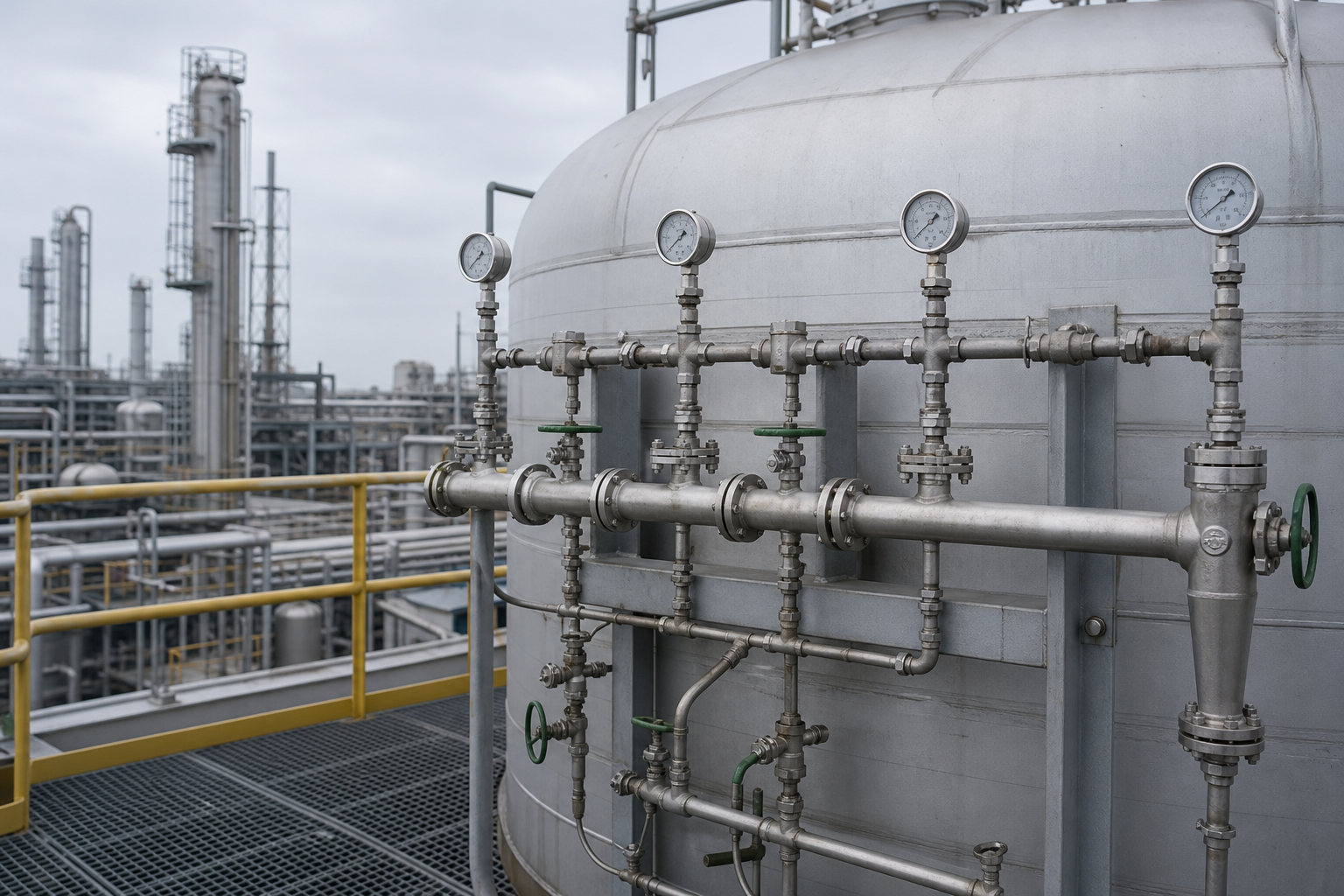
Blanketing integrity is measured at the tank headspace—not only at the generator skid.
Magnitudes that keep CapEx honest
Exact ppm targets belong to your solvent and your metallurgy. The ordering is more portable: spoiled batch cost usually outranks liquid-N₂ invoice savings; analyzer placement outranks brochure purity; feed-air oil and dew-point discipline outranks buying a second skid when the first is poisoned. Sites that “save” by skipping portable verification eventually save their way into oxidation, off-spec polymer, or a flammable headspace that permits will not forgive.
One more ordering rule: if inerting is part of your explosion-protection basis, purity is a safety integrity topic, not a utilities convenience. Treat it like proof—not like a green LED.
Where adjacent briefs stop
Compressed-air leak programs own the air network’s wasted kWh. Cooling-tower chemistry owns heat-rejection water. CHP owns coincident heat and power. Acoustic listening owns rotating-asset sound. None of them own adsorber health, product-N₂ oxygen contracts, or blanketing headspace integrity. Do not buy a smarter air-leak gun and expect stable inert atmospheres.
Questions that replace checklist theater
Who can open a crossover between instrument air and nitrogen without a recorded reason? When did you last compare skid oxygen to a portable reading at the farthest blanketed tank on the same day? Is liquid backup an automatic purity fail-safe or a manual hope? If the generator vendor disappeared for a month, would your CMMS still know sieve age, analyzer calibration, and which tanks are on which header state?
Nitrogen is quiet infrastructure until a batch—or a permit basis—reminds you it was never “just pressure.” Name an owner, instrument purity where the process feels it, and treat inert gas as a reliability product with a specification.