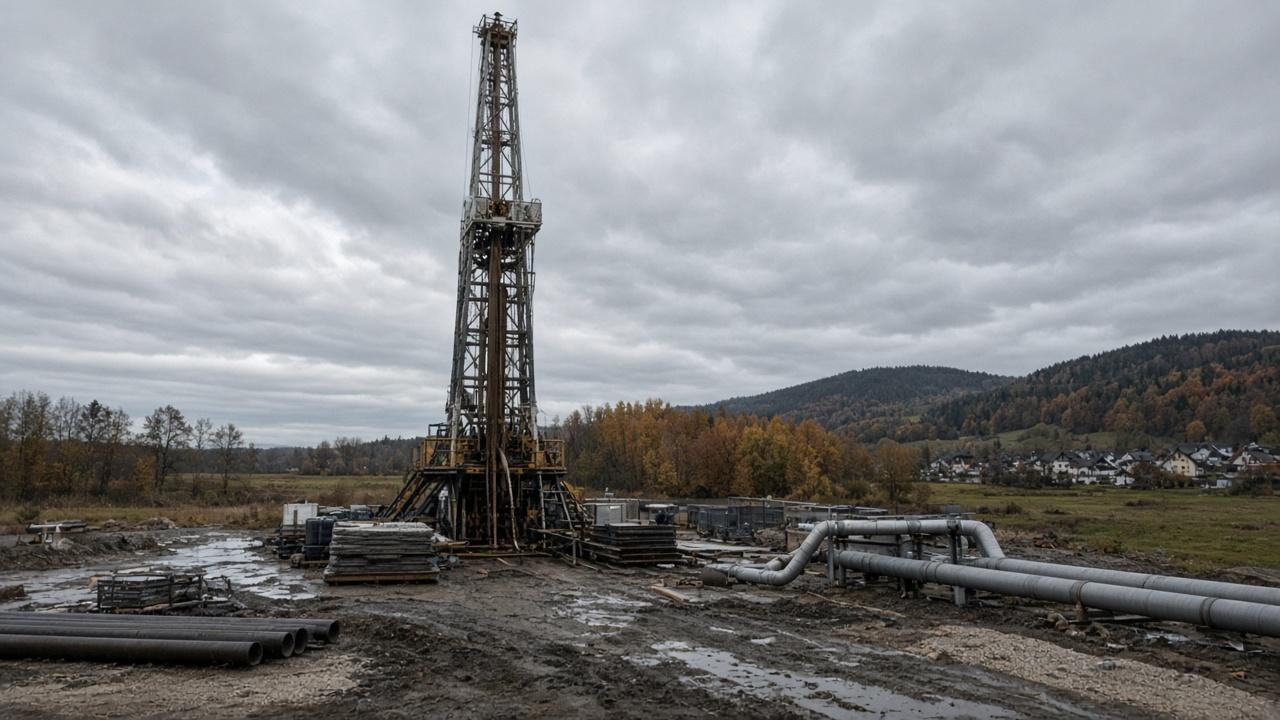
Patrick Hinze, global head of green tech at Munich Re, called the Pullach contract a milestone for Germany’s heating transition: the joint KfW–Munich Re programme is now a live deal, not a brochure. The date on the release is 18 November 2026. The municipal project company is Innovative Energie für Pullach GmbH (IEP). The site is Pullach Süd, south of Munich, where a stand-alone geothermal plant is already under construction to secure existing heat supply and feed further district-heating expansion.
Three new boreholes, each to about 3,500 metres, are planned and insured. They target the Molasse Basin aquifer that already supplies much of the Munich region’s geothermal heat; temperatures there can exceed 100 °C. Drilling is scheduled to start at the end of November 2026. KfW puts the project cost at around €47 million and is financing part of that through its geothermal promotional loan under the Germany Fund—the first geothermal project funded that way. NORD/LB acts as IEP’s bank. Munich Re had already assessed insurability before the cover closed.
The risk product is specific. Munich Re prices feasibility from the available data and, when criteria match, insures 30% to 70% of the loan against dry or insufficiently productive wells. On a claim event, KfW grants a partial debt waiver under the same conditions, so sponsors can cover up to 100% of the loan. Federal funds stand behind the KfW share. That structure is what moves exploration risk off a municipal balance sheet without pretending geology is certain. Helmut Mangold, IEP’s managing director, said the programme lets Pullach South start and, from 2029, supply heat from local sources for 50,000 people—his operational target, not a measured COD.
Programme context matters for readers outside Bavaria. Late in 2025 Munich Re, KfW, and the Federal Ministry for Economic Affairs and Energy launched the deep-geothermal promotion scheme for municipal and industrial heat. Munich Re’s note says at least 65 further projects are meant to be implemented by 2030, with an aim of lifting geothermal’s share of heating energy to ten times its current level. KfW separately says seven other projects are already under assessment, and that other project companies have already shown interest. None of that is a guarantee that every Molasse well will produce; it is a pipeline and a policy target around the first closed deal.
Why insurers and development banks will price this geography at all is the regional track record. The Molasse Basin under the Munich area is already the single largest source of geothermal heat in Germany, per Munich Re’s own briefing. Pullach is not a greenfield municipality inventing deep geothermal from a cold start; IEP is extending an existing heat network with deeper wells and a new plant at Pullach Süd. The insurance product still exists because dry-hole risk remains real even in a proven basin—depth, flow, and temperature for these three holes are still drilling outcomes.
Stefan Wintels, KfW’s chief executive, framed Pullach as proof that the Germany Fund’s model—federal funds and guarantees meant to crowd in private capital—can work for geothermal: federal government, KfW, and Munich Re jointly hedge drilling risk so municipal and private investors have a bankable base. Ingrid Spletter-Weiß of NORD/LB stressed the same combination for complex infrastructure: financing, promotion, and risk hedging in one package. Those are institutional voices explaining why the loan closed. They are not reservoir measurements.
What this note is not: a published MWth capacity for the new plant, a reservoir test result, or proof that every Bavarian suburb can copy Pullach’s aquifer. It is also not COD. The verified package is narrower and more useful—named partners (IEP, Munich Re, KfW/BMWE, NORD/LB), three insured ~3,500 m wells, ~€47 million project cost, late-November 2026 spud window, 30–70% Munich Re / residual KfW waiver up to full loan cover, and Mangold’s 2029 / 50,000-person heat target. Watch next for measured temperatures and flow after the first well, and whether IEP converts exploration cover into construction and operations financing once the reservoir is proven.