
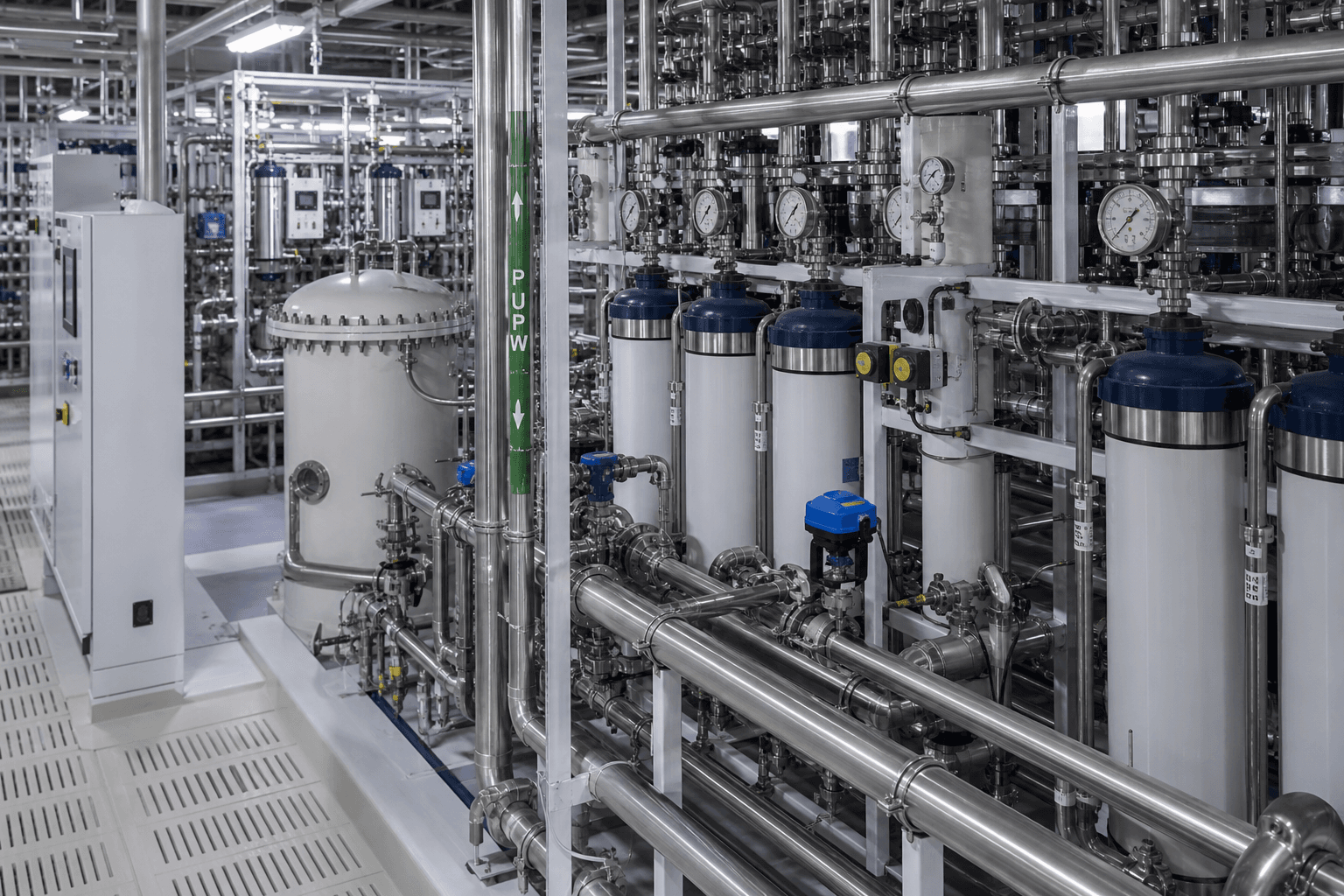
The first alarm was not a resist defect. It was a wet bench that could not hold particle counts after a weekend maintenance window, followed by a lithography rinse step that tripped a conductivity excursion. Only later did someone walk the UPW loop and find a polishing train running on borrowed time: one mixed-bed vessel past its exchange window, a reclaim skid throttled to “save makeup,” and an online TOC probe sampling a dead leg that had not seen fresh product water in days.
Ultra-pure water sits in the same ownership fog that once hid cooling-tower chemistry. The water vendor owns drum deliveries and periodic resin swaps. Facilities watches header pressure and flow. Process owns the tool alarm. Nobody owns the living chain from makeup → pretreatment → RO → polishing → point-of-use → reclaim → discharge compliance.
This brief is that chain—not a catalog of membrane brands, and not another general industrial water-treatment piece.
Symptom → likely owner (before you blame the tool)
| What you see | Often not the tool | First place to look | | --- | --- | --- | | Particle spikes on wet benches | “Operator technique” | Polishing train resin age, filter integrity | | Resistivity soft at POU | “Sensor drift folklore” | Mixed-bed exhaustion, bypass valve position | | TOC excursion after PM | “Contamination event” | Hose rinse procedure, dead-leg flush discipline | | Rising makeup despite reclaim | “Summer load myth” | Reclaim RO rejection, concentrate bleed | | Silica breakthrough on monitors | “New chemistry” | Anion/cation balance, regeneration schedule |
The point of the table is ownership: facilities owns the loop health; process owns the tool spec window; the vendor owns contracted exchanges—but only a named UPW program owner connects them before scrap.
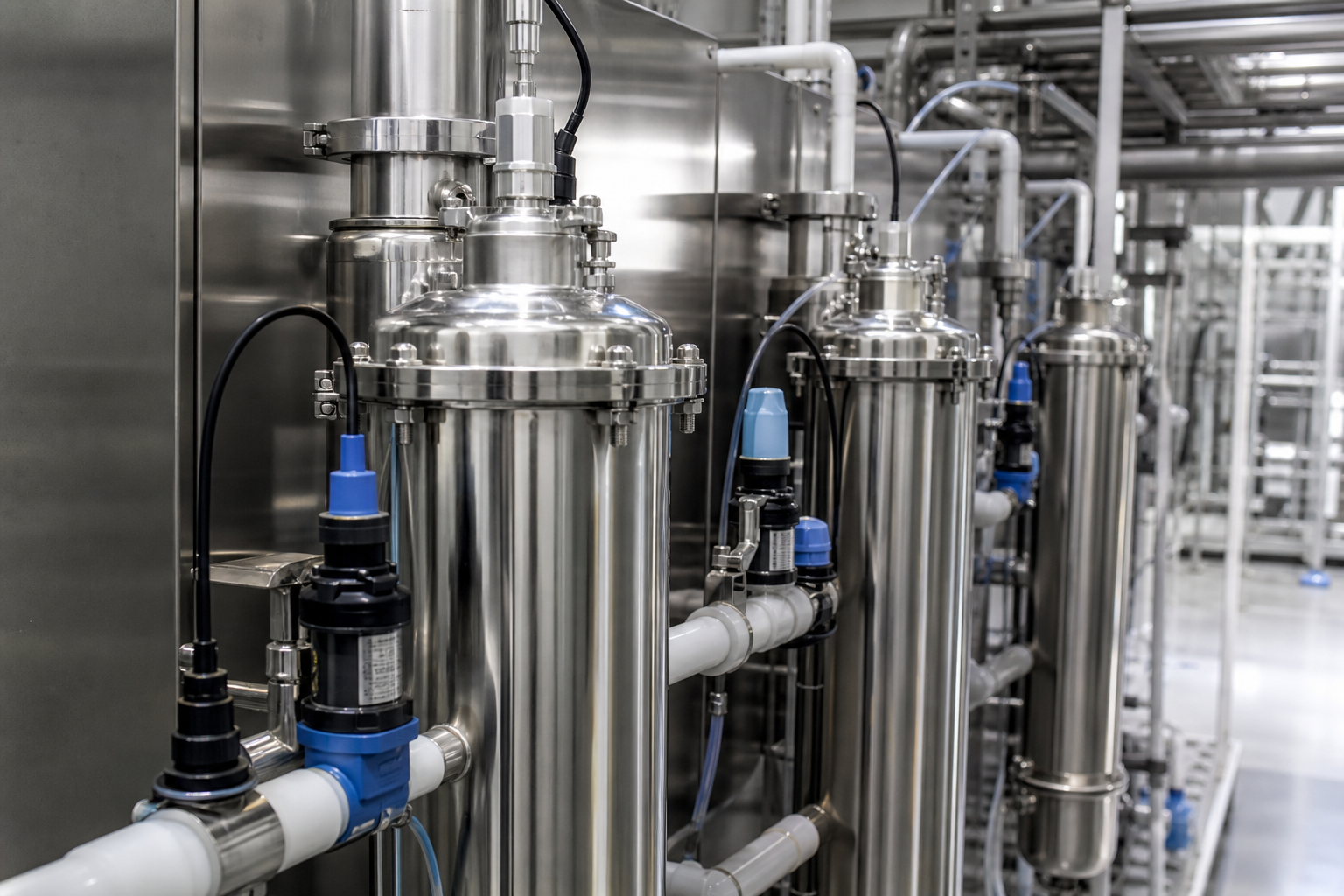
Resistivity at the skid is not resistivity at the bench.
What a fab UPW program actually controls
UPW is not “water with a high number.” It is a distributed process: particle counts, resistivity, TOC, dissolved oxygen, and sometimes boron or silica at parts-per-trillion relevance for advanced nodes. Mature fabs run resin life keyed to throughput and breakthrough curves, not calendar folklore; reclaim trains that match the chemistry they actually ingest, not brochure recovery percentages; and POU verification on the same shift as skid alarms.
Reclaim is not a green checkbox. Wet benches, CMP, and some cleans return streams with solvents, surfactants, or metals that a naive reclaim skid will pass straight back into the loop—or poison RO membranes slowly enough that the failure looks like “tool drift.” Sites that throttle reclaim to save makeup without trending silica and TOC at the blend point buy water invoices and particle excursions in the same quarter.
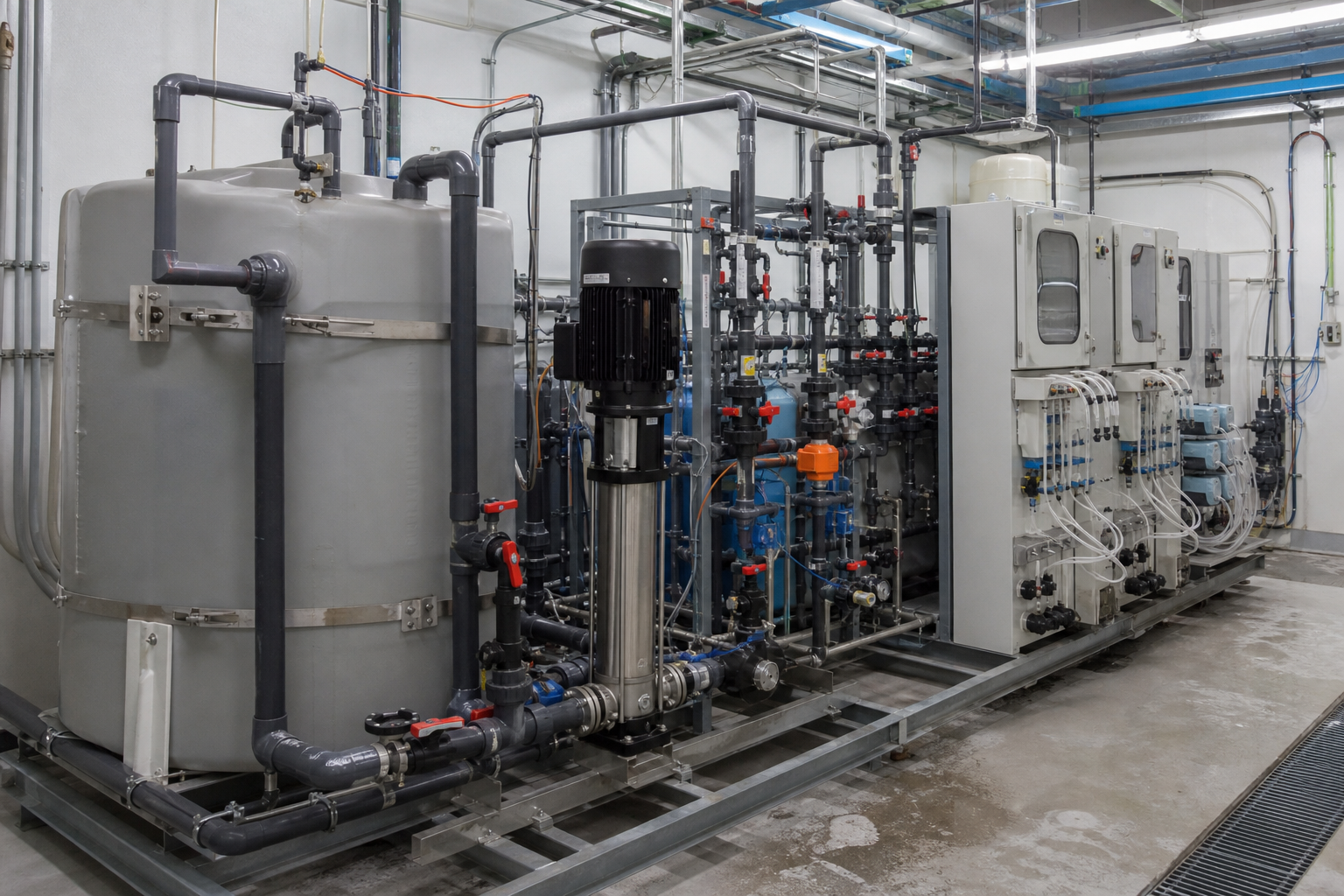
Reclaim without chemistry ownership is delayed contamination.
An anonymized Monday that should have been the prior Wednesday
A memory fab lost twenty-two hours of lithography-adjacent wet capacity after particle counts climbed across three benches simultaneously. The ticket trail showed mixed-bed vessels two weeks past exchange window, a reclaim skid running at reduced flux “until the vendor visit,” and a POU particle counter that had not been zero-checked against a reference in months. Post-mortem was not bench procedure. It was a missing rule: any polishing-train breakthrough trend blocks new high-sensitivity recipes until disposition—same shift, named owner.
Magnitudes without brochure theater
Exact resistivity targets belong to your node and your tool OEM. Ordering is portable: lost tool-hours outrank deferred resin spend; POU truth outranks skid-local green lights; reclaim chemistry discipline outranks makeup invoice savings. Sites that only monitor loop header resistivity will keep celebrating “stable UPW” while the bench quietly writes the next particle chapter.
Adjacent topics that stop here
Cooling-tower chemistry owns heat-rejection water and basin biology. On-site nitrogen owns inert atmosphere purity. AI campus water caps own hyperscale cooling demand—not fab UPW particle specs. Compressed-air programs own the air network. None of them own mixed-bed exchange windows, reclaim RO rejection, or wet-bench POU verification. Do not fund a tower biocide upgrade and expect litho rinse integrity.
Questions that replace hope
Who can defer a mixed-bed exchange past its throughput limit without recorded risk acceptance? When did you last compare skid resistivity to a portable reading at the farthest wet bench on the same hour? Is reclaim throttled for savings without a silica/TOC trend at the blend point? If the water vendor disappeared for a month, would your CMMS still know resin lot ages, bypass valve states, and which tools share which POU branch?
UPW is not glamorous infrastructure. It is the reason your “stable” wet process still becomes a capacity story on Monday. Instrument the chain, name the owner, and treat polishing trains as process equipment—because the bench already does.