

Compressed air is the most expensive utility in most manufacturing plants, and the least carefully managed. Electricity to run compressors accounts for seventy to eighty percent of compressed air lifecycle cost. Leakage typically consumes twenty to forty percent of compressed air volume in a plant that has not run a formal leak program in the past two years. Put those numbers together and leakage represents fifteen to thirty percent of total electricity spend on the compressed air system—a number large enough to fund a capital project if it were instead visible on a balance sheet.
The reason it does not appear on a balance sheet is that there is no meter between the compressor and the leak. The electricity consumption shows up in the utility bill. The lost air volume shows up nowhere. This invisibility is the fundamental problem that leak programs are designed to solve, and it is also the reason that leak programs so frequently fail to deliver sustained savings.
What ultrasonic detection actually detects
Compressed air leaks at connections, fittings, hoses, cylinder rod seals, condensate drains, pressure regulators, and lubricator seals generate turbulent flow. Turbulent flow in a pressurised system produces ultrasonic emissions—acoustic energy in the 38 to 42 kHz range—that travel through the air and can be detected by a directional ultrasonic sensor from distances of up to five metres, even in noisy factory environments, because the frequency range of the leak is above the ambient industrial noise floor.
The ultrasonic instrument does not tell the user how large the leak is. It tells the user that a leak exists at a specific location and gives a signal strength reading that is proportional to leak intensity, but with important caveats: signal strength depends on distance, orientation, surface reflection, and background noise. Two leaks at different distances producing equal signal strength on the instrument may have very different flow rates. Flow rate estimation from ultrasonic data requires either a calibrated conversion factor specific to the instrument model or a direct measurement using a pressure decay test at the isolated fitting.
The practical implication is that ultrasonic surveys identify leak locations; they do not produce a reliable total leak volume number on their own. Total system leakage is better measured using the compressor load/unload cycle method—isolating the distribution system from active users and measuring how long it takes the system pressure to decay from upper setpoint to lower setpoint across multiple cycles—or by comparing compressor run hours at constant production against a baseline established when the system was last verified leak-free.
Why surveys produce lists rather than savings
An ultrasonic survey of a medium-sized manufacturing plant—say, fifty thousand square metres with eight hundred points of use—run by a competent two-person team will typically identify between sixty and two hundred leak points in a single shift. Tabulated, photographed, and reported, those sixty to two hundred leak points represent the deliverable of the survey contractor.
The gap between that report and actual energy savings is everything that happens after the report is delivered. In a plant that has not thought through the work management process before the survey, the report is emailed to maintenance, someone enters a fraction of the items into the CMMS, the urgency competes with reactive maintenance demands, and two months later forty percent of the identified leaks have been repaired—mostly the easy ones—and nothing has been verified.
The measured reduction in compressor load at that point, if anyone measures it, is typically thirty to fifty percent of what would have been achieved if all leaks had been repaired. The remaining unrepaired leaks continue to consume energy. New leaks develop as the system continues to operate. Within six to twelve months, total leakage has returned to near the pre-survey level.
This is not a technology problem. It is a work management and accountability problem.
What an effective program looks like before the survey starts
A leak program that delivers sustained savings is designed before the ultrasonic instrument leaves the equipment room. The design addresses four questions.
First: how will repairs be work-ordered, assigned, and tracked? The survey data needs to flow directly into the CMMS as work orders, not as a spreadsheet attachment to an email. Each work order needs an assigned trade, a priority based on estimated leak size and location accessibility, and a due date. The priority scheme should ensure that the twenty percent of leaks representing eighty percent of the estimated volume are repaired within the first thirty days.
Second: how will repairs be verified? Verification means returning to the repaired location with the ultrasonic instrument—not just checking that the work order was closed. A fitting that was tightened rather than replaced may leak less than before but still exceed the threshold that warrants re-repair. Verification data goes back into the system as a pass or fail, and failures reopen the work order.
Third: how will the total system benefit be measured? The compressor load/unload cycle measurement before the survey establishes the baseline. The same measurement is repeated after sixty days of repairs and again at six months. If the six-month measurement shows regression beyond a defined threshold—say, returning to more than fifty percent of initial leakage volume—a partial re-survey of the highest-traffic areas is triggered automatically, not waiting for the next annual program cycle.
Fourth: who owns this on an ongoing basis? A compressed air leak program that is an annual event managed by a contractor has no owner during the eleven months between surveys. A program with a designated plant engineer who reviews compressor load trend data monthly and flags anomalies for investigation has an owner. The ownership decision is made before the first survey, not after.
The repair cost and part selection problem
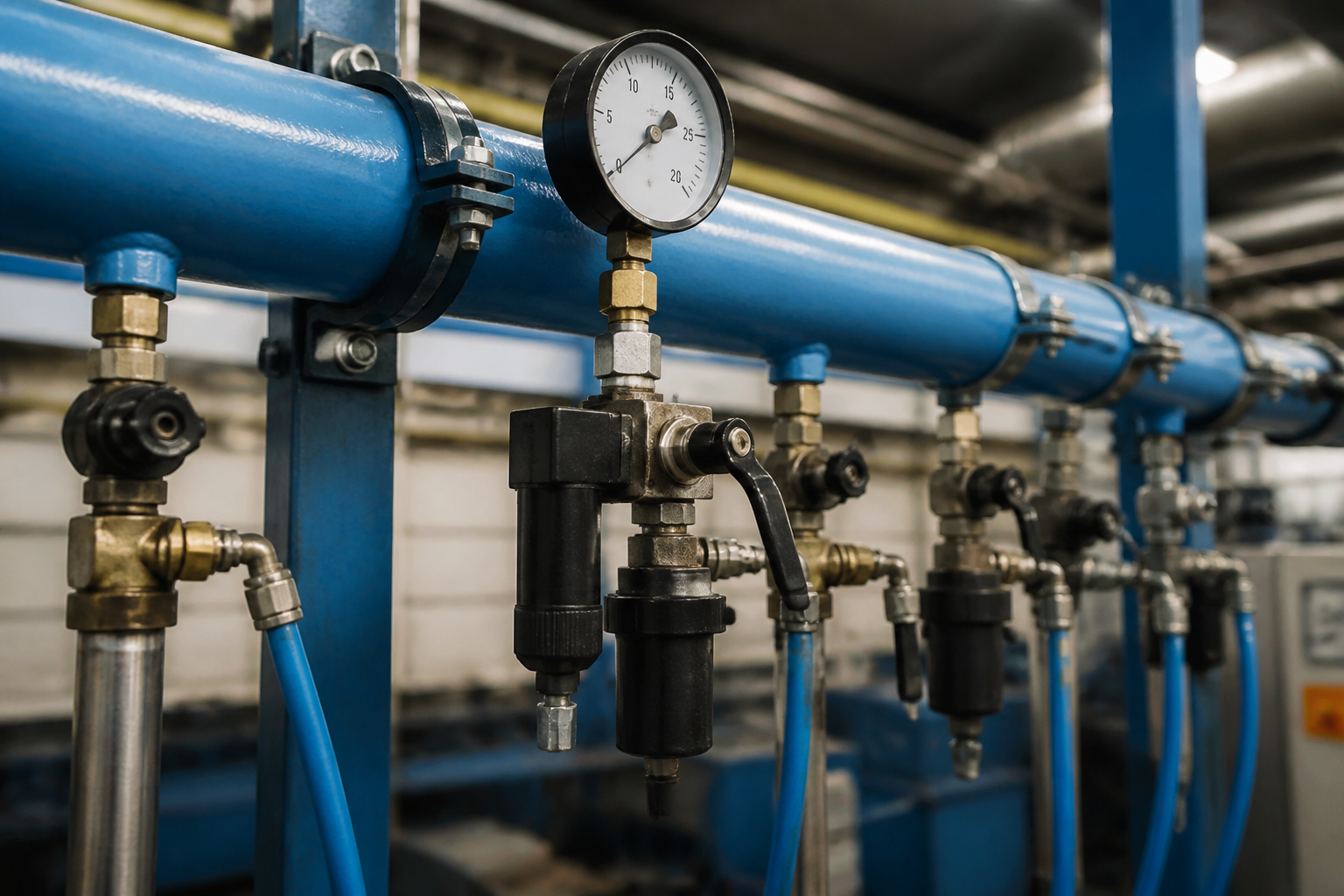
Compressed air leaks cluster around certain component types. Polyurethane push-to-connect fittings—used extensively for pneumatic tool connections, cylinder supplies, and instrumentation lines—are high-frequency leak sources because the collet grip mechanism degrades with repeated tube insertion and removal, and because the tubing itself develops surface wear that prevents a consistent seal.
The correct repair for a leaking push-to-connect fitting is usually replacement of both the fitting and the tube end, not retightening. Retightening a push-to-connect fitting that leaks because the collet is worn produces a leak that reappears within weeks. Replacement with a new fitting and a fresh tube cut costs approximately the same technician labour time and adds the cost of one fitting—typically under three dollars—against a leak that may be consuming hundreds of dollars of electricity per year.
The same logic applies to compressed air hoses with cracks or abrasion damage. Wrapping with tape or applying thread sealant to a cracked hose body is not a repair; it is a delayed failure. A hose that costs eighteen dollars replaced properly will not return to the leak list at the three-month re-survey. A hose that was taped will.
The economic case for proper rather than expedient repairs is overwhelming at any system pressure above 6 bar. It fails to materialise when the repair culture treats compressed air leak fixes as a nuisance job to be closed as quickly as possible rather than as an energy asset to be properly maintained.
Pressure system design and the leak rate relationship
Leak flow rate through an orifice is proportional to the upstream pressure. At 7 bar system pressure, a one-millimetre diameter orifice passes approximately twenty-five litres per minute of free air. At 6 bar, the same orifice passes approximately twenty-two litres per minute. Reducing system pressure by one bar reduces leak flow rate by approximately ten percent across the entire leak population—without repairing a single fitting.
This is the argument for system pressure audit as a parallel activity to the leak survey. Many compressed air systems operate at a pressure set by historical practice or by the single highest-demand tool in the plant, rather than by an engineered assessment of actual user requirements. A system set at 7.5 bar to satisfy one legacy press that has since been replaced is costing the entire plant excess compression energy for every hour of operation.
A pressure audit maps each zone of the distribution system against the actual required pressure for tools and processes in that zone. Where zone pressure can be reduced, local regulators can be set lower. Where specific high-pressure users can be identified and isolated, a separate high-pressure drop can serve them while the main system operates at lower pressure. The energy savings from a one-bar reduction in system pressure are of the same order as a fifty-percent reduction in leak volume—and the pressure reduction is achieved once, with no maintenance degradation risk.
The condensate drain: the most consistent source of waste
Automatic condensate drains are among the most frequently malfunctioning components in a compressed air system. Float-operated drains fail open, venting compressed air continuously. Electronic timer drains with incorrect cycle settings dump condensate with air attached—wasting compressed air on every drain cycle—or fail to drain at all, allowing condensate to carry forward into the distribution system.
A compressed air leak survey that does not include condensate drain verification is incomplete. Drain losses are often individually larger than single fitting leaks, and a failed-open float drain on a large refrigerant dryer can represent a system leak of fifty to one hundred litres per minute—equivalent to the twenty smallest fitting leaks on the survey list combined.
Proper drain verification requires observing each drain through at least one complete drain cycle with the system under normal production pressure. A zero-loss electronic drain that is functioning correctly fires briefly and closes cleanly; a malfunctioning drain either blows continuously, fails to fire at all, or fires with a blast that visibly discharges more air than condensate. The observation takes three minutes per drain. In a plant with thirty condensate drains, it takes ninety minutes. The energy savings from finding and fixing two failed-open drains typically exceed the savings from repairing twenty fitting leaks.
Where the savings are measured and where they should be reported
The final barrier to compressed air leak programs becoming permanent plant management practice is visibility. Electricity savings from leak repair do not show up as a line item anywhere in the standard management reporting structure. They show up as a reduction in total electricity cost, which is usually attributed to production volume, weather-driven HVAC load, or energy market price changes rather than to specific maintenance activities.
The solution is compressor load factor as a standing KPI—the ratio of compressor output at current production volume to rated compressor capacity, tracked monthly and reported alongside production efficiency metrics. When leak repair reduces compressor load factor from sixty-two percent to forty-eight percent, that number is visible and attributable. When load factor drifts back to fifty-five percent six months later, the regression is visible and triggers investigation rather than being absorbed into the noise of the utility bill.
Compressed air leak programs are not a project. They are a maintenance discipline. The plants that treat them as a discipline—with ownership, measurement, and reporting—sustain the savings. The plants that treat them as a project—with a survey, a report, and a contractor invoice—restart from near the beginning every two years.