

A lithium cell line can look world-class on a walkthrough and still lose weeks to moisture. The failure rarely announces itself as a broken dehumidifier icon. It shows up as electrolyte fill holds, electrode scrap that “should have been fine,” and a dew-point trend that only becomes urgent after quality already moved.
Formation and aging halls are capacity plants inside the factory. Dry rooms are something else: atmosphere as process parameter. If absolute humidity drifts, chemistry does not wait for facilities to finish a meeting.
This brief is a moisture-budget map for battery dry rooms—how zones, people, and machines load water into air that must stay far drier than any ordinary cleanroom story implies.
What “dry” has to mean in numbers
Relative humidity percentages mislead operators who grew up on office HVAC. At battery-relevant dew points, the useful language is dew point (°C) and grams of water per kilogram of dry air. Typical industrial practice still clusters assembly zones around roughly −35 °C to −45 °C dew point, while electrolyte fill and the most moisture-sensitive chemistries push toward −60 °C and, in solid-state or next-gen fill cells, still lower.
Those are not comfort setpoints. They are process windows. A room that “feels dry” can still be wet for the film you just electrode-calendered.

If the only moisture meter is the operator’s throat, you do not have process control.
Zones beat one giant desert
Treating the entire footprint as one ultra-dry volume is expensive and fragile. Mature layouts segment:
| Zone intent | Typical dew-point band (indicative) | Why it exists | | --- | --- | --- | | Electrolyte fill / critical seal | Coldest band on site | Smallest moisture budget before chemistry damage | | Cell assembly / stacking | Tight but warmer than fill | Labor and robot traffic without oversizing every cubic meter | | Airlocks / gowning buffers | Controlled transition | Stop outdoor air and breath from dumping into fill | | Mechanical / DHU gallery | Not a process zone | Protects the machines that make dryness real |
Segmentation is not interior design. It is CapEx discipline: the coldest dew point should occupy the smallest justified volume, served by desiccant capacity sized to the moisture load of that volume—not to a marketing slide that says “whole plant −70 °C.”
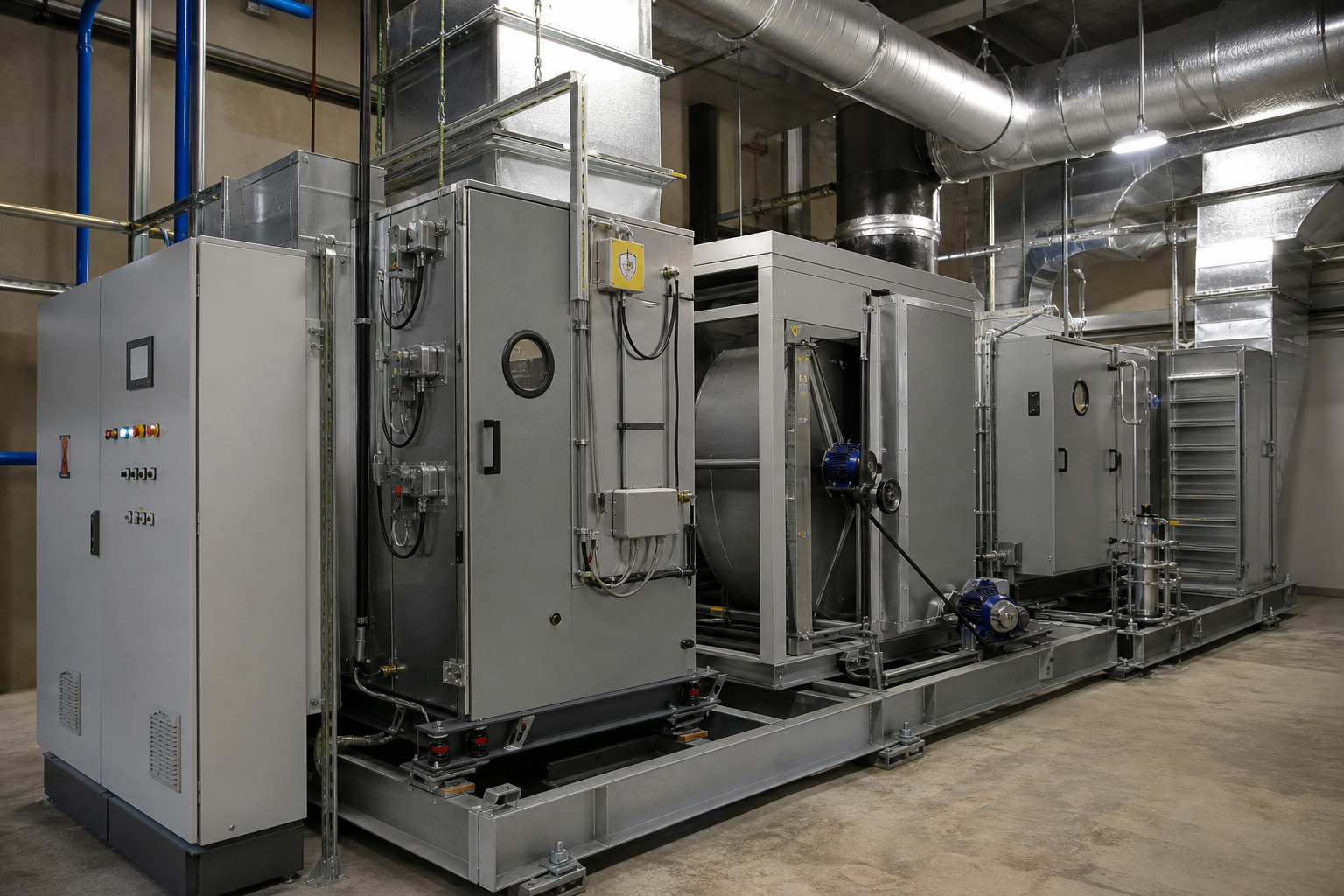
The DHU gallery is part of the process. Starving it of space is a yield decision wearing facilities clothes.
Moisture loads nobody puts on the P&ID
Engineering packages often model infiltration and make-up air. They under-model what actually moves dew point on a Tuesday:
- Door cycles — Every airlock open is a water pulse. Shift change is a process disturbance.
- People — Breath and skin load are real; mask discipline exists because operators are moisture sources, not only contamination sources.
- Material moves — Pallets, totes, and coils carry adsorbed water into the envelope.
- Robots and cable carriers — Motion plastics and dress packs chosen for ordinary halls can shed dust or fail mechanically in ultra-low humidity; dryness is also a materials compatibility problem.
- Maintenance entries — A “quick wrench” with the wrong procedure is a dew-point incident with a work-order number.
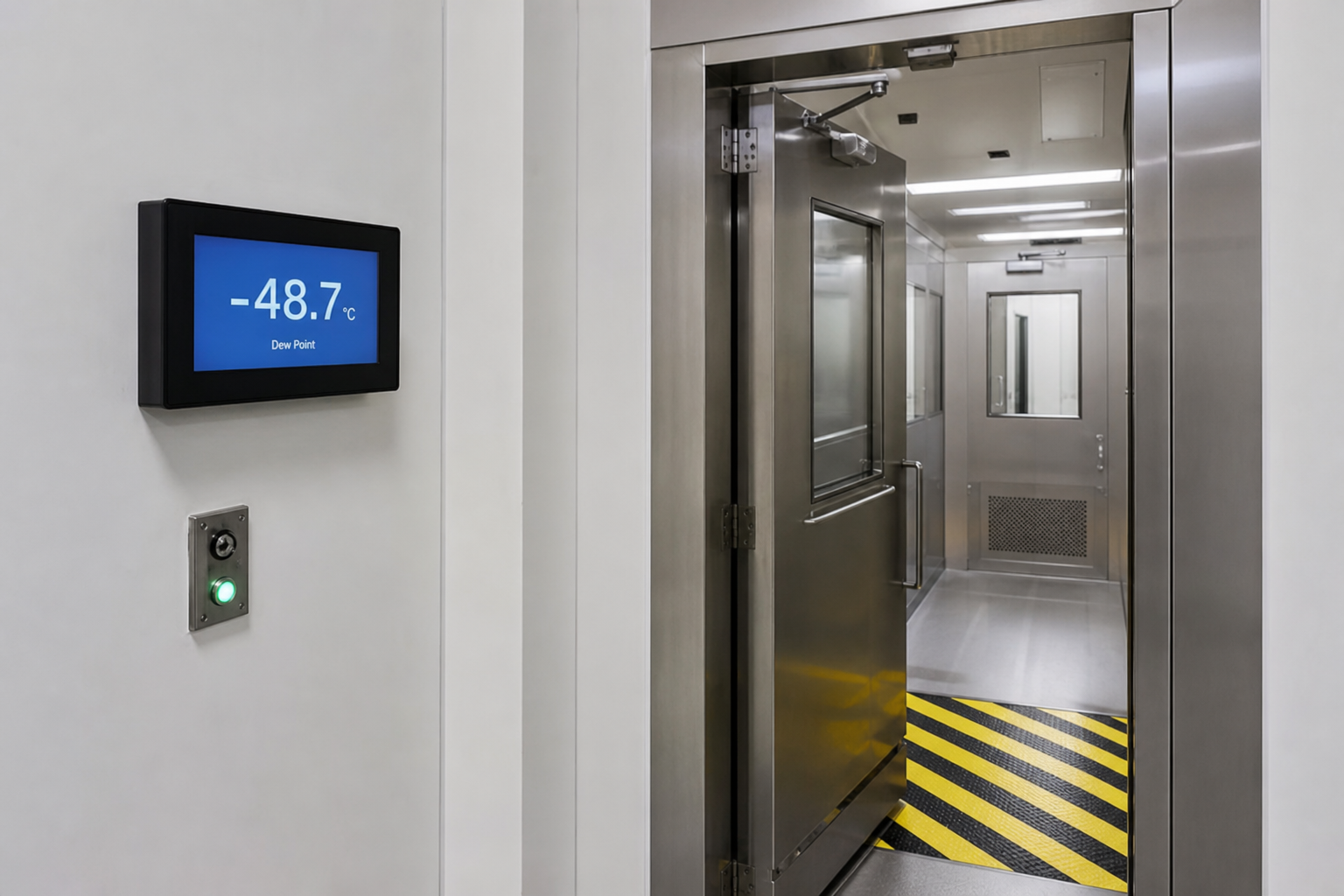
Traffic control for moisture is as real as traffic control for AMRs.
Instrumentation that keeps honesty
A single wall sensor above the supervisor desk is not a moisture budget. Useful plants:
- Place sensors where process air actually is—near fill, near electrode exposure—not only in return ducts that average away truth.
- Trend dew point with door-open counters and DHU status on the same shift review page.
- Alarm on rate-of-rise as well as absolute threshold; a slow climb during a busy airlock hour is the warning, not the scrap report two days later.
- Treat sensor calibration and sampling location under change control. A mis-mounted probe invents a false “green” room.
An anonymized week that should have been a design review
A mid-scale pouch line held fill dew point through quiet weekends and lost it every Monday morning. The DHU was healthy. The airlock traffic after weekend shutdowns was not sized into the moisture model. Operations blamed “weekend purge.” Engineering found door-cycle counts and material staging outside the lock that had never been in the load calculation. The fix was not a bigger slogan about dryness. It was staging rules, lock timing, and a fill-zone volume that stopped sharing air with a high-traffic assembly bay.
Adjacent fences
Formation/aging briefs own cycler halls and thermal soaks. Industrial BESS diaries own storage dispatch. Plant CDA dew-point stories own pneumatic tool air. Compressed-air leak programs own utility waste. This page owns dry-room moisture as battery process control. Do not fund another formation lane and discover the fill room cannot hold dew point at takt.