
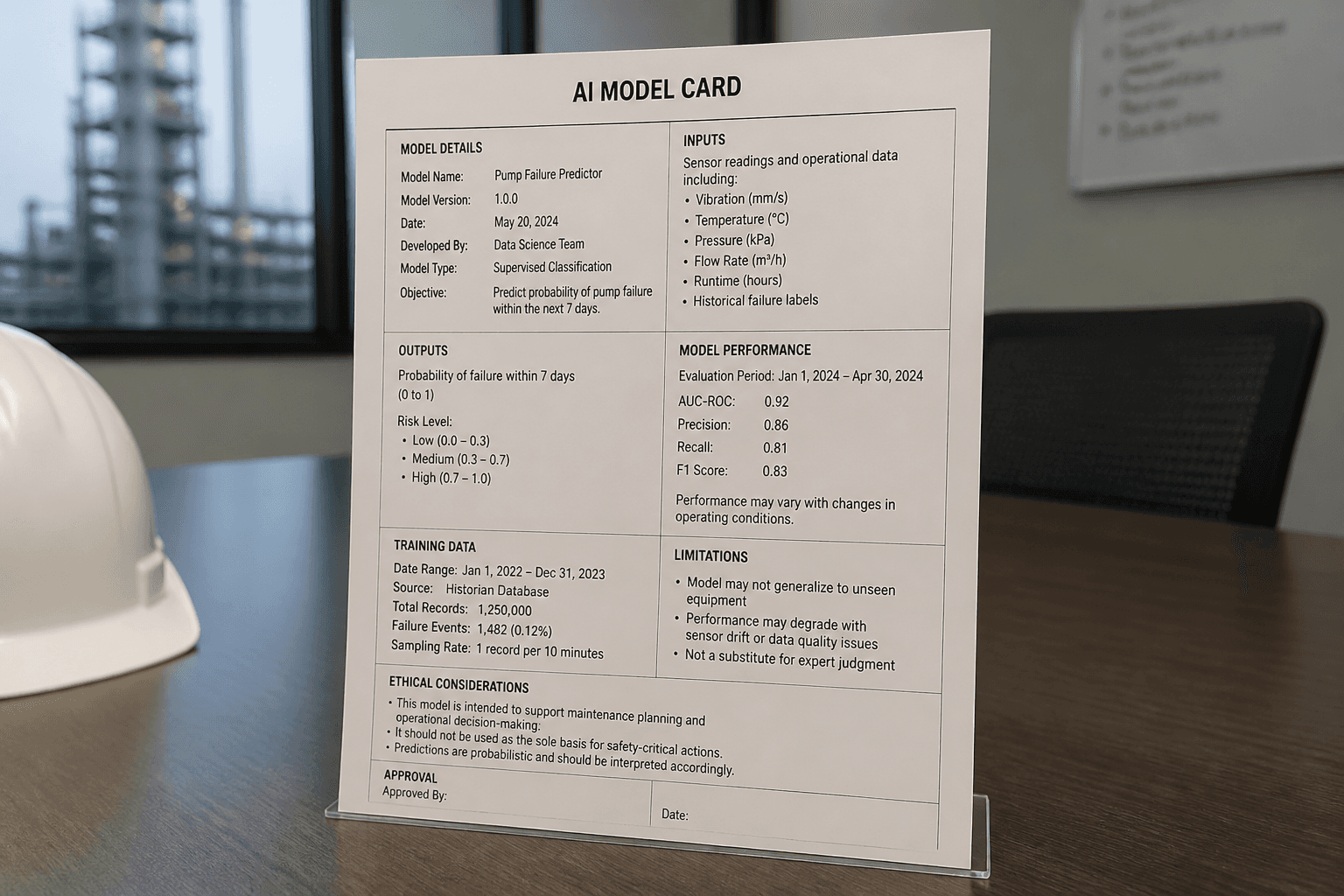
MODEL CARD — CV-17 Soft Sensor (Composition proxy)
Status: Closed-loop use REJECTED
Site: continuous unit(익명)
Review board: process · reliability · data · OT security
This page is the card. Pitch deck 아님.
1. Intended use (claimed)
Lab sample 사이 composition CV-17 infer로 setpoint trim.
Human-on-the-loop promised. Code path writes 허용.
2. Training data
| Field | Claim | Audit | | --- | --- | --- | | Window | 18 months | Bad analyzer 6 weeks 포함 | | Labels | Lab GC | Lab lag 14–36 h; loosely backfilled | | Sampling | 1 min | Historian compression present (H-19 lessons 참조) | | Leakage | None claimed | Setpoint in feature list — leakage |
Reject reason R1: controller setpoint feature 경유 target leakage.
3. Metrics (offline)
R² excellent looked. Model이 setpoint smell하면 always.
Setpoint feature 없는 holdout: collapse.
Reject reason R2: vanity metrics.

High R² with leakage는 confession, credential 아님.
4. Operating envelope
Grade change, startup, analyzer cal에 stated 없음.
Reject reason R3: envelope 없음 → plant gate 없음.
5. Monitoring & fallback
Lab 대비 residual monitor 없음. Lab disagreement 시 automatic disable 없음.
Reject reason R4: unmonitored soft sensor는 silent operator.
6. Authority
Proposed: model PID ±2% nudge.
Safety review: ±2% continuous intent 넘어 walk 가능 (write-path F-01 pattern 참조).
Reject reason R5: gated clamp + ack 없는 write authority.
7. Allowed residual use (conditional)
Advisory trend only, watermarked, no OPC write, 다음 후:
- Setpoint features에서 removed
- Compression-aware training export
- Envelope + lab residual monitor
- New card review
Until then: REJECTED.
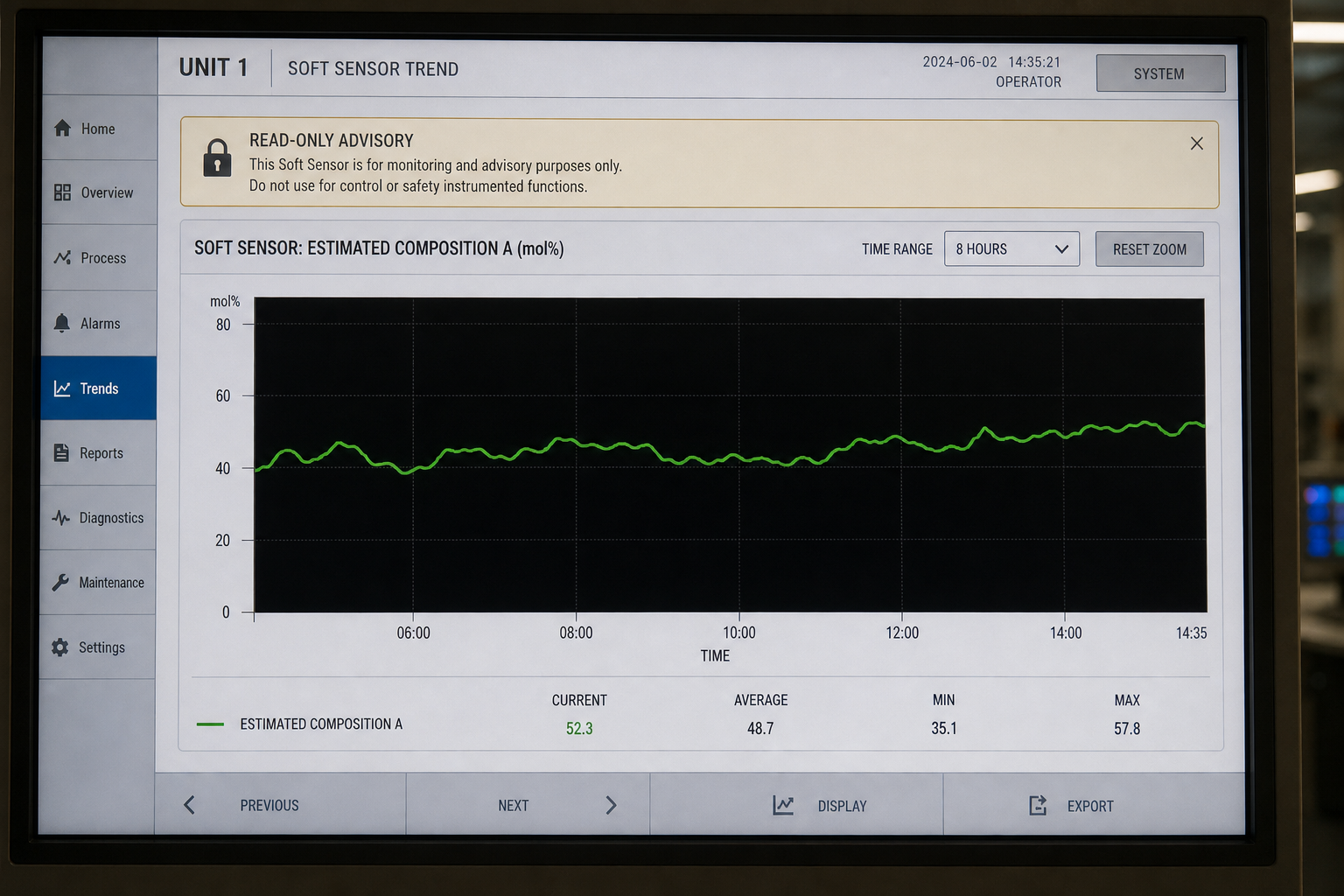
Read-only는 status. Closed-loop는 privilege.
Adjacent fences
Unsupervised drift는 unlabeled hypothesis. Semantic catalog는 meaning. Write-path red-team은 dangerous actuation class. Soft-sensor closed-loop essay는 successful pattern—this card는 gate clear failure 소유. Leaked R² promote 금지.
Sign-off
Process ____ Data ____ OT ____ Reliability ____
Future resubmission four required. Verbal “it looks good” signature 아님.