
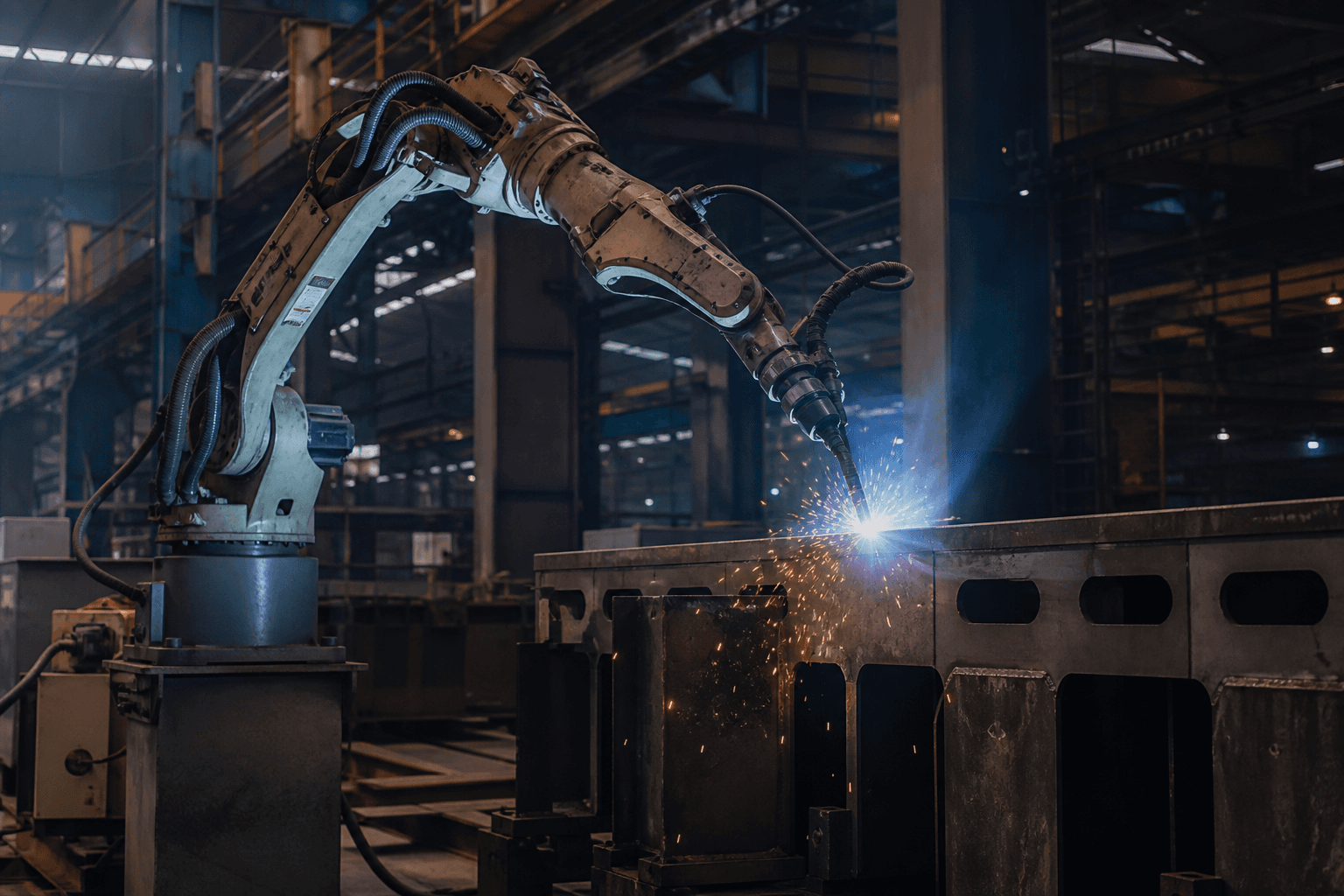
Heavy welding cells fail rarely in a way that fills a neat labeled dataset. Controllers log hours of healthy arcs; the expensive stops arrive as cable wear, torch collision geometry, wire feed slip, or a power-source drift that nobody photographed as “class: fault.” Teams that wait for balanced failure libraries wait forever.
Recent shipyard and heavy-fab deployments are therefore training anomaly detectors on normal operation only—current, voltage, wire speed, gas flow, joint tracking residuals—then scoring live robots against that baseline. The industrial question is not whether the math can light up a dashboard. It is whether the score becomes a stop authority without inventing a second alarm flood.
What normal-only learning is allowed to claim
Allowed:
- This robot’s sensor envelope left the reference band learned from healthy shifts.
- A residual between commanded and measured weld parameters thickened for N cycles.
- Two robots on the same joint recipe diverged while the WPS stayed fixed.
Not allowed:
- “Replace the torch now” without a work order path.
- “Weld quality is scrap” without NDT or visual disposition.
- Write-back to the robot program from the model without MoC.
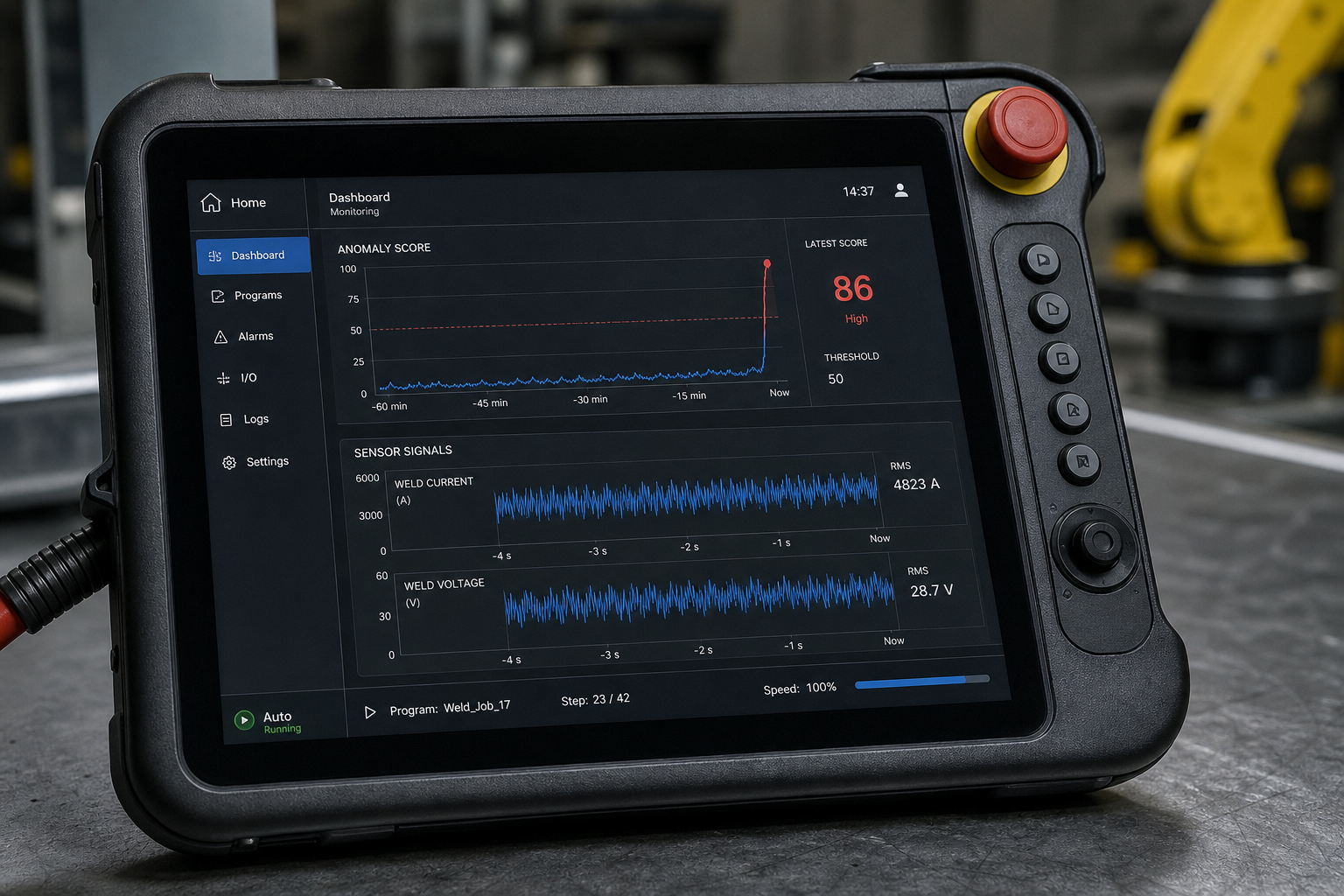
A score is a hypothesis. Disposition still belongs to welding engineering and the shift lead.
Why shipyard welding is a hard but honest proving ground
Hull and block welding stacks rework cost into entire zones. A slow torch degradation that looks like “still welding” can seed meters of repair. Normal-only models fit that economics: failures are sparse, instrumentation already exists, and the cost of a late detection dwarfs the cost of a reviewed false positive—if review is real.
An anonymized twelve-robot bay that went live on normal baselines found its first useful catches were not dramatic crashes. They were feed motor current shapes and gas-flow residuals that operators had learned to ignore until porosity showed up downstream. The model did not invent those signals; it made them harder to normalize away.
Governance that keeps the model plant-grade
- Freeze a reference window per robot, per WPS family—not one global “healthy” blob.
- Route every high score to a named adjudicator with a close-out code (confirm / dismiss / retune).
- Ban mute culture: repeated dismissals without cause code become an engineering ticket, not silence.
- Keep the model off the write path until shadow weeks publish precision that operations trusts.
Unsupervised process-drift briefs own continuous process tags. Vision label audits own annotated images. Soft-sensor model cards own inferential quality gates. This page owns rare welding-robot faults without a failure library. Do not treat a glowing anomaly score as a completed repair.