Amit Gupta, chief AI strategy officer and general manager of Siemens EDA, described Fuse EDA AI Agent as a move from in-tool AI features to autonomous, end-to-end workflow orchestration. The announcement landed 16 March 2026 from Plano, timed with NVIDIA GTC in San Jose. That framing is the useful start: Siemens is selling an agent layer that plans and runs multi-tool jobs across semiconductor, 3D IC, and PCB flows—not a new place-and-route engine that replaces Aprisa, and not a claim that sign-off now belongs to a chatbot.
Fuse EDA AI Agent sits on top of the existing Fuse EDA AI system. That base layer already carried a retrieval-augmented generation pipeline, a multimodal EDA data lake, specialized parsers for EDA file formats, customizable access controls, multi-model support, and an open path for third-party integrations. The agent adds Model Context Protocol (MCP) tool discovery, Agent Skills playbooks, hierarchical planning with a supervisor and worker agents, and recovery loops when a step fails. Siemens’ security language is explicit: role-based access, audit trails, human checkpoints, and air-gapped compute options. Those controls exist because a generic cloud agent pointed at a design database is an IP risk; Siemens is answering that objection in the same release that sells productivity.
The tool map is long and concrete. Front-end: architectural exploration, design planning, and RTL work with Catapult; digital verification with the Questa One Agentic Toolkit for testbench generation and debug. Physical: place-and-route, timing closure, and power work through Aprisa; custom design with Solido; hardware-assisted verification with Veloce; DRC violation analysis through Calibre. 3D IC work goes through Innovator3D IC for power/ground load optimization and signal-path plan clustering. PCB side: Xpedition and Hyperlynx for layout and signal integrity. Manufacturing readiness: Tessent for DFT and Calibre OPC products. That list is the operational content of the announcement. It is also the limit: Fuse orchestrates these licensed tools; it does not retire the licenses or the people responsible for DRC, LVS, and timing closure checklists.
NVIDIA’s piece of the bill of materials is Agent Toolkit, Nemotron models, and NVIDIA AI infrastructure for tool calling and reasoning. Kari Briski, NVIDIA’s vice president of generative AI, said the joint aim is long-running agents that can safely operate engineering tools. Siemens notes that NVIDIA uses Siemens’ Fuse EDA solution in its own chip development—a named customer reference for the broader Fuse stack, not a published wall-clock delta for the new Agent SKU. Jung Yun Choi of Samsung Memory Design Technology called Fuse a key enabler inside Samsung’s agentic semiconductor workflows; again, endorsement language, not a measured tape-out study in the press note.
Vendor claims about dramatically shorter design cycles and higher-quality designs stay labeled as vendor claims. Generic agent platforms, Siemens argues, saturate on dense physics-based EDA data and can hallucinate; Fuse answers with domain guardrails and validation. That is a product thesis. Field proof is still the open item: named teams publishing before/after cycle times under controlled baselines.
The architecture detail that matters for IT and security reviewers is the MCP and AgentOps layer. Siemens describes dynamic tool discovery across MCP-connected EDA tools, hierarchical planning, and autonomous recovery when a step fails. Agent Skills are framed as executable playbooks that designers can customize for multi-step tasks. Resource allocation is said to ride existing scheduling frameworks and HPC clusters rather than inventing a parallel compute island. Centralized data handling is pitched for air-gapped environments—the usual constraint in semiconductor design houses that will not send netlists to a public model endpoint. Looking ahead, Siemens says it plans to deepen Fuse with NVIDIA’s enterprise agentic stack, including NemoClaw and the OpenShell runtime inside Agent Toolkit for safer always-on assistants. That roadmap sentence is a product plan, not a shipping feature list for March 2026.
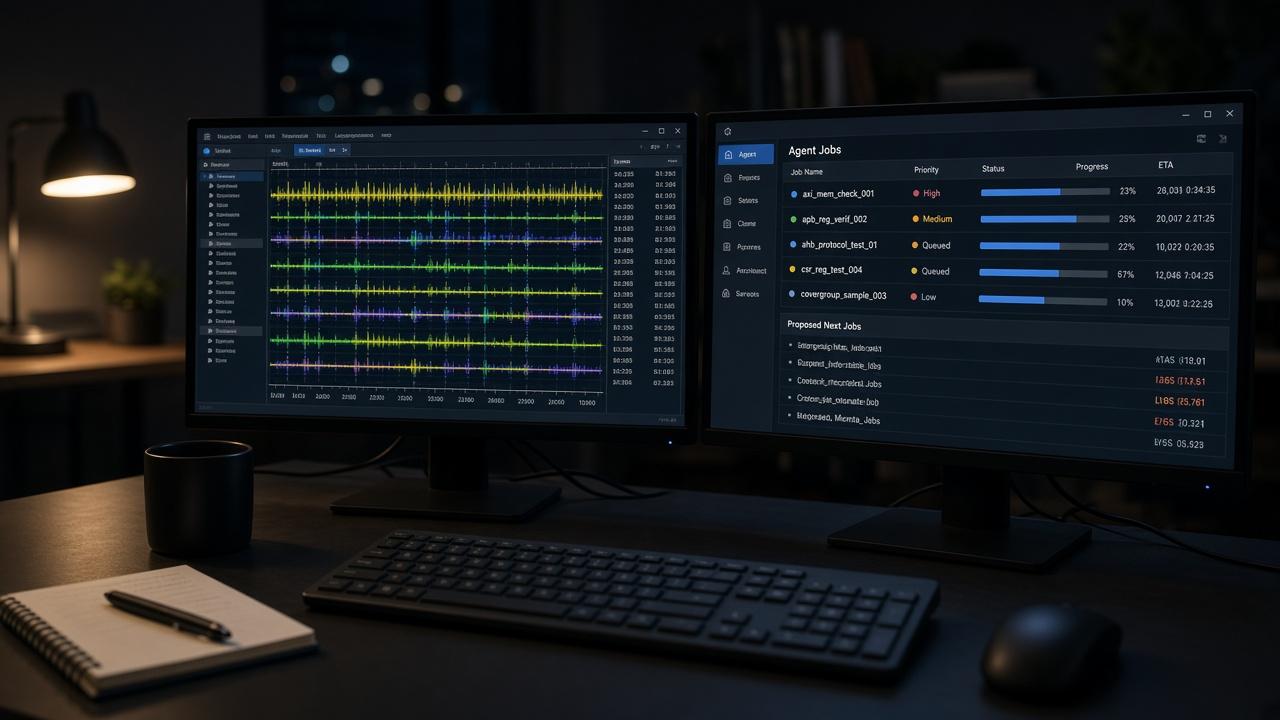
Deployment assumptions are ordinary and easy to miss. Fuse needs the same project databases, license seats, and HPC schedulers the human team already uses. If those queues are saturated, an agent that submits jobs faster only moves the bottleneck. An agent that can launch Calibre or Aprisa across a design database is a privileged actor; the RBAC and human-checkpoint language in the release is there for a reason, and site security teams should treat it as a checklist item rather than brochure wallpaper.
For plant and operations readers who do not live in EDA, the cut is simple: this is a software/orchestration story in the AI column—chip design as industrial software with multi-million-dollar schedule risk—not a robot cell, not a fab tool, not a power-plant controller. Watch next whether Fuse Agent appears in published customer references with measured cycle-time deltas, or whether it remains a GTC architecture slide with a long tool map. Until then, treat it as a named domain-scoped agent over Siemens’ EDA portfolio with NVIDIA Agent Toolkit and Nemotron in the published stack—and keep manufacturing sign-off where the Calibre and Tessent licenses already put it.