
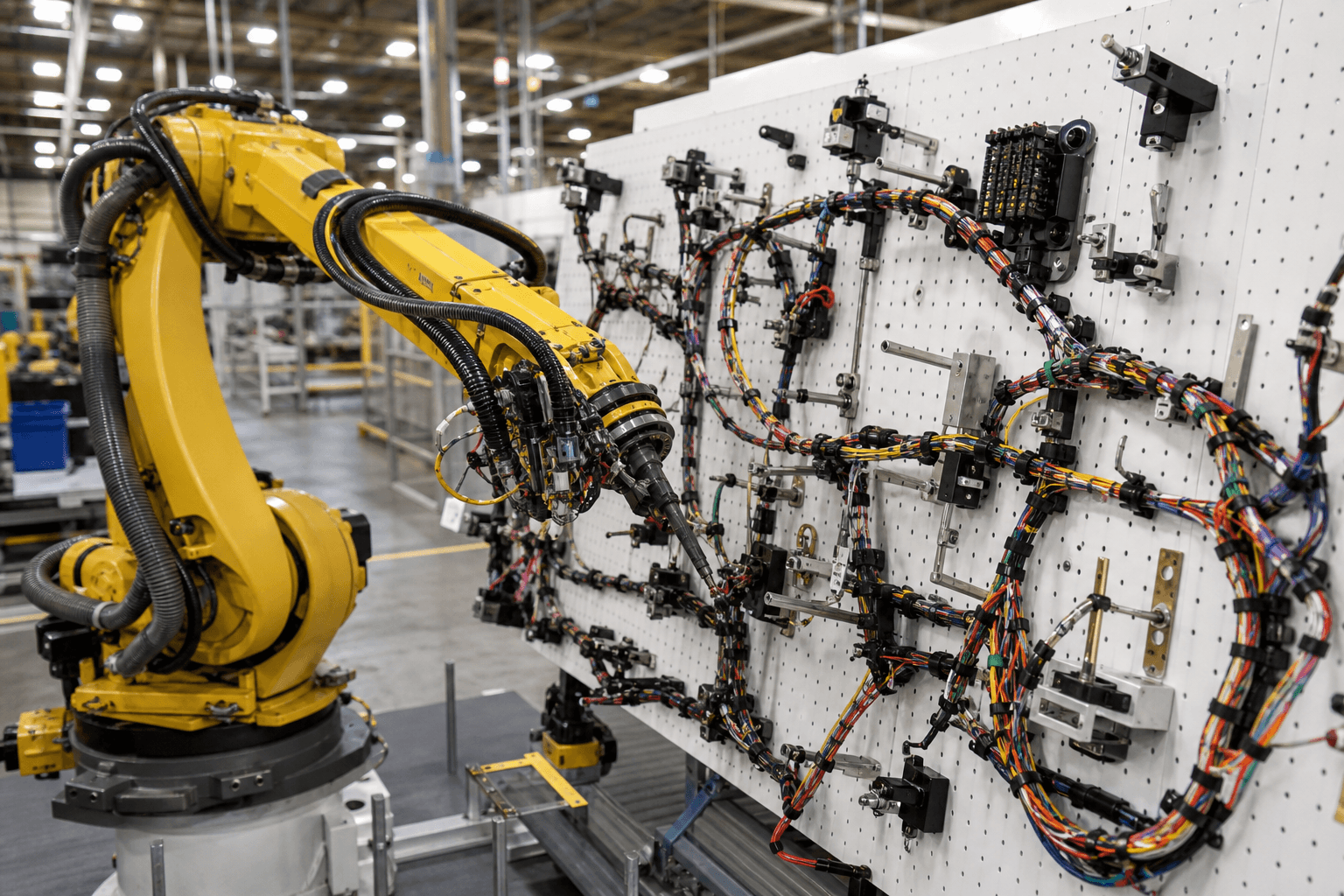
Screwdriving cells own torque and angle. Adhesive cells own bead path and volume. Bin picking owns singulation from chaos. What still dominates automotive, appliance, and industrial cabinet labor hours is wire harness build: routing on a formboard, inserting connectors without crushed pins, and proving continuity before the harness leaves the rack.
Robotic harness cells—arm plus vision plus compliant insertion plus sometimes specialized finger tooling—are leaving prototype labs for lines where harness variants explode and skilled hand builders are the bottleneck. The cell’s product is not a pretty demo weave. It is a harness that passes electrical test with traceable insertion and routing records.
The industrial point is variant control. A robot that builds one golden harness while engineering releases twelve weekly ECO wire changes is an expensive sculpture.
Why harnesses resist “just add a robot”
Harnesses combine flexible media, tight connector tolerances, and dense variant matrices. Insertion force windows are often discussed in tens of newtons with angle and seating confirmation; a hard push that seats a connector can also bend pins that only fail in the vehicle. Routing must hit pegs and clips in order; a missed clip becomes a rattle or an abrasion warranty months later.
Cycle-time studies on manual boards frequently show that connector insertion and sub-assembly joining, not the long wire runs, dominate touch time. That is why serious cells instrument force-torque and vision for the connector family library first, then expand routing coverage.
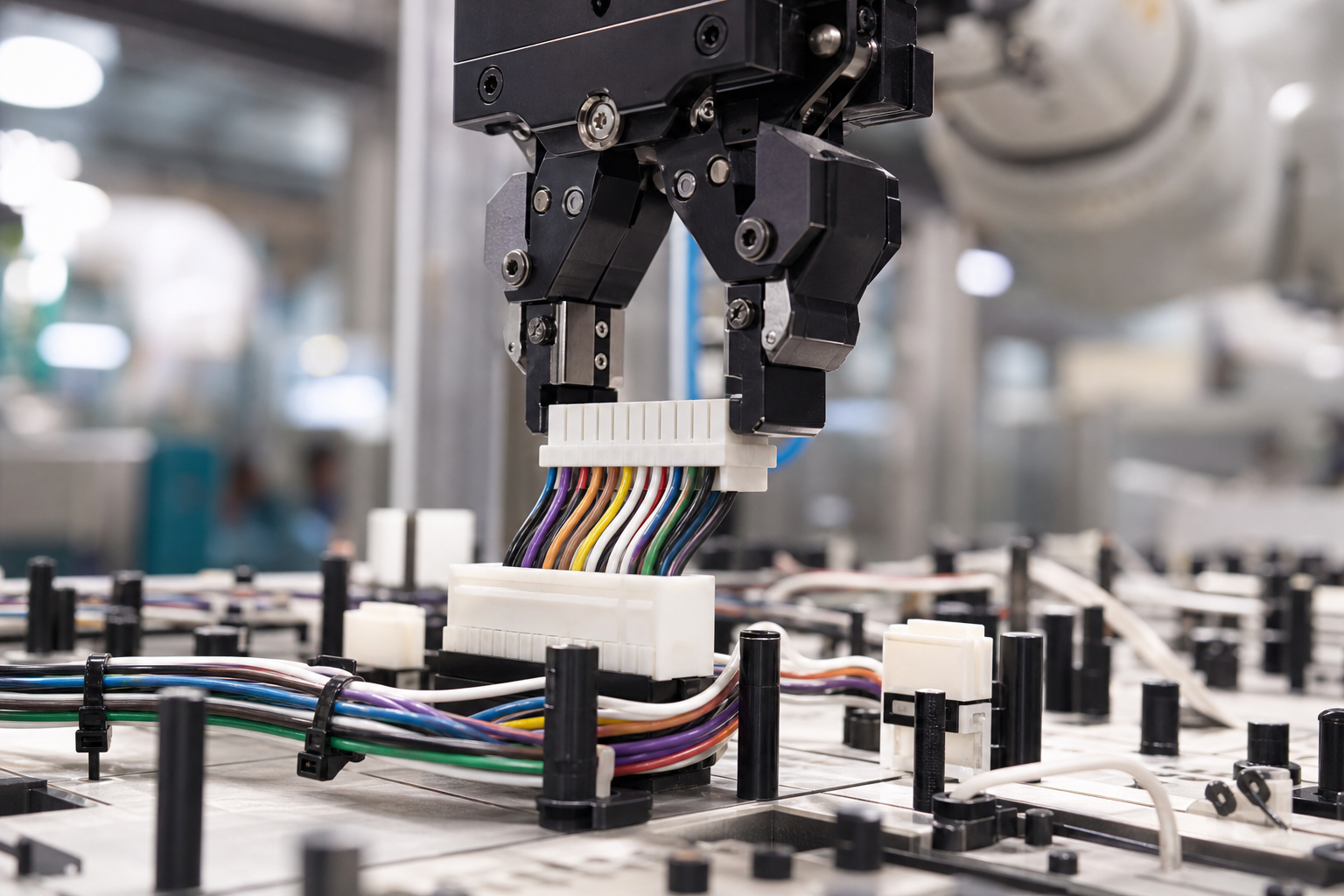
Seating force and pin protection matter more than how fast the arm looks on a trade-show loop.
An anonymized Tier-1 harness plant moved a family of ~40 mid-complexity automotive harnesses onto two robotic formboard cells after a six-month connector library campaign. First-pass electrical yield rose by roughly 2–3 points versus the manual board average, mainly from fewer partial insertions—not from faster wire laying. Labor did not vanish; it moved to changeover, exception handling, and test.
What the cell actually controls
- Connector library — Vision models, insertion poses, force windows, and seating criteria per housing family.
- Routing program — Peg order, clip engage, and length control tied to the BOM revision.
- Traceability — Which program revision built which harness serial before EOL test.
- Test handshake — Continuity/hipot fixtures that reject before packaging, with failure codes that point back to a station—not “rework somewhere.”
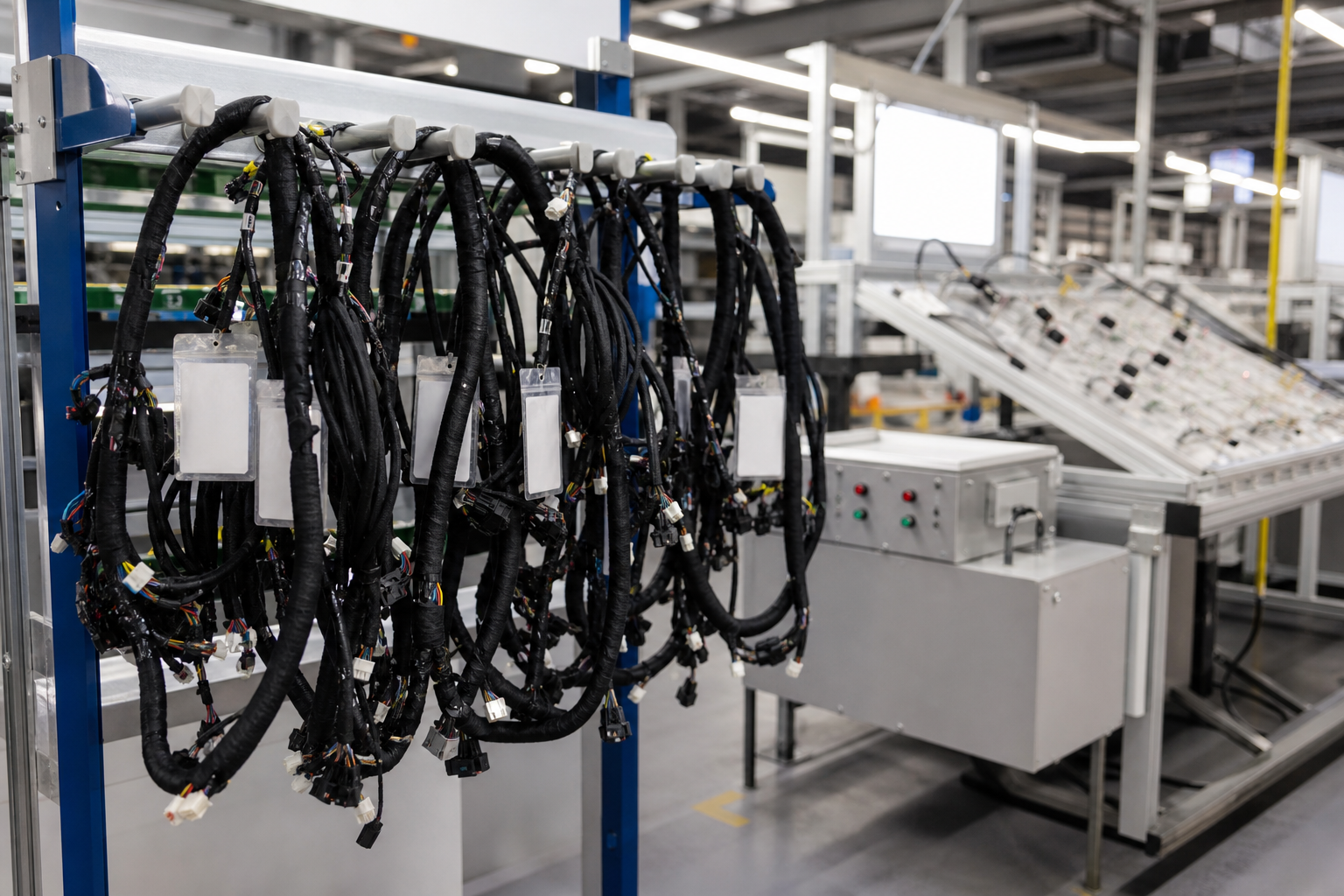
If the cell cannot speak to electrical test, you automated craft—not quality.
Situation: the demo harness versus the weekly ECO
A robot integrator ran a flawless demo on a frozen harness drawing. Three months after SOP, engineering had released enough wire-color and connector revisions that teach time exceeded run time. The recovery path was manufacturing engineering ownership of a digital harness variant package: board photo fiducials, connector library IDs, and ECO effective-dating in the same system that released the BOM. The robot became usable when the data model matured—not when the arm got faster.
What this is not
This is not bin picking of random parts, not screwdriving torque control alone, not adhesive dispensing, not ultrasonic NDT, and not AFP composites. Those cells do not own flexible wire routing and multi-pin seating libraries. Do not buy a bin-picking cell and expect harness competence.
Numbers worth putting on the buyer slide
| Signal | Practical ranges teams use | | --- | --- | | Connector families before ROI | Often dozens must be taught, not three demos | | Insertion process window | Force + angle + vision seat confirm | | Yield lever | Partial inserts and crossed wires, not showpiece speed | | Changeover reality | Variant package quality dominates arm brand |
If a vendor leads with cycle time and cannot show connector-library coverage against your BOM, you are buying a video.
Failures that still look like automation progress
Teaching one harness and declaring the cell done. Ignoring strain relief and clip engage. Separating electrical test from the cell’s reject logic. Letting ECOs land as paper while the robot runs yesterday’s program.
Buyer checklist
- Library coverage — What percent of your connector housings have qualified insertion recipes today?
- Variant package — How does an ECO freeze update the robot program with audit trail?
- Force + vision evidence — Sample traces from real partial-insert catches.
- EOL test link — Serial-level pass/fail tied to cell station data.
- People plan — Who owns teach, who owns quality releases, who owns exceptions on shift?
Harness quality is proven at the test fixture and in the vehicle. Robots help when they make insertion and routing repeatable under the same revision control you already owe your customer—not when they only look busy on a formboard.