
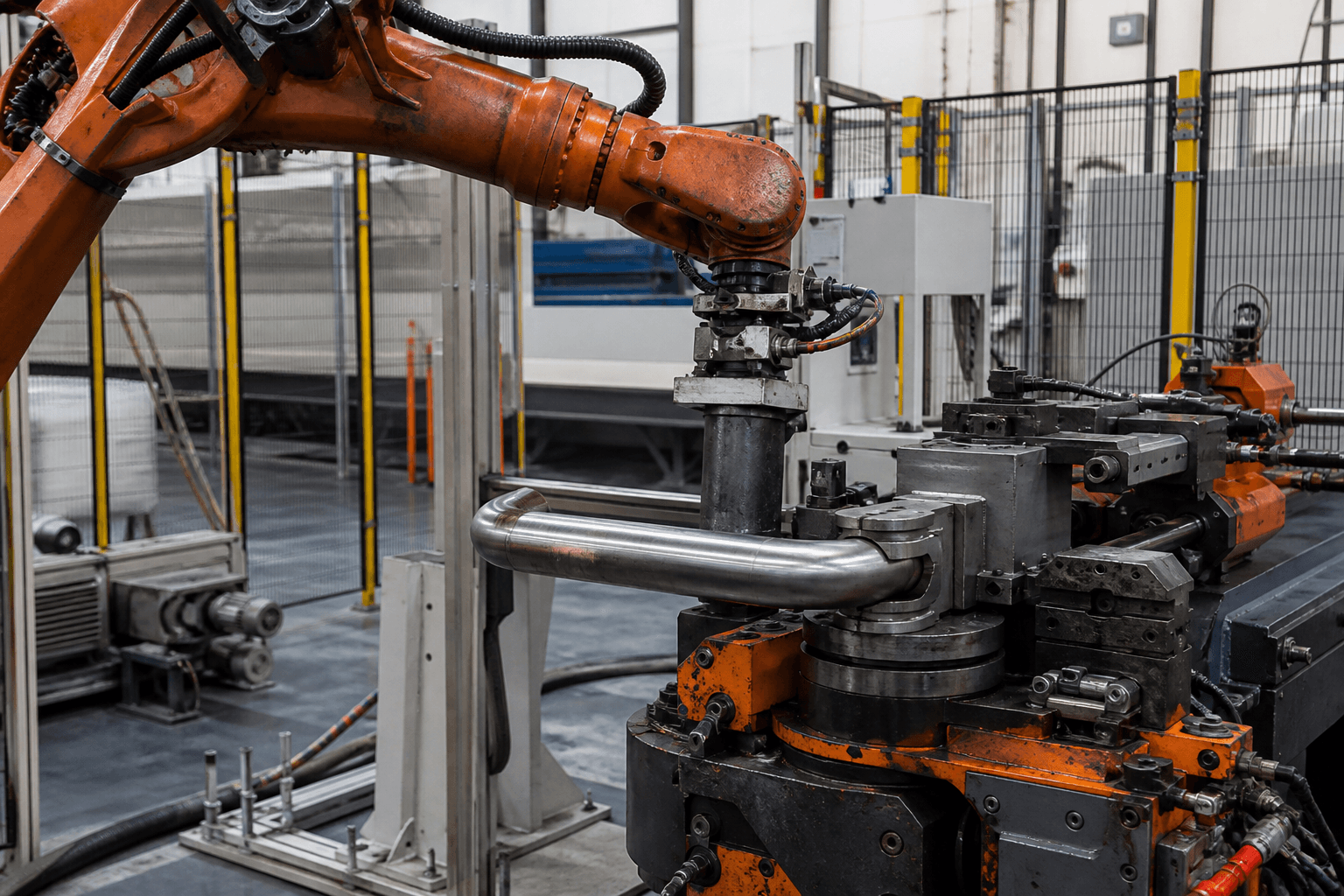
Tube bending looks simple from the aisle: a bender, a robot presenting sticks, a bin of finished bends. The scrap tells a different story—wrinkles on the intrados, flatten ovality beyond seal specs, clamp scars that become leak paths after welding, and angles that drift when the alloy lot changes hardness. Press-brake tending owns sheet flange springback. Friction stir welding owns tool wear and fixturing. CNC machine tending owns chip-making volume. This brief owns robotic tube-bending cells: the marriage of rotary-draw (or related) bending physics with robot handling that must present length, orientation, and clamp attitude without inventing a new process variable every cycle.
The cell is a measurement loop dressed as automation
A serious tube cell keeps five truths in one cycle:
- Material identity — alloy, wall, heat/lot; springback is not a universal constant.
- Clamp and pressure die setup — marks and slippage are quality events, not cosmetic.
- Bend angle with springback compensation that updates from measured first-articles, not from tribal pendant edits.
- Robot present accuracy — end-of-arm tooling that does not ovalize thin wall before the bend starts.
- In-process or immediate post-bend check for critical angles and planes—especially before the tube enters a weld fixture that cannot forgive.
If the integrator sold “cycle time” and left springback as a weekend tribal art, you bought a demo.
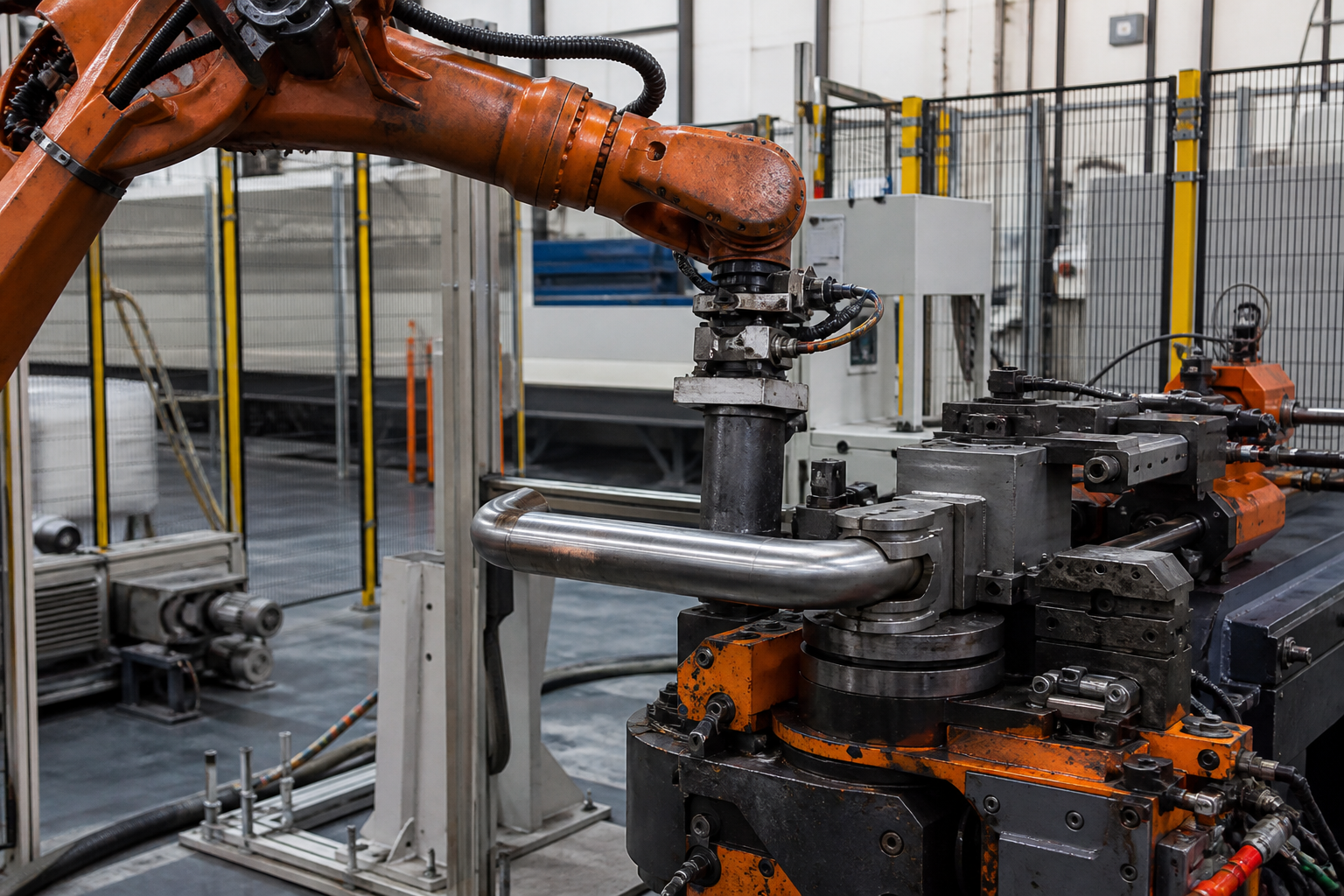
Reachability is not a bend tolerance.
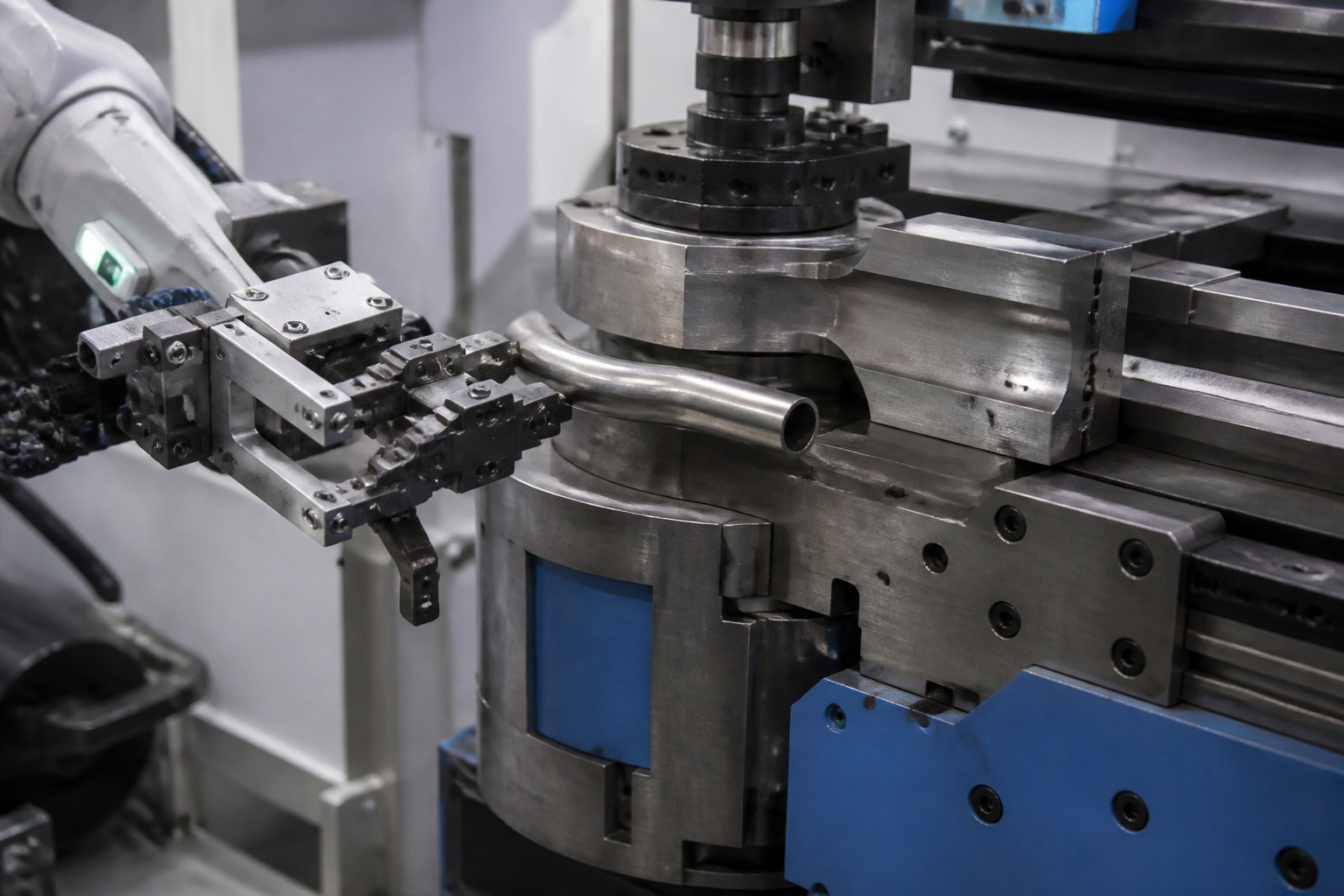
Die and clamp geometry write the scrap signature the pendant cannot erase.
Scrap signatures and what they usually mean
| Scrap signature | Often means | Wrong fix | | --- | --- | --- | | Angle opens after unclamp | Springback model stale vs lot hardness | Permanent pendant overbend folklore | | Intrados wrinkle | Insufficient mandrel/wiper support or wrong pressure | Slower robot—irrelevant | | Excessive ovality | Clamp/pressure die or thin-wall handling abuse | Blame “soft alloy” forever | | Length stack-up fails fixture | Cut length + stretch + robot grip slip | Weld fixture shim culture | | Clamp scar leaks after hydro | Clamp jaw geometry / pressure | Polish and ship |
An anonymized HVAC and process-skid fabricator automated stick presentation to a CNC bender and cut labor while scrap rose. The root cause was not robot TCP. It was a springback table frozen to a previous alloy lot while purchasing chased a cheaper tube mill. The robot faithfully presented wrong assumptions at takt. When they tied lot ID to compensation recipes and added a quick angle check on critical bends, scrap fell without buying a larger robot.
Commissioning rules that keep the cell honest
- Baseline springback per qualified material family, with a MoC when the mill or temper changes.
- Treat clamp jaw condition as tooling wear with photos in CMMS—same seriousness as gripper fingers on assembly cells.
- Separate “robot faults” from “bender recipe faults” in downtime codes; otherwise MES lies about automation maturity.
- Validate thin-wall EOAT with ovality checks before celebrating pick success.
- For welded assemblies, measure the bend that matters to the fixture—not only the bend that looks dramatic on the pendant.
Adjacent fences
Press-brake robots own sheet flanges. FSW cells own solid-state weld seams. Selective solder and screwdriving own electronics fastening. Machine tending owns chip removal volume. This page owns tube bending as a robotic process with springback and clamp physics. Do not celebrate path polish while the die set writes the real quality story.