
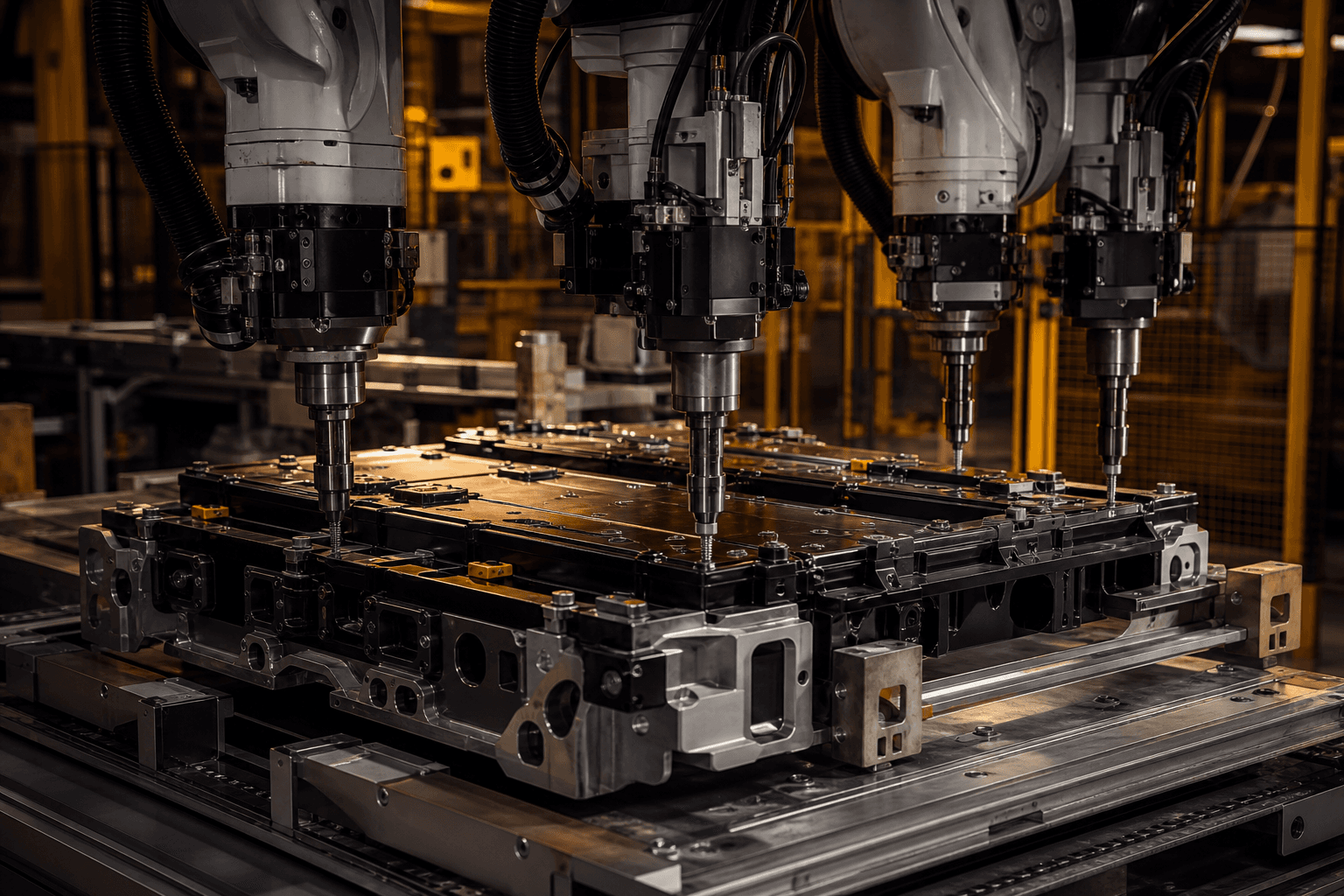
Force-torque cells feel press-fit and precision assembly. Adhesive cells meter beads. Welding closes seams. Spray owns film build. What still decides many product warranties is fastening: multi-spindle screwdriving with torque, angle, and seating curves that reject silently when bits wear or joints float.
Screwdriving cells with recipe libraries, bit-life tracking, and traceable joint curves are leaving demo fixtures for automotive, appliance, and electronics lines that need every fastener logged.
The industrial point is a known-good joint with evidence—not a faster air gun.
What screwdriving robots change
- Torque-angle recipes — Spindle programs as controlled process, not operator feel.
- Bit and vacuum discipline — Wear and feed faults gated before scrap piles grow.
- Joint genealogy — Curve and result tied to serial and station.
What still fails
Open-loop impact tools with a robot arm bolted on. Cells without fastener lot and bit changeovers. This is not general force-torque fit-up, not adhesive potting, not weld-path AI, and not spray film control.
What to watch next
- First-pass fastening yield versus manual multi-spindle baselines.
- Whether curve analytics catch floating nuts before field failures.
- Recipe reuse across sister plants without re-engineering every station.
Fit-up feels the mating surface. Screwdriving proves the joint that holds the product together.