
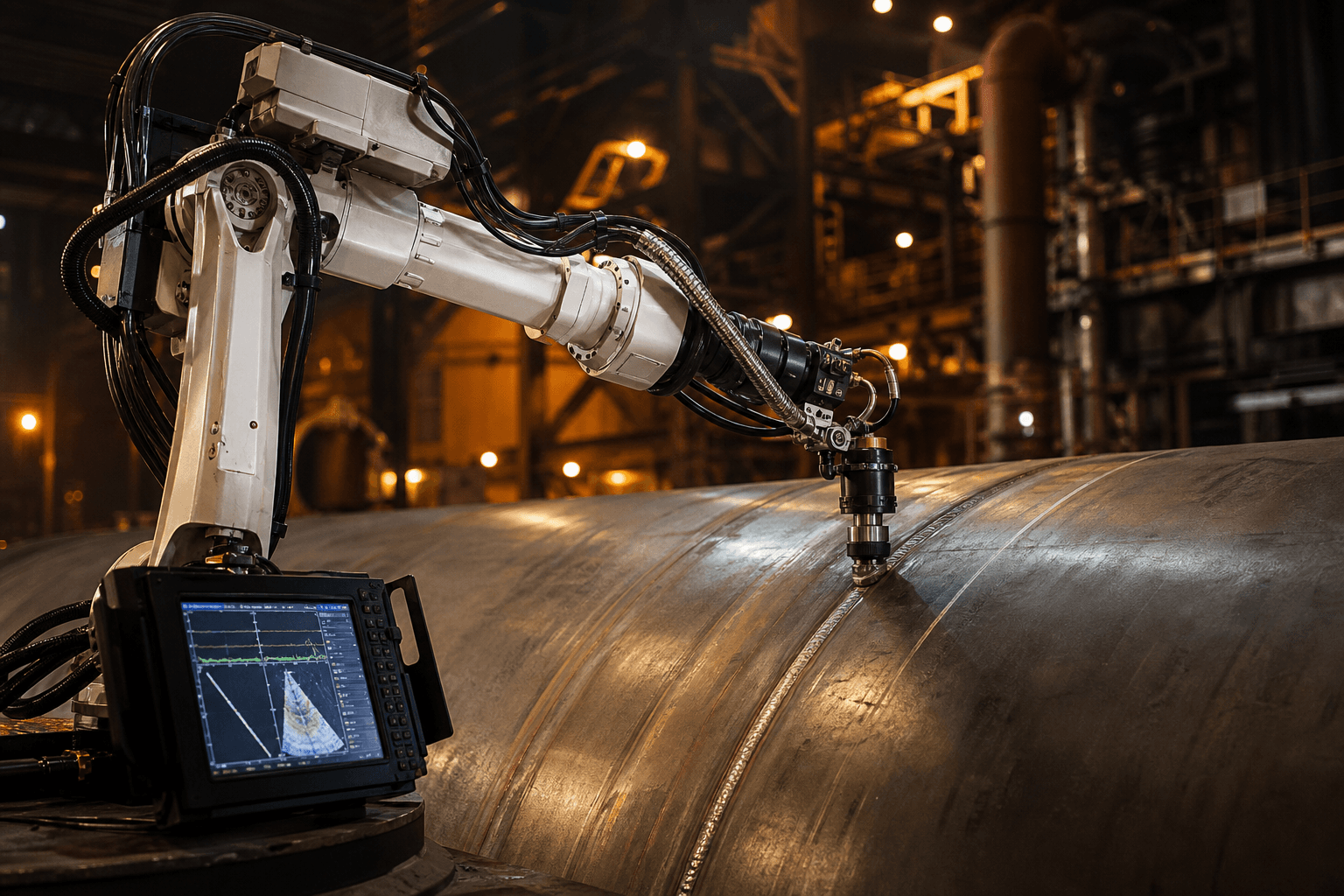
Vision systems catch surface defects. Quadrupeds walk plant rounds with cameras. Welding robots close seams. What still gates turnaround duration and vessel fitness-for-service is volumetric inspection: ultrasonic coverage that a human scanner cannot repeat identically across every meter of weld and shell.
Robotic and mechanized ultrasonic NDT—phased array, TOFD, and encoded UT on tracks or arms—are moving from specialty contractors into owned cells where the scan path, coupling, and data file are the controlled product.
The industrial point is a complete, repeatable inspection record. A robot waving a probe without encoded coverage is a faster way to miss a skip.
When manual UT cannot keep the outage calendar
On large pressure equipment and pipe racks, manual UT hours stack until the critical path is the inspector, not the crane. Mechanized UT programs commonly target encoded coverage maps with positional accuracy tight enough for overlay across outages—often discussed in millimeter-class encode steps on production scans. That only helps when procedure, calibration blocks, and acceptance criteria are locked before the arm moves.
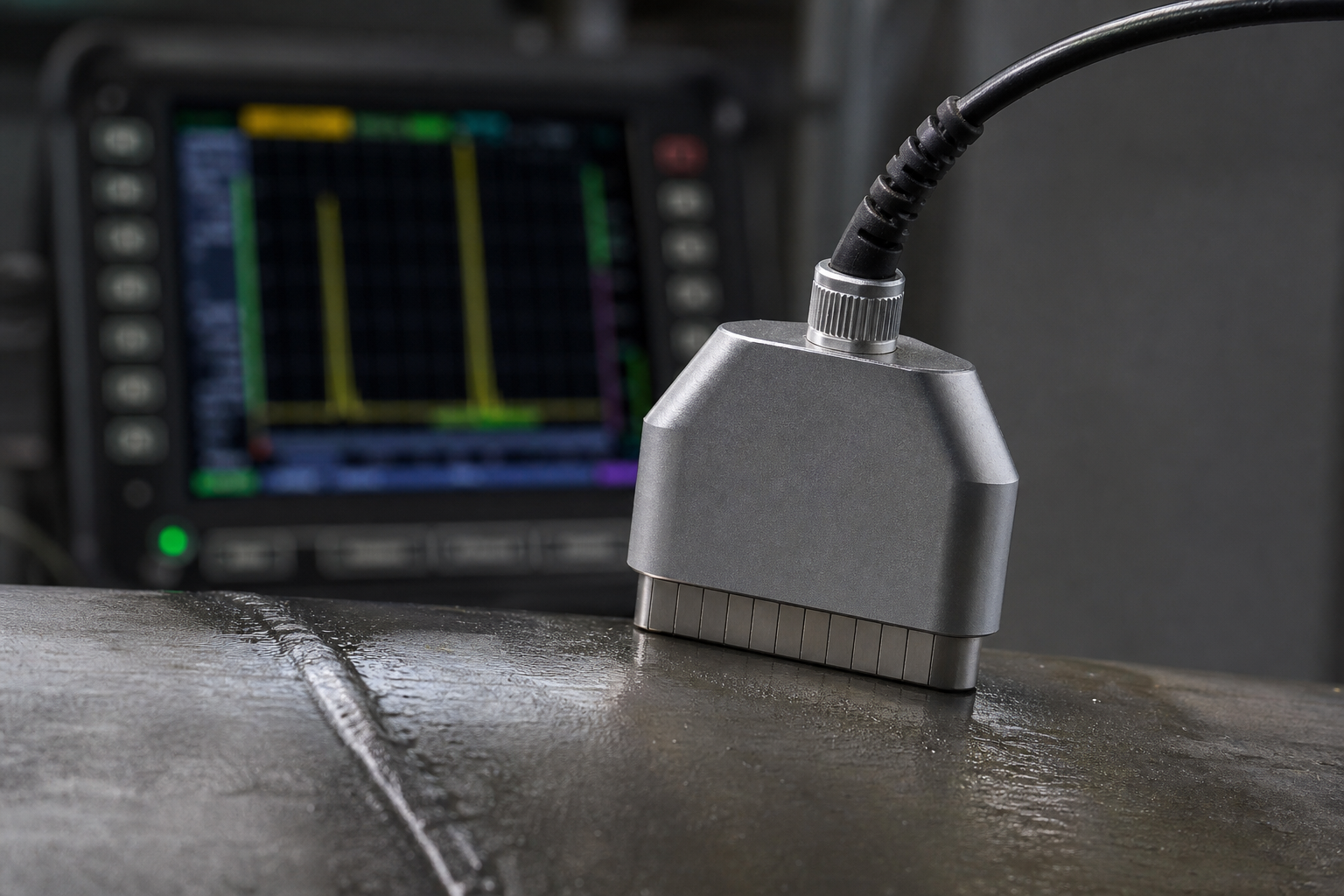
Couplant, probe angle, and encode integrity decide whether the file is evidence.
An anonymized midstream operator cut vessel inspection days on a turnaround after a track-mounted PAUT cell ran the same circumferential paths with automatic data merge into the integrity database. Interpreters still owned calls; the cell owned coverage completeness that previously varied by shift skill.
What robotic UT actually controls
- Scan path and encode — Proven coverage without silent gaps.
- Calibration discipline — Blocks and sensitivity tied to the procedure, not tribal settings.
- Data as the deliverable — Files linked to isometric/weld IDs for the next outage comparison.
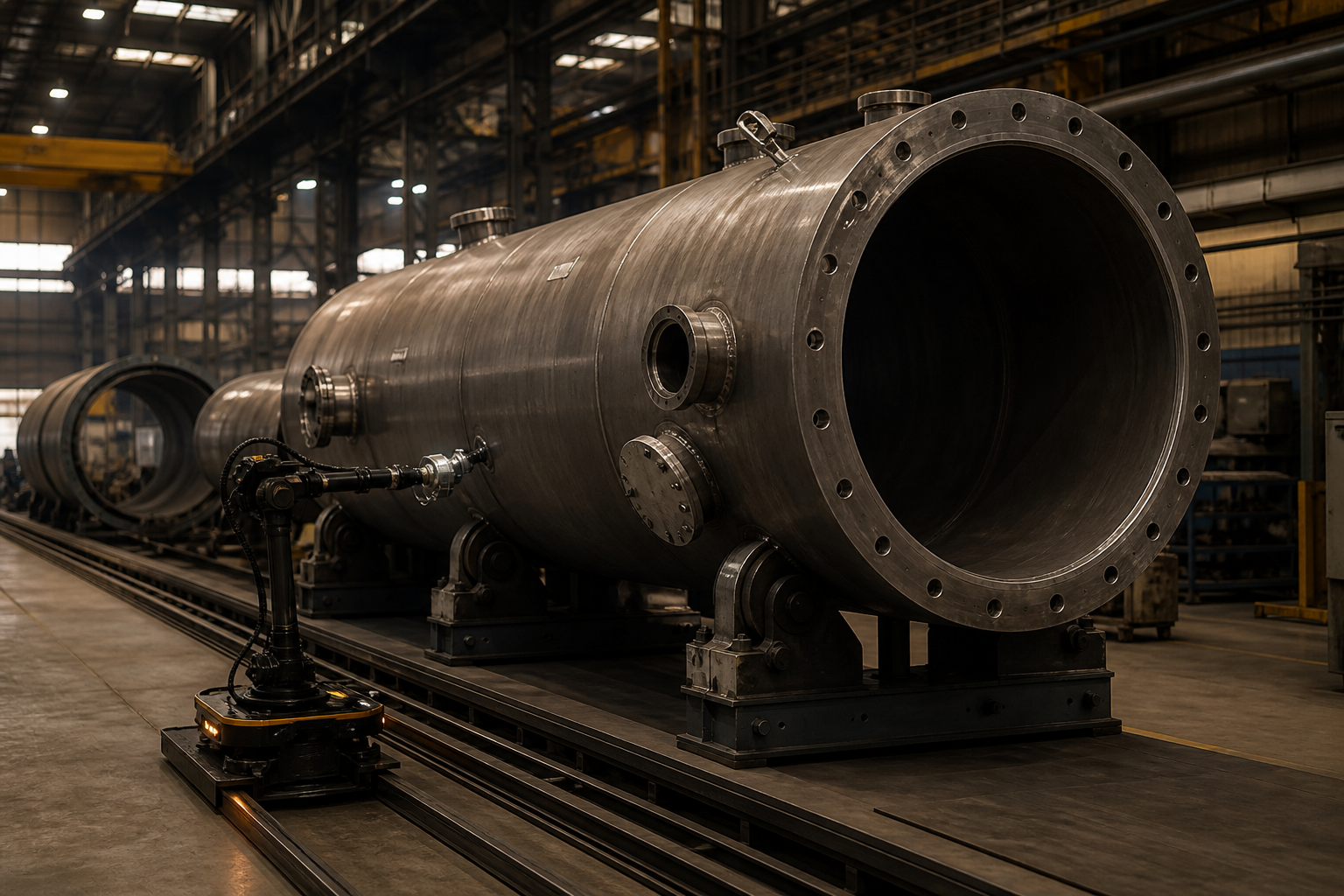
Access tooling and cell layout matter as much as the robot brand.
Failures that still look like “we automated NDT”
Skipping procedure qualification for the mechanized setup. Treating AI flaw hints as acceptance without Level II/III review. Confusing this with surface vision AOI or with adaptive welding process control.
This is not spray coating, not AFP composites, not CNC tending, and not PPE cameras. Those do not own ASME/API-style volumetric records.
What to watch before buying a cell
- Coverage completeness metrics on blind panels—not only scan speed demos.
- Whether integrity software ingest is one click or a manual USB ritual.
- Staffing: interpreters and procedure owners funded, not only robot techs.
Buyer checklist (short)
- Code/procedure fit — Which standards does the cell qualify under?
- Encode proof — How do you show a missed strip cannot hide?
- Data ownership — Who stores, compares, and retains files for years?
- Human gate — Who signs the final accept/reject?
Robots move probes. NDT value is the defensibility of the scan you can still explain to an auditor after the outage.