
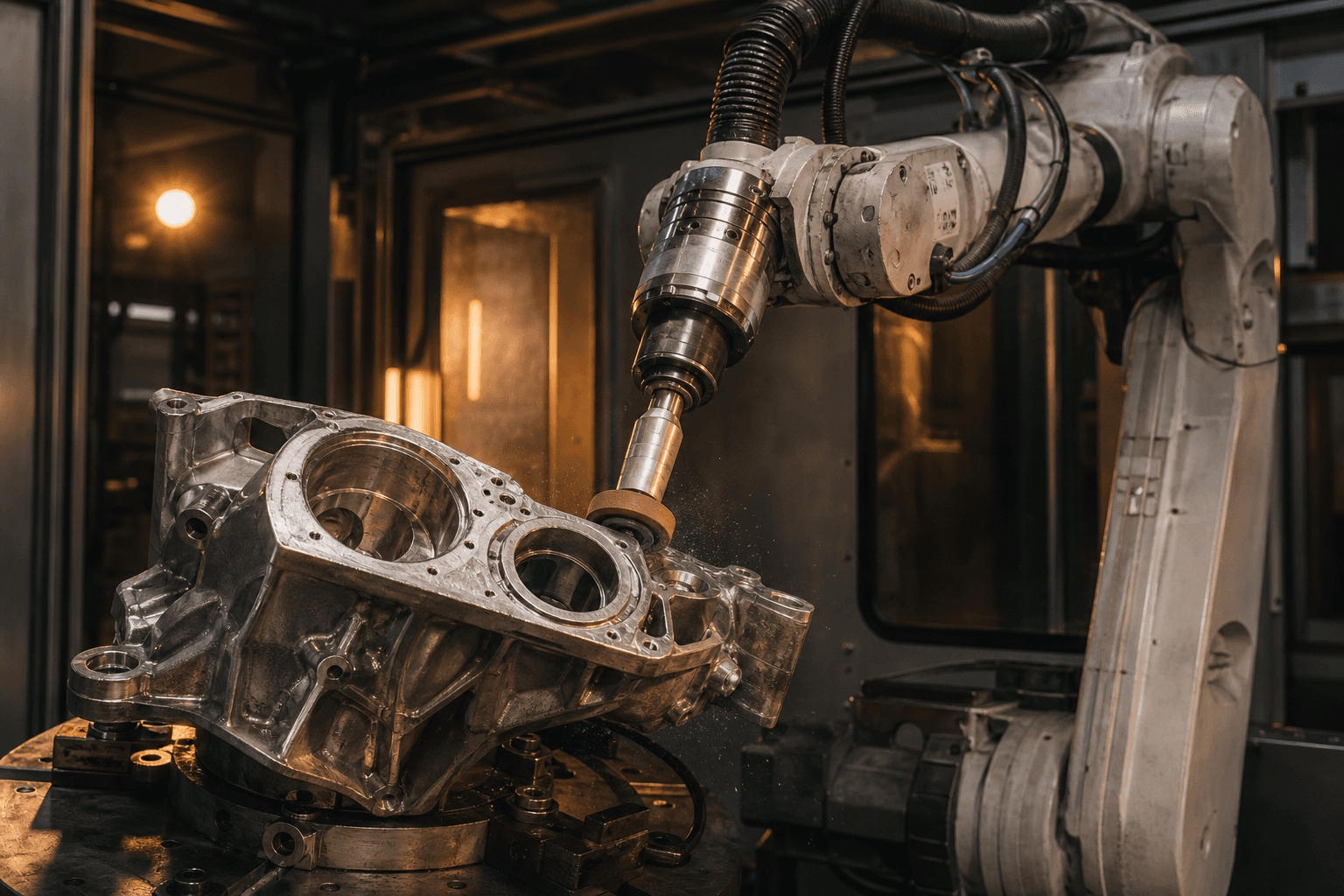
CNC tending robots load and unload machines. Force-torque cells tighten precision assemblies. Adaptive welding closes skilled-labor gaps on seams. What still eats manual hours after machining is edge break, flash, cast-part gates, and surface finish—work that burns operators out and rejects inconsistently.
Deburring and finishing cells combining force control, compliant tools, and in-process gauging are moving from trade-show polish demos onto high-mix machining and cast-finish lines.
The industrial point is stable edge and Ra within cycle time—not a prettier video of sparks.
What finishing robots change
- Force profiles as process recipes — Repeatable pressure and path, not teach-pendant art.
- Tool wear compensation — Media and brush life folded into quality gates.
- High-mix changeovers — Part families programmed without full re-engineer for every SKU.
What still fails
Open-loop grinding that overcuts thin walls. Cells without dust, fire, and particulate controls for abrasives. This is not CNC machine tending, not fastener insertion assembly, not bin picking, and not weld-path AI.
What to watch next
- Measured scrap and rework cuts versus manual finishing baselines.
- Whether force+vision stacks survive dust and abrasive mist for years.
- Standardized finishing recipes shareable across sister plants.
Tending feeds the machine. Finishing is what makes the machined part shippable without another human shift of sandpaper.