

The first alarm was not a servo fault. It was an unplanned stop on a body-in-white line after communication errors on a tool changer—followed by a “mystery” encoder fault that cleared after power cycle. Only when maintenance opened the dress pack did they find a shield ground frayed at the carrier bend radius, a pneumatic hose abraded white, and a cable tie pulling a profibus pair into the twist axis on every sixth cycle.
Dress packs sit in the blind spot between robot OEM warranties and production takt ownership. Mechanical builds the carrier once. Controls owns the program. Production owns the stop count. Nobody owns the living system that couples them: bend radii, strain relief, service loops, contamination, and the inspection rhythm that should have caught wear before the controller lied.
This brief is that ownership map—not a catalog of robot models, and not another end-of-line palletizing piece.
Symptom → likely owner (before you blame the controller)
| What you see | Often not the controller | First place to look | | --- | --- | --- | | Intermittent comms / fieldbus faults | “Firmware glitch” | Dress-pack flex point, connector strain | | Tool-changer air loss | “Seal kit” | Abraded hose at carrier entry | | Encoder / resolver faults after cycle N | “Cable quality myth” | Twist-axis service loop length | | Grease or weld spatter “near” robot | “Housekeeping” | Unguarded carrier path, missing bellows | | Repeat failures after “fixed” cable | “Bad batch” | Routing geometry, tie placement, bend radius |
The point of the table is ownership: controls owns the program and network; maintenance owns the carrier and connectors; production owns takt—but only a named dress-pack owner connects them before the line invents a new stop code.
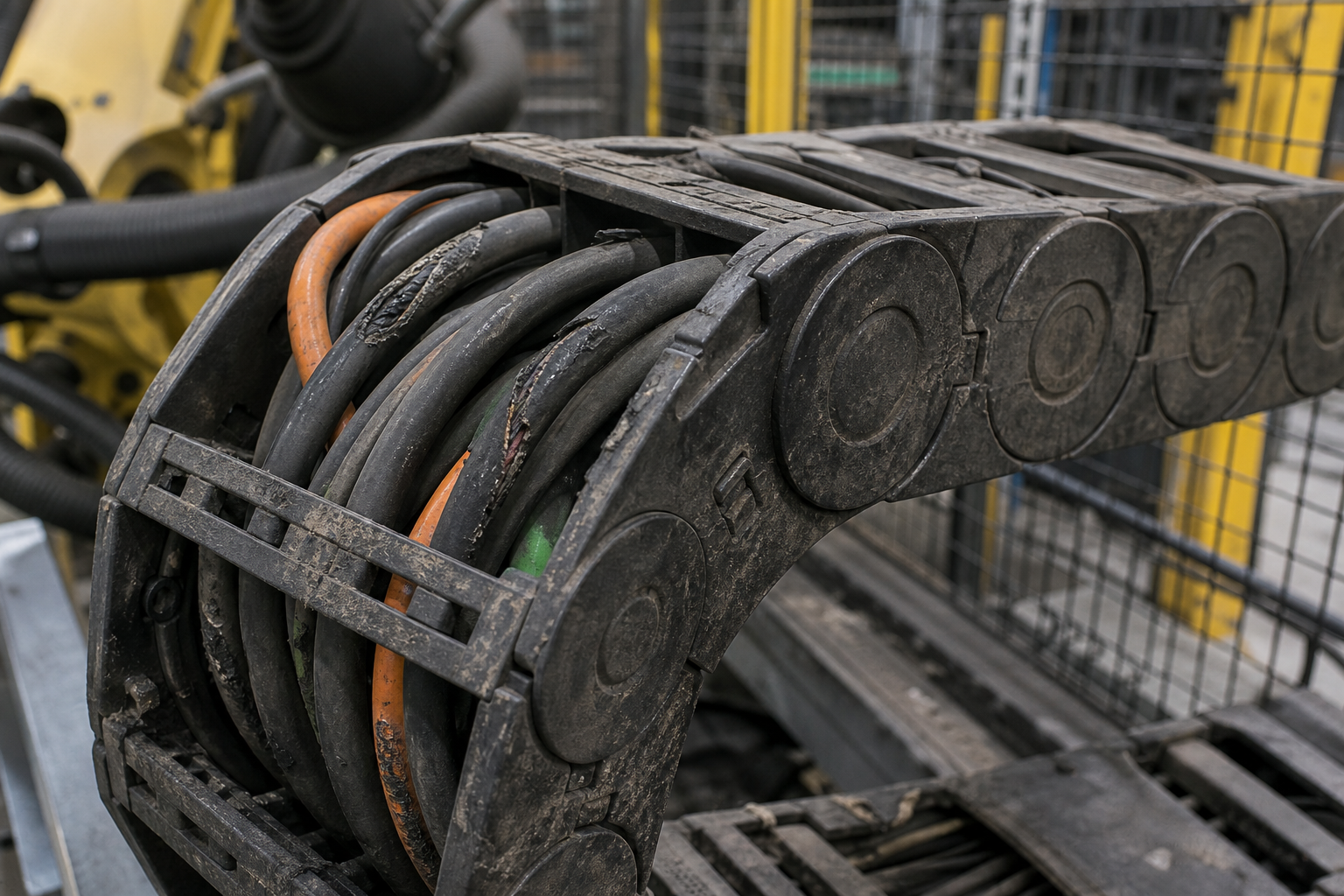
A passing visual walk is not a flex-life program.
What a dress-pack program actually controls
Cable management is not zip ties and hope. It is engineered routing: minimum bend radius per cable class, service loops sized for full axis travel plus maintenance posture, separation of power and signal, pneumatic hoses with proper swivel entry, and cycle-counted inspection keyed to robot motion hours—not annual PM folklore.
Multi-axis cells amplify small sins. A dress pack that works in teach mode at half speed fails at production takt when centripetal twist and acceleration harmonics find the one rub point nobody documented. Sites that clone a “working” dress pack to a mirror cell without re-measuring reach and loop length buy symmetric scrap on both sides of the line.
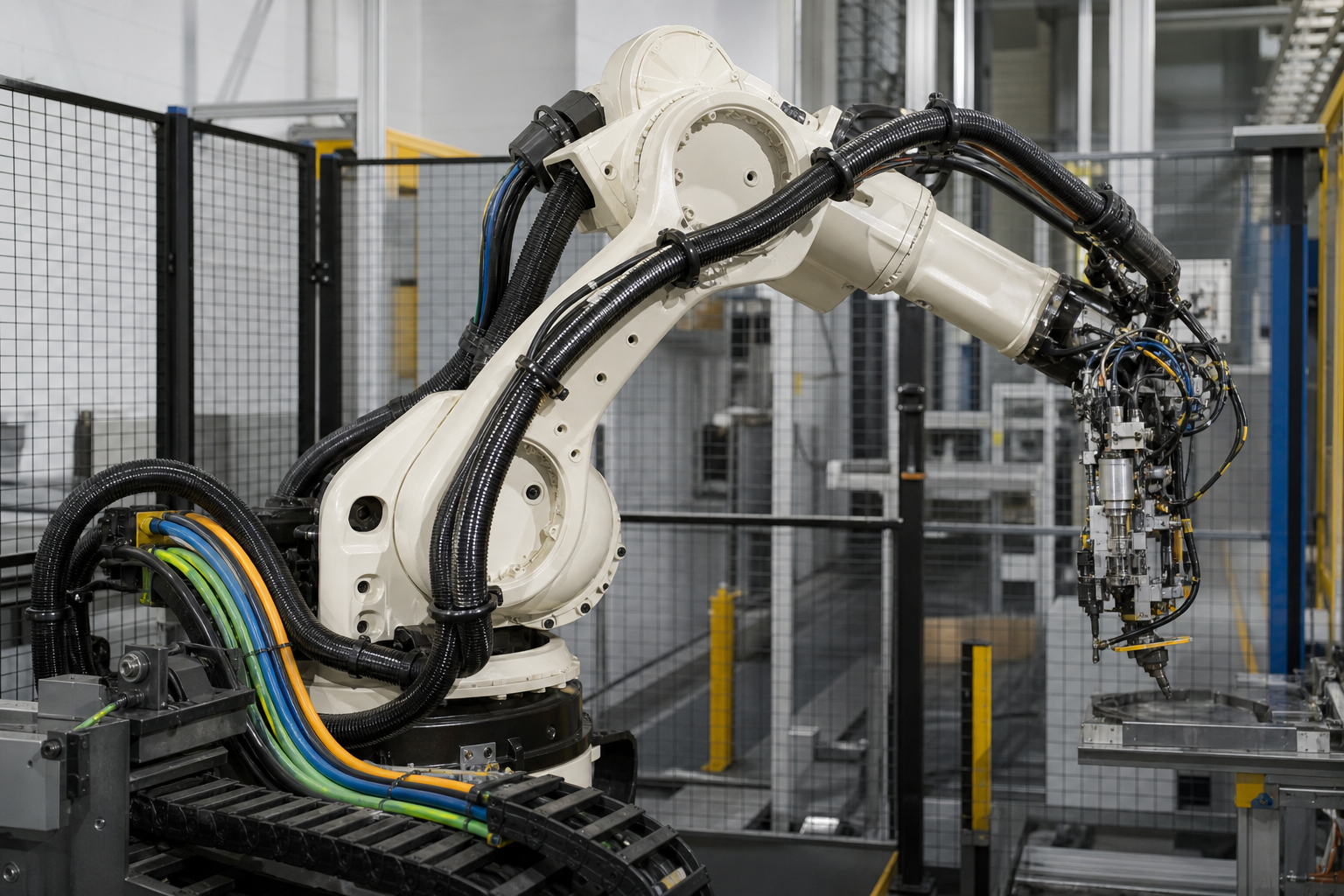
If the routing was never drawn, every teach pendant “fix” is debt.
An anonymized night shift that should have been last week’s PM
An automotive weld cell lost eleven hours of takt after three identical stops on communication timeout across two robots sharing a station design. Post-mortem showed carrier chain links cracked at the same bend index on both arms, a shared routing template that violated minimum radius for the profibus cable class, and PM checklists that said “inspect dress pack” without a measured wear criterion. The fix that stuck was not a controller swap. It was a flex-life counter, a routing drawing under change control, and a rule that any unplanned comms fault triggers dress-pack inspection before reset—same shift, named owner.
Magnitudes without brochure theater
Exact flex-life limits belong to your cable OEM and your motion profile. Ordering is portable: lost takt hours outrank deferred carrier spend; documented routing outranks tribal zip-tie fixes; cycle-based inspection outranks blaming the last firmware patch. Cells that only monitor controller faults will keep celebrating “stable cycles” while the dress pack quietly writes the next stop chapter.
Adjacent topics that stop here
Wire-harness assembly robots own connector routing in build cells. Laser weld monitoring owns seam disposition on EV lines. Robotic screwdriving owns torque-angle verification. Acoustic PdM owns plant rotating assets. None of them own multi-axis dress-pack bend radius, carrier link wear, or service-loop geometry. Do not buy a harness cell and expect body-shop robot uptime.
Questions that replace hope
Who can alter dress-pack routing without a drawing revision? When did you last measure bend radius at the highest-flex point—not glance at it? Are inspection intervals keyed to robot motion hours or calendar? If the robot OEM disappeared for a month, would your CMMS still know carrier part numbers, cable classes, and which stations share which routing template?
Dress packs are not cosmetic clutter around a robot. They are the reason your “healthy” controller still stops at night. Document the routing, count the cycles, and treat cable management as motion equipment—because the servo already depends on it.