

Machine-learning scores appear more often on manufacturing quality gates: predicted defect probability, predicted dimension, predicted scrap risk. A single number is easy to threshold. It is also easy to misuse. When the process drifts, the sensor suite changes, or the training window no longer matches the current product mix, that number can stay confident while becoming wrong.
MES changeover duration estimates and lot-code OCR print quality are different AI-adjacent topics. This article is about uncertainty around quality predictions—why a point estimate is incomplete for release decisions.
What a prediction interval adds
A point forecast answers “what value does the model expect?” An interval answers “where does the method claim the outcome is likely to fall, under stated assumptions?” In industrial use, the practical question is often: does the interval sit entirely inside the specification or control limit, overlap the limit, or fall outside? Those three cases support different actions—release, inspect, or hold—without pretending the model is certain.
Conformal prediction and related calibration techniques are one family of approaches discussed in the research and practitioner literature for attaching intervals with clearer coverage properties than ad-hoc error bars. The implementation details vary; the editorial point does not: decision policies should see uncertainty, not only the mean score.
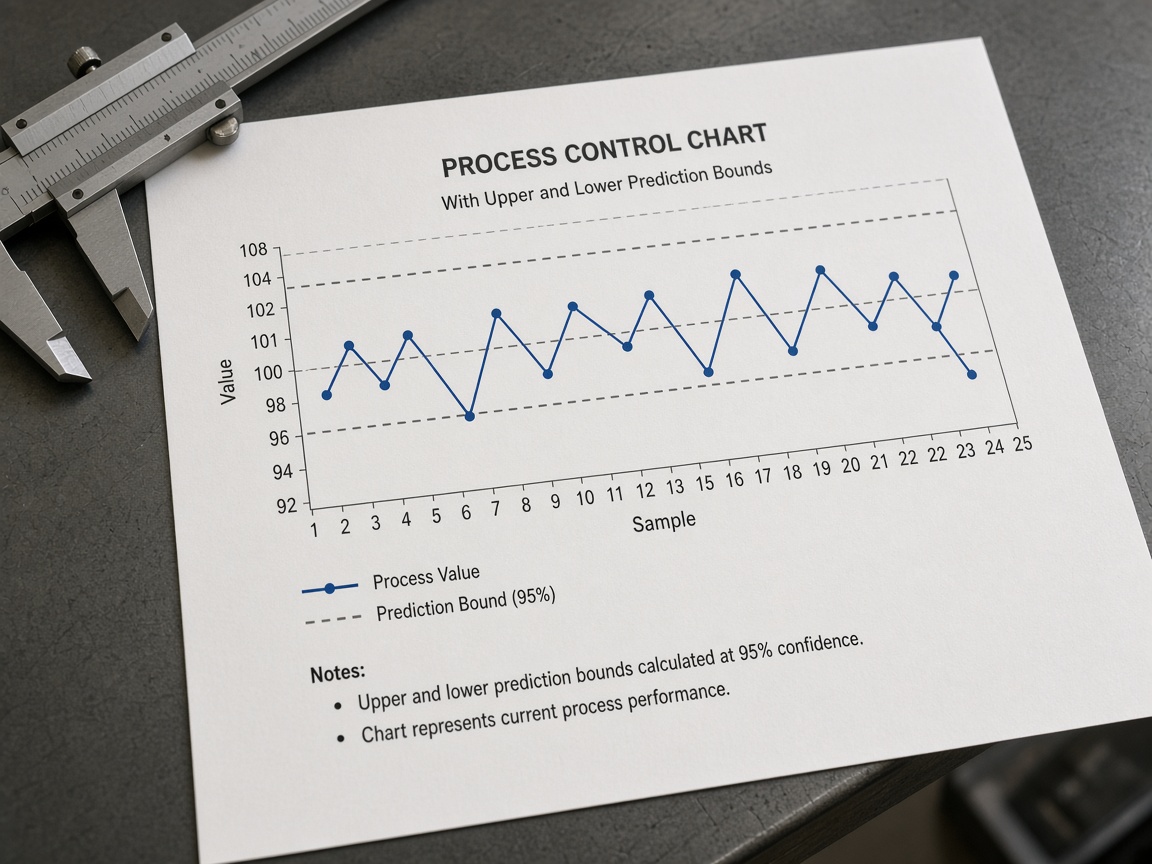
Operating rules that keep the math honest
- Retrain or refresh models on a defined cadence when materials, tools, or recipes move; stale models produce misleadingly narrow or wrongly centered intervals.
- Separate training metrics from production monitoring. A strong offline score does not prove the live interval still covers.
- Do not shrink intervals by silently dropping difficult lots from the monitoring set.
- Keep a human path when intervals overlap critical limits. Automation that always picks the point estimate recreates false certainty.
No article of this length can prescribe one algorithm for every plant. What it can insist on is the display and policy layer: if operators only see a green/red score, they cannot tell confident correctness from confident error. Show the band. Define what the band means for the gate. Then the model is a measurement with error bars—not an oracle.