

A pressure safety valve is a last-line mechanical device. It does not know the SIS logic, the alarm flood, or the operator's workaround. It knows spring force, nozzle area, and the pressure at its inlet. If that pressure is not the vessel pressure—because of a long inlet, a partial isolation, or a plugged weep—the nameplate set point is a fiction attached to the wrong location.
Plants that treat PSV testing as a contractor calendar item get a stack of certificates. Plants that treat it as an integrity function track the valve, the inlet, the discharge path, and the test that actually moved the disc.
What "set pressure" is allowed to mean
API and ISO practices define how a valve is tested: cold differential test pressure, corrections for backpressure and temperature, and whether the test is on a bench or in situ with a lift-assist device. Mixing those methods in one spreadsheet without noting which was used makes interval decisions indefensible.
Seat leakage after a test is not a cosmetic annoyance. A leaking PSV on a toxic or flammable service is a continuous emission and a reason the next operator gags the valve "until maintenance can get to it." A gagged PSV is not a PSV. The isolation and gag log belongs in the same system as the test certificate, or the certificate is describing a valve that may no longer be in service as drawn.
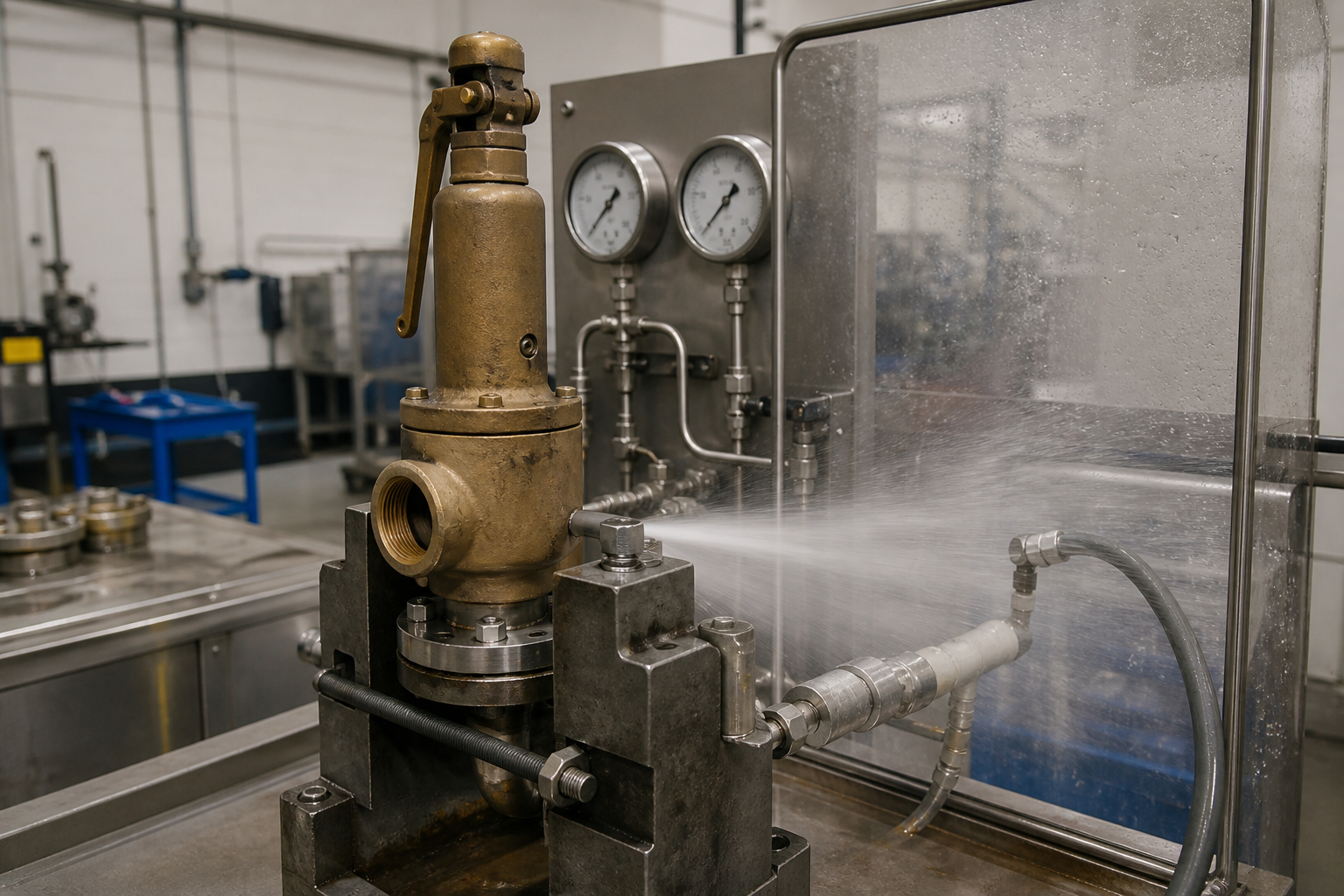
Inlet and discharge are part of the valve
Excessive inlet pressure drop causes chatter: the valve opens, flow collapses the inlet pressure, the disc slams, the cycle repeats, and the seat is destroyed. A discharge line that is undersized, full of liquid, or blocked by a closed rain cap does the same job from the other side. Inspection of the valve body without walking the inlet and outlet is an incomplete test.
Rupture discs under PSVs, isolation valves, and bleed valves between disc and PSV have their own position requirements. A closed bleed that traps pressure, or a disc that has already burst and was never replaced, changes the set of the assembly. The P&ID is the test boundary, not the flange-to-flange of the PSV.
Intervals from history, not from habit
A valve that lifts cleanly at set for three cycles and leaks after the third has told you something about service fouling. Shorten the interval or change the trim. A valve that never lifts in service still needs a test; corrosion and spring relaxation do not require a process excursion.
Document as-found set, as-left set, leakage, and any inlet/outlet findings. As-found is the integrity data. As-left is the restoration. A file that only contains as-left is a contractor completion metric.
Overpressure protection is a system. The PSV is the moving part. If the system around it is not in the work pack, the plant is protected on paper.