
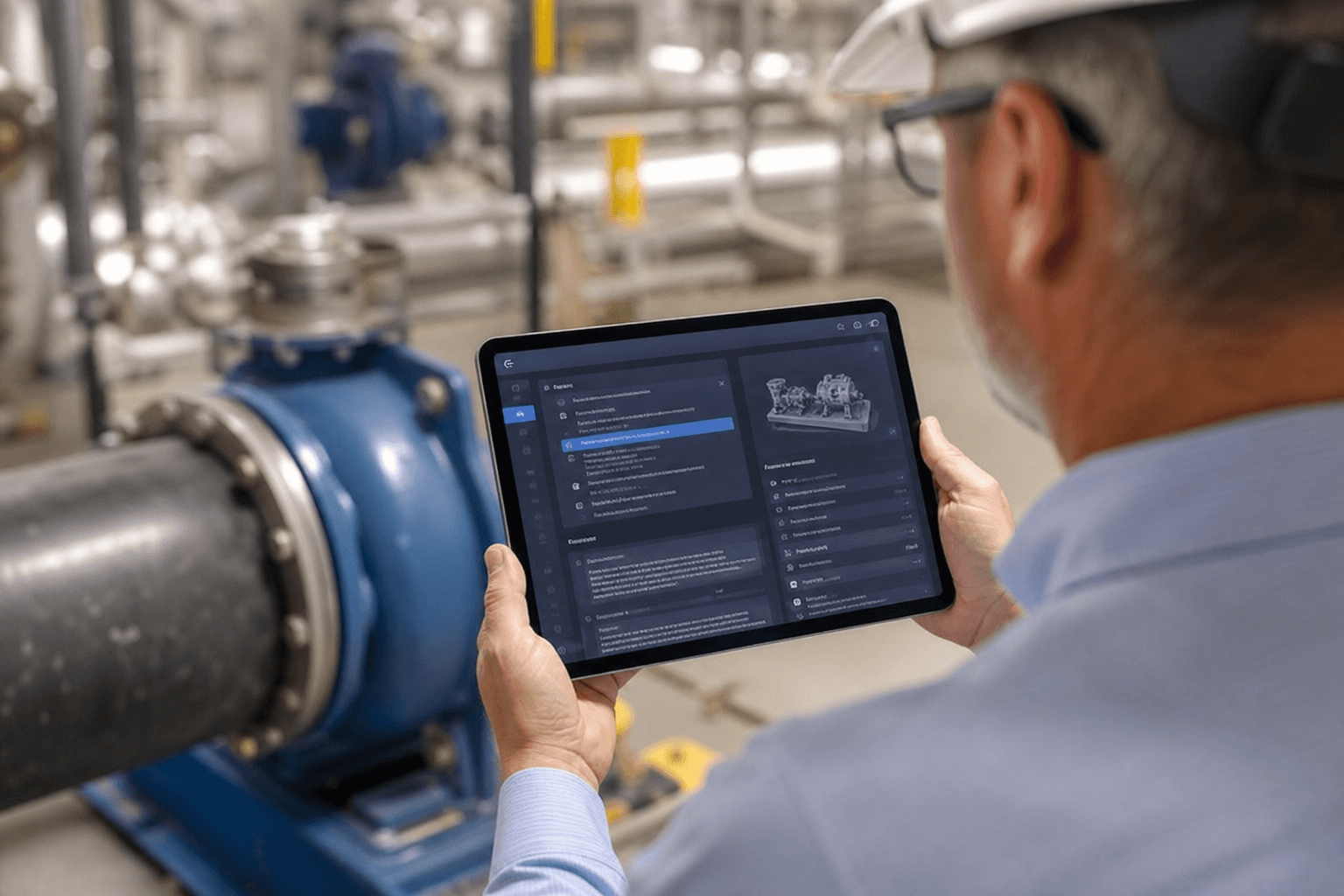
Every maintenance team has lived through the same Tuesday morning: a centrifugal pump trips on high vibration, the on-call technician resets it, and the CMMS work order reads "checked and OK." Three weeks later the mechanical seal fails, taking a day of production with it. The information to prevent that failure often existed—bearing temperature trend, lube-oil sample deviation, a footnote in the last PM record—but nobody connected the dots before the event.
LLM-powered maintenance copilots promise to do exactly that connecting. Feed the tool a fault code or an alarm description, and it returns a ranked list of probable causes drawn from similar historical events, OEM documentation, and engineering knowledge encoded in its training. On paper, that sounds like a transformation. In practice, the value depends entirely on what happens after the ranked list appears on screen.
What the tool actually does
A maintenance copilot is not a predictive maintenance model and should not be confused with one. A PdM model watches live sensor streams and fires an alert when a pattern deviates from learned normal behaviour. A copilot is an inference engine: you describe a symptom and it reasons about cause using language.
The distinction matters because the two failure modes are different. A PdM model fails when sensor data is missing, compressed, or mislabelled. A copilot fails when the text it reasons over—work orders, fault codes, PM notes—is incomplete, inconsistently worded, or simply absent. Most CMMS instances are all three.
The typical copilot workflow runs in three steps. First, the user pastes or dictates a symptom description. Second, the model retrieves semantically similar historical records from a vector store, combines them with its own parametric knowledge, and generates a hypothesis list with supporting evidence snippets. Third, the technician uses that list to guide physical investigation.
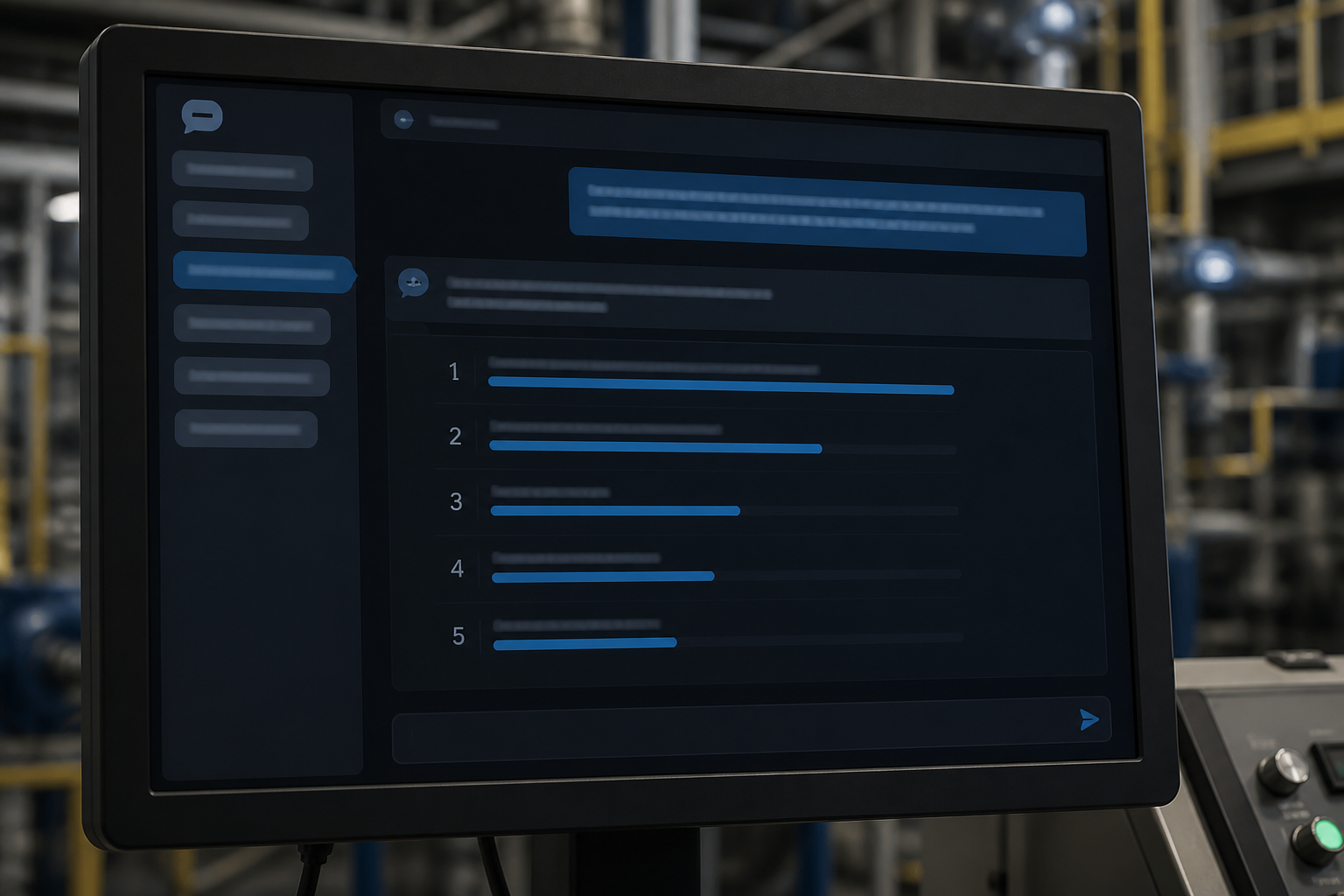
The power of step two is real. A well-indexed CMMS covering a decade of maintenance history, cross-referenced with OEM service bulletins and P&ID-linked tag names, can surface a hypothesis that a first-year technician would never reach and a veteran might overlook under time pressure. But the ranking is probabilistic, not causal. Hypothesis number one is not necessarily the correct cause; it is the cause most consistent with similar-looking past events.
Where the trust problem begins
The first deployment mistake is treating the ranked list as a diagnosis rather than a structured brainstorm. When a copilot returns "bearing lubrication deficiency" as the top hypothesis, a team under pressure may order the bearing and schedule the repair without checking whether the lube system was actually inspected. If the real cause was an undetected impeller wear ring failure starving flow and raising radial load, the new bearing fails in weeks.
The second mistake is ignoring confidence heterogeneity. The model assigns similar-sounding confidence language to hypotheses backed by fifty matching events and to hypotheses backed by two. A well-designed interface makes that distinction visible—showing record counts, date ranges, and equipment classes that fed each hypothesis. A poorly designed one shows a ranked list with percentage confidence scores that look more authoritative than they are.
The third mistake is letting the CMMS data quality slide because "the AI compensates." It does not. Every gap in work-order history, every generic description ("repaired as found"), every fault code that maps to ten different physical faults, directly degrades hypothesis quality. Teams that invest in the copilot interface without investing in the data governance behind it will, within six to twelve months, find that the hypotheses stop surprising them—the tool starts echoing the last thing anyone wrote, because that is the densest signal it has.
What verification culture actually looks like
The discipline that separates teams getting measurable value from copilot tools and teams accumulating a library of unchecked printouts is structured verification.
In practice this means two things. First, before any hypothesis-driven part order is raised, a designated step in the work order requires a technician or engineer to record the physical evidence that confirms or refutes the top hypothesis. Not "checked" but: oil sample result, bearing clearance measurement, visual inspection finding with photo, or test pressure reading. That record goes back into the CMMS, explicitly tagged as hypothesis verification.
Second, the outcome—whether the hypothesis was correct—feeds a monthly review. Teams that run this review find patterns: certain equipment classes consistently generate hypothesis rank-one misses, certain fault codes are too broad to retrieve useful matches, certain PM data is so sparse that the retrieval step fires on irrelevant plant sections. Those patterns drive targeted CMMS improvement, which improves the next retrieval cycle.
This loop is not glamorous. It does not appear in vendor demo videos. But it is the mechanism that converts a language model into a net-positive maintenance tool rather than a confidence-looking shortcut to the wrong repair.
The sourcing problem behind every hypothesis
One issue that is discussed less often is what happens when a copilot draws on OEM documentation that is outdated or equipment-specific failure modes that the OEM never published. Most industrial LLM deployments are retrieval-augmented: the model searches a curated document library in addition to its training. The quality of that library matters as much as the model itself.
Teams that have gone through the exercise of curating their document library consistently report the same surprise: the most relevant documents are not the OEM manuals but the internal investigation reports from past failures—root cause analyses, failure review board outputs, deviation reports. These documents contain the failure fingerprints that the model needs to reason well about plant-specific modes. They are also the documents that are least consistently stored, least consistently indexed, and most frequently treated as archives rather than operational knowledge.
A copilot deployment that indexes only OEM literature and ignores five years of internal failure analyses is running at partial capacity from day one.
What plant context the model cannot carry
Language models do not hold plant state. A copilot does not know that the pump it is reasoning about is currently running at 40 % of rated flow because a downstream valve has been throttled for the past two weeks, nor that the bearing housing was shimmed by a third-party contractor three months ago outside the CMMS record. That context lives in the technician's head, in paper logs, and in conversations.
The practical design response is to build the copilot interface so that plant context can be added to the prompt explicitly, before the model reasons. Fields for current operating point, recent non-CMMS interventions, and process conditions at the time of the fault are not optional niceties—they are the difference between a generic hypothesis and a plant-specific one.
Teams that treat the copilot as a passive recipient of a symptom description and expect a high-precision answer are measuring the wrong thing. Teams that treat it as an active reasoning partner—providing context, challenging hypotheses, recording verification—are the ones reporting reduced mean time to correct diagnosis.
Where the value genuinely lands
When the conditions are right—honest data, structured verification, curated document library, context-augmented prompts—the areas where maintenance copilots create measurable impact are specific.
Cross-asset knowledge transfer is the clearest one. A large multi-site plant may have thirty identical pump models across twelve facilities. A failure mode that only one site has encountered can be retrieved the next time any site faces a similar symptom. Without a copilot, that knowledge transfer happens only if someone writes a memo or gives a talk; with a well-indexed system, it happens at the point of need.
Onboarding acceleration is the second. A new maintenance engineer facing an unfamiliar failure on an unfamiliar piece of equipment reaches a structured hypothesis list in minutes rather than spending two hours reading manuals. The hypothesis list may need expert validation, but it gives the engineer a structured investigation path rather than a blank page.
Shift handover quality is the third. A copilot that generates a structured symptom-and-hypothesis summary from a natural-language description of the fault at shift end gives the incoming team a more useful starting point than "vibration alarm, reset, monitoring."
None of these benefits require the model to be correct every time. They require the model to be consistently useful enough that structured verification catches its errors before they become repair orders.
The number the dashboard should show
The metric most teams track is the proportion of hypothesis-driven work orders where a physical verification record was completed before parts were ordered. When that number is above eighty percent, the copilot is running as a structured thinking tool. When it falls below fifty percent, the tool is being used as a shortcut, and the error rate in the repair record will confirm it.
That number is not an AI metric. It is a maintenance process metric. Which is the point: the value of a maintenance copilot is not determined by the model. It is determined by the team's willingness to treat every ranked hypothesis as the start of a structured investigation, not the end of one.