
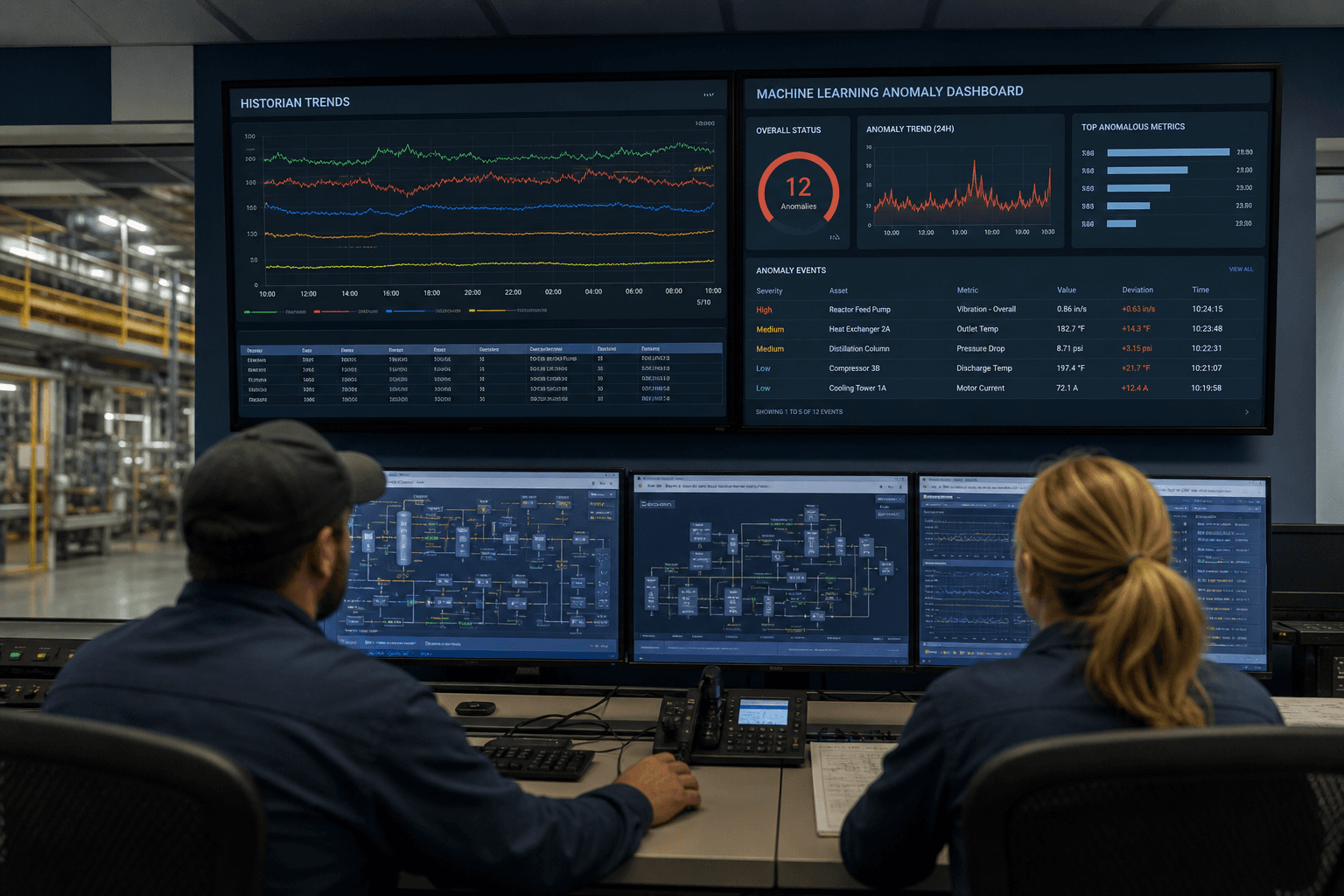
Case: H-19
Plant: continuous process unit (anonymized)
Allegation: “Our anomaly model found a new failure mode.”
Finding: it found the historian.
This brief is a case file—evidence order fixed—not a method manifesto.
1. Complaint
Reliability reported the model flagged “oscillatory instability” on a critical temperature three times in two weeks. No trip. No lab confirm. Operators called it haunted.
2. Scene
Training used two years of historian exports. Live inference used the same tags. Dashboards looked professional. Confidence intervals looked like science.
3. Evidence A — Deadband footprints
Zoomed raw-ish extracts showed flatlines with occasional step jumps—classic deadband / exception reporting cosmetics. The model treated step edges as physical events.
Exhibit note: exception reporting is not a sensor.
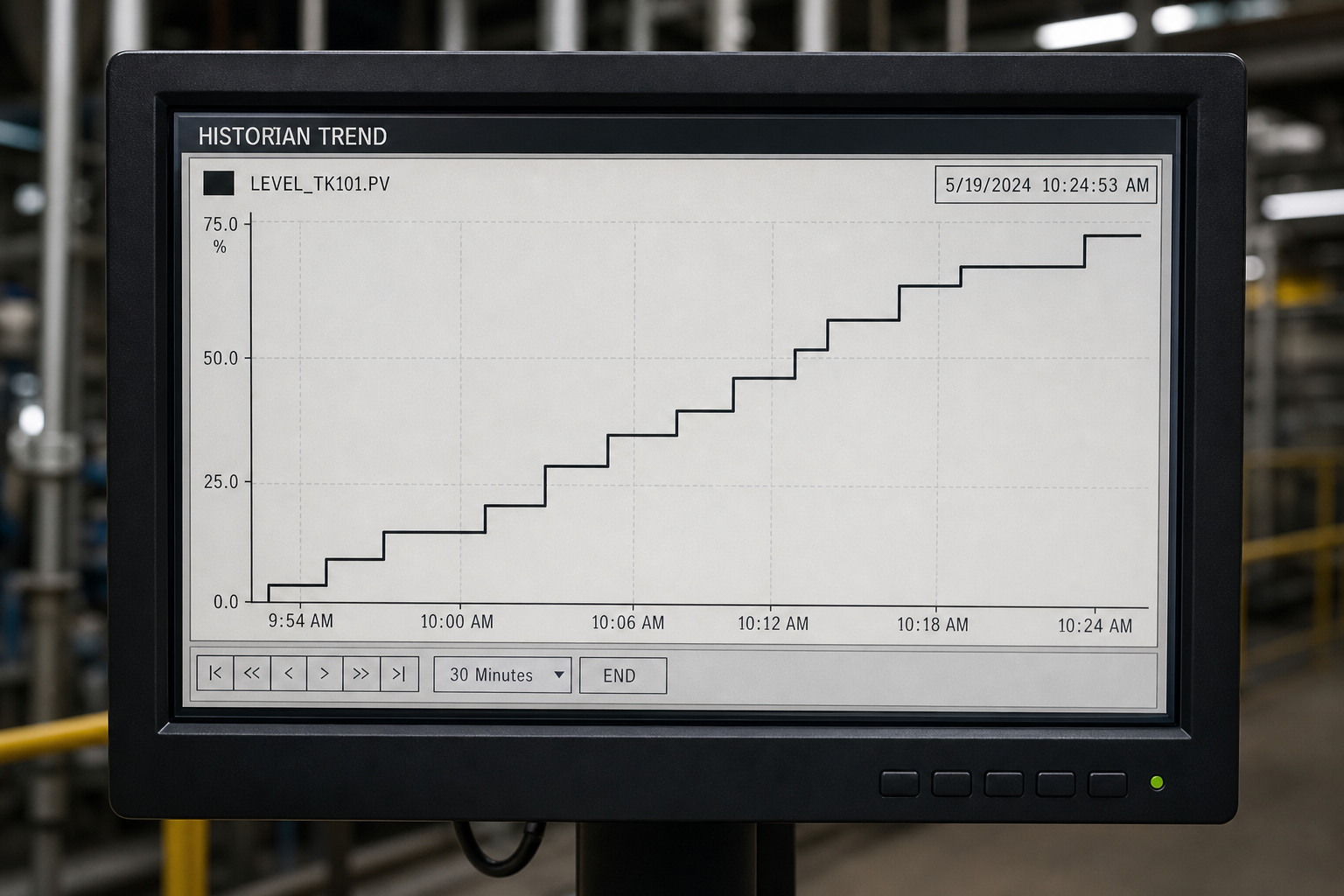
Stairsteps are storage policy wearing a process mask.
4. Evidence B — Swinging-door compression
A second tag showed the geometric “corners” of swinging-door compression. The model’s “regime change” aligned with compressor reconfiguration after a historian upgrade—not with valve work.
Timeline matched IT change ticket HST-4417 within hours.
5. Evidence C — Stitch across archive tiers
Training mixed hot cache and deep archive with different compression settings. The model learned the seam between tiers as a seasonal effect.
6. Control experiment
Replayed the same window from a high-resolution temporary logger on the same transmitter. Oscillation vanished. Stairsteps vanished. Model went quiet.
Conclusion: detector of compression policy, not thermodynamics.
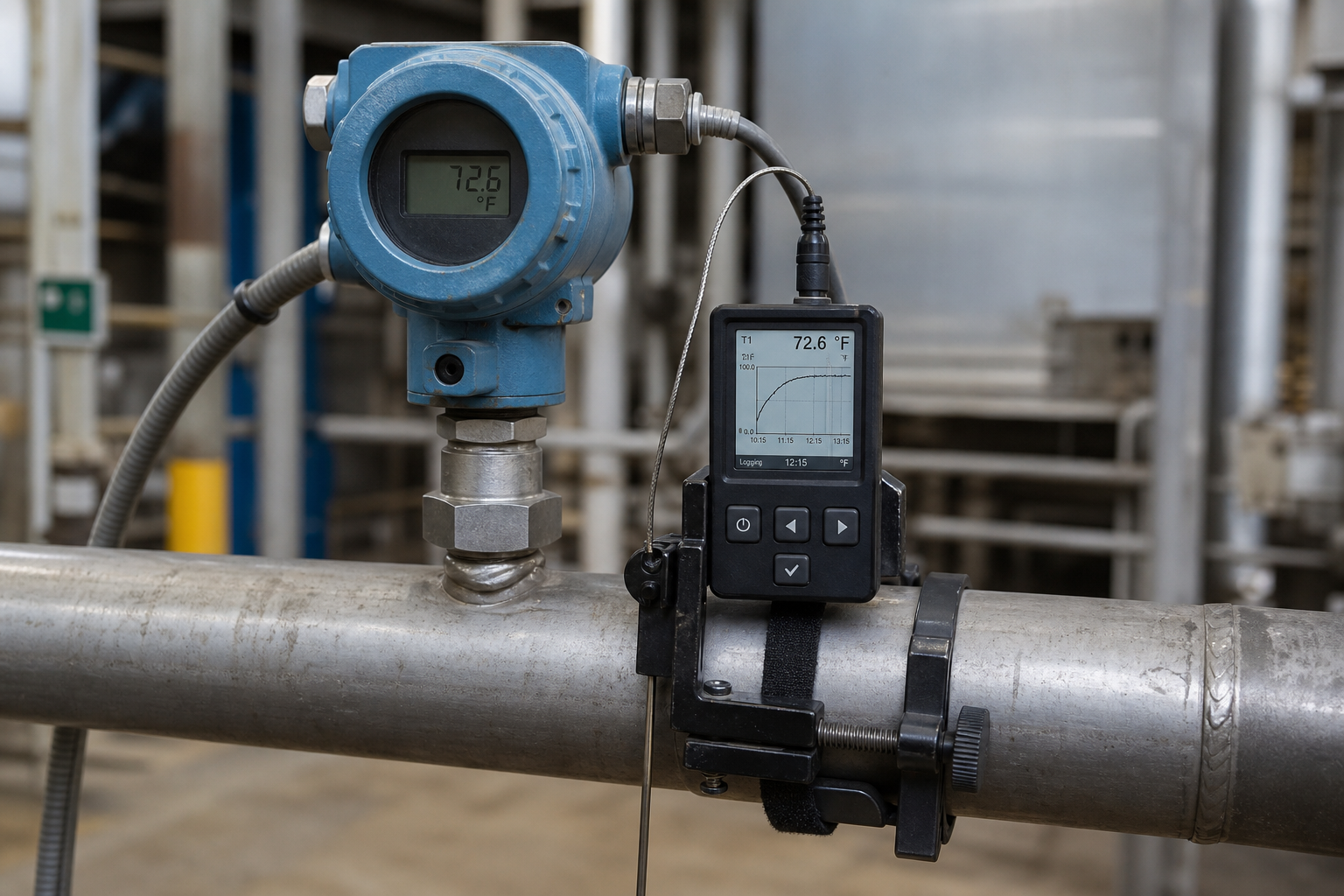
If the logger disagrees with the historian, believe the logger first.
7. Disposition
| Action | Owner | Done | | --- | --- | --- | | Freeze model claiming “instability” | Data science | Y | | Document compression settings per tag | Historian admin | Y | | Retrain only on verified high-res windows | Joint | In progress | | Add “storage artifact” review gate before any reliability work order | Reliability | Y |
8. Rules of evidence (post H-19)
- No ML training export without compression metadata attached.
- Any “new oscillation” requires a temporary high-res confirm.
- Historian upgrades are MoC for analytics—not only for IT.
- Models may not open maintenance work orders without human artifact review.
Adjacent fences
Unsupervised drift essays own hypothesis governance without labels. Semantic catalogs own meaning for agents. Write-path red-teams own dangerous actuation. Soft sensors own closed-loop predicted CVs. None of them own historian compression forensics. Do not retune a valve because a swinging door drew a triangle.
Close
Case H-19 is closed as storage masquerading as process. If your industrial AI cannot tell the difference, it is not detecting assets—it is detecting your archive settings.