
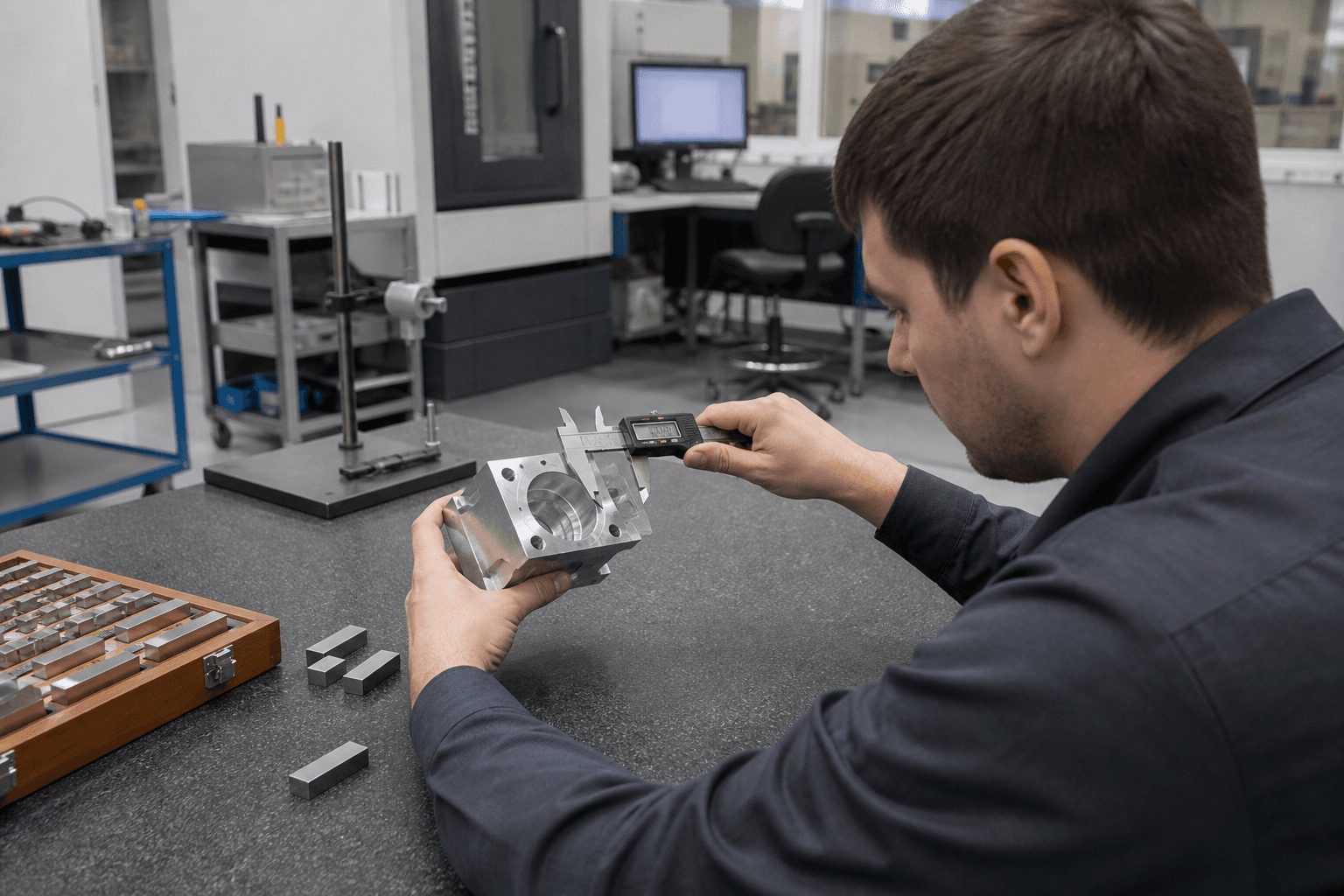
Plant AI on dimensional data fails in a boring way. The model looks sharp on last month's lots. A new inspector starts. The predicted-versus-measured plot opens like a fan. Retraining does not fix it, because the label was never a property of the part. It was a property of the measurement system.
Gauge R&R is not a quality-department ritual to print before an audit. It is the statement of how much of the observed variance is the gauge, the fixture, and the person. Until that split is known, a supervised model has no honest target.
What the study is actually splitting
A crossed Gauge R&R on a critical dimension uses the same parts, the same operators, repeated measurements. Repeatability is the same person, same gauge, same part. Reproducibility is the between-operator (or between-fixture) term. If those two together eat a large fraction of the tolerance, you do not have a modeling problem. You have a measurement problem that modeling will launder into a false process story.
The usual shortcut is to take MES values as ground truth because they already exist. MES values inherit every appraiser, every worn anvil, every fixture that was "close enough," and every software rounding rule. The model then learns the mix of inspectors on shift A versus shift B and calls it process drift.
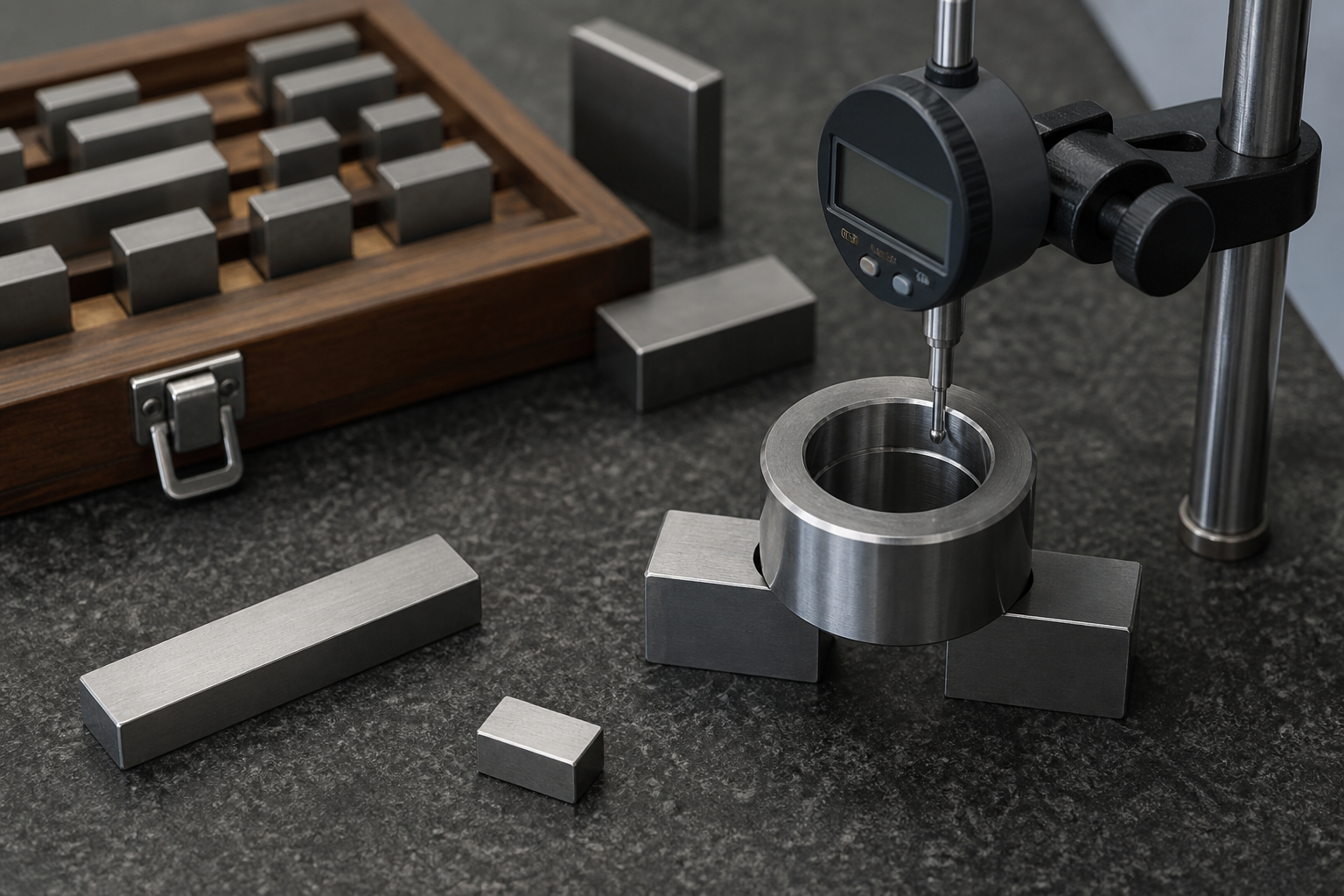
The number that should gate training
ndc—number of distinct categories—is the practical gate. If the measurement system cannot distinguish enough categories across the process spread, no amount of gradient descent recovers a part signal that was never in the labels. A study that fails ndc should stop dataset collection, not start a new architecture.
The second gate is the control of the study itself. Parts must span the real process, not a drawer of golden samples. Operators must be the people who will generate production data, not the metrology specialist who only appears for the study. A study run by one expert on ten perfect pieces is a brochure.
After the study passes
Lock the gauge, the fixture, and the work instruction that the study used. If production later switches to a vision cell for the same characteristic, that cell is a new measurement system. It needs its own R&R against the reference method, not a transfer of the old model's weights.
The brief version: do not train on a dimension until you can say how much of that dimension is the part. Everything else is fitting noise with better hardware.