
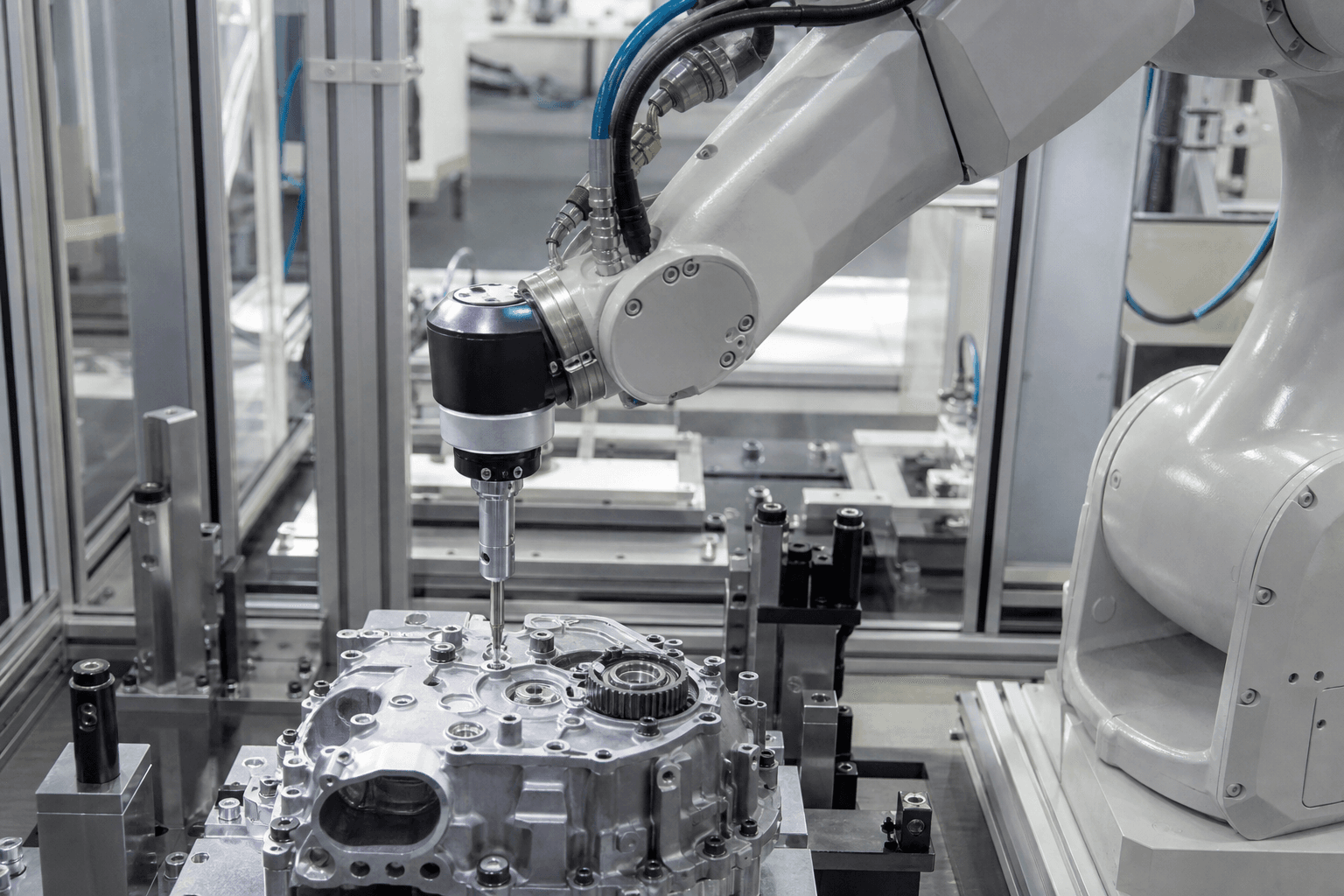
Bin picking solves unstructured intake. Palletizing clears the dock. Precision assembly still fails when a bolt cross-threads or a press-fit exceeds force limits the pendant never felt. Force-torque sensors and impedance control are moving from lab demos into production cells for electronics, drivetrains, and medical devices—logging every insertion curve as quality evidence.
The industrial point is contact tasks under variation. A robot that only follows Cartesian paths cannot own torque windows the QMS already requires from human stations.
What force control changes
- Fastening quality — Angle/torque and prevailing-torque signatures as release criteria.
- Compliant insertion — Peg-in-hole and connector mate without brittle crashes.
- Traceability — Per-part force profiles tied to serials in MES/QMS.
What still limits rollout
Calibration drift, tool-changer residuals, and cycle-time penalties versus hard-tooled presses. Cells without clear reject logic create silent rework. This is not adaptive welding, not mobile manipulators roaming the aisle, and not humanoid pilots—those are different robot economics.
What to watch next
- Which OEMs ship force packages as standard on small-assembly arms.
- Whether force signatures become gated SPC features, not optional plots.
- Measured first-pass yield lifts on fastener-heavy stations versus vision-only guidance.
Vision finds the part. Force proves the joint was made correctly.