

Electrode coating lines get the camera crews. Formation and aging halls get the schedule misses. A gigafactory can print cells faster than it can form, age, grade, and buffer them—and the mismatch shows up as WIP mountains, delayed module starts, and CapEx change orders for “just one more cycler row.”
This brief treats formation/aging as a plant inside the plant: power density, thermal uniformity, recipe libraries, and fire-safety envelopes. It is not an HBM packaging yield story, not a campus microgrid brief, and not a recycling black-mass piece.
The industrial point in one sentence
Formation is where chemistry becomes a graded product under controlled current, voltage, and temperature—and aging is where time and thermal history finish what the cycler started. If those halls are undersized or unstable, upstream speed is inventory, not output.
Anatomy of a formation hall (what must be true)
- Cycler channels matched to cell format — pouch, prismatic, or cylindrical fixtures that do not become the bottleneck when you change SKUs.
- Thermal control that matches the recipe — chamber uniformity beats average temperature; hot corners create grade scatter that looks like “chemistry” in yield meetings.
- Recipe and grade governance — who may edit formation profiles, and how MOC treats a “small” current tweak.
- Power and harmonic reality — dense cycler halls are nonlinear loads; ignoring power quality here is how you buy nuisance trips during peak formation waves.
- Fire and gas response sized for energy density — detection, suppression strategy, and segregation that match cell energy on the rack—not a copied warehouse standard.
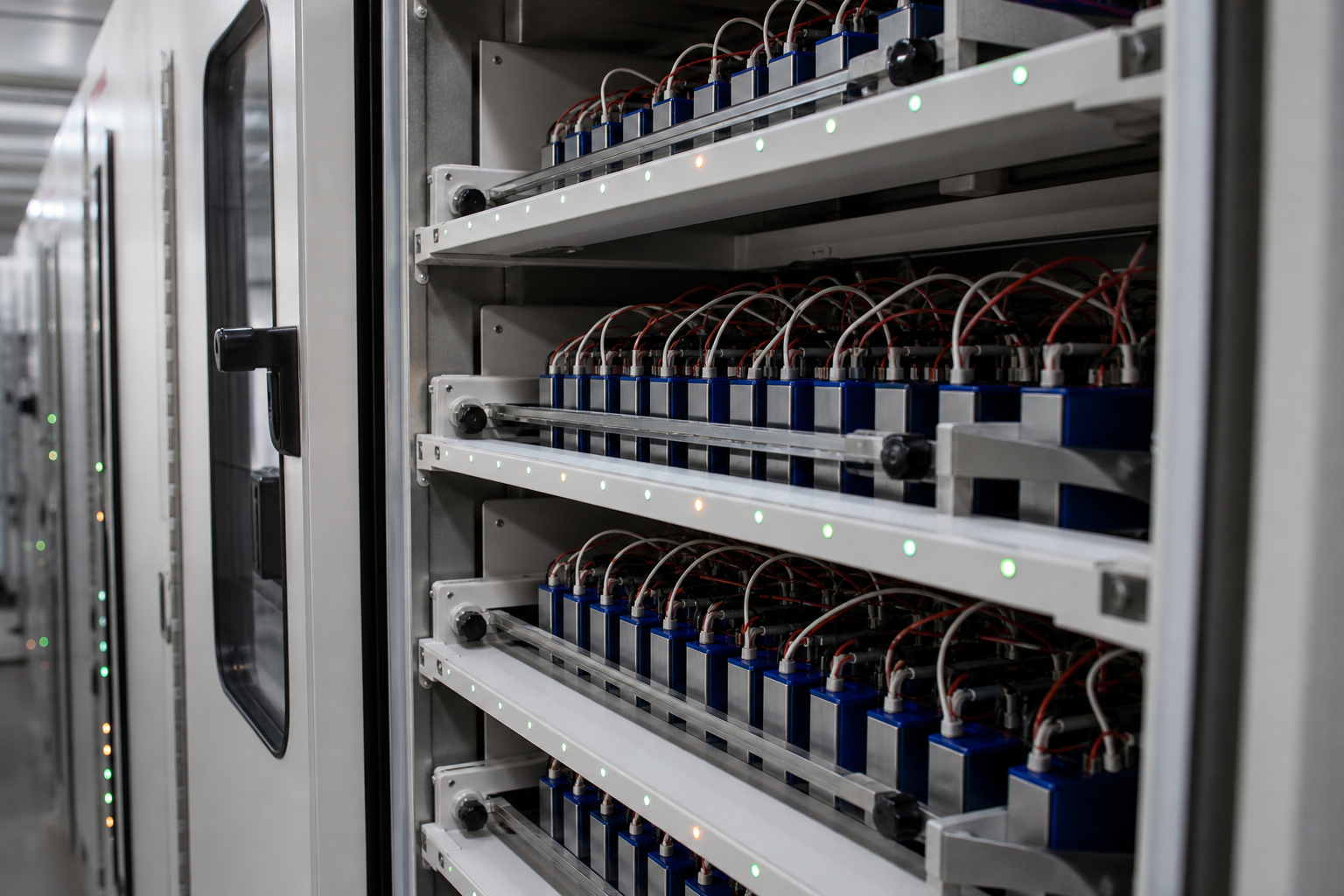
Each channel is a tiny process tool. Treat channel health like tool health.
Capacity math that survives a steering committee
| Lever | What it changes | Failure mode if ignored | | --- | --- | --- | | Channels per cell format | Parallel formation throughput | SKU change starves the hall | | Recipe hours (charge/discharge + rests) | Occupancy time per cell | “Nameplate channels” overstate output | | Aging buffer days | WIP and grade stability | Module line starvation or rush grading | | Thermal rejects / re-form rate | Effective capacity | Hidden tax on every wave | | Utilities uptime (power, HVAC, N₂ if used) | Hall availability | Beautiful racks, idle weekends |
A useful sanity check: effective cells/day ≈ available channels × utilization ÷ recipe hours, then subtract re-form and aging constraints. Teams that quote only channel count are selling furniture.
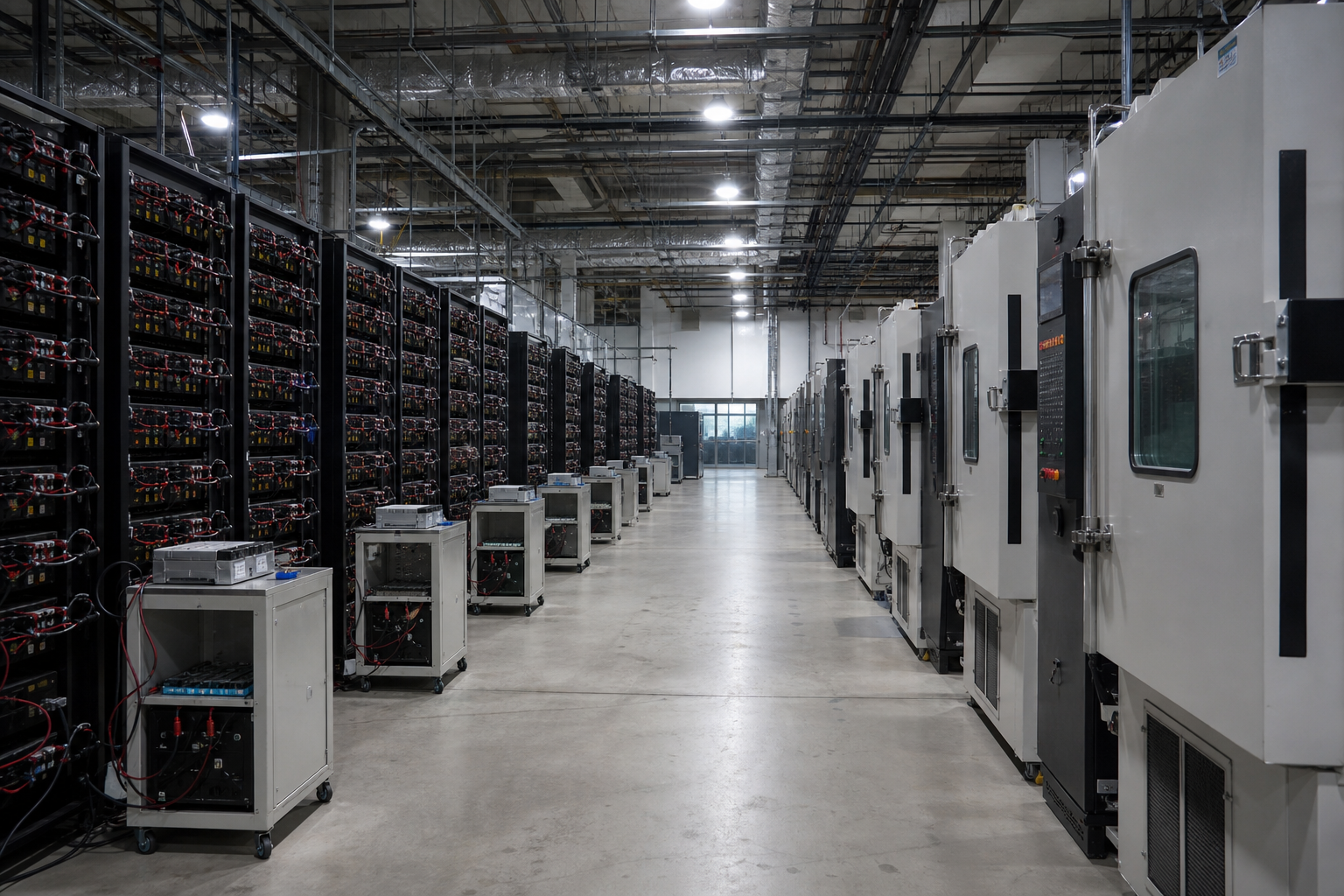
Aging space is schedule inventory. Undersize it and formation becomes a parking lot.
An anonymized schedule miss
A European module program delayed SOP by weeks after electrode output outran formation. The temporary “fix” was overtime and selective grading—until thermal scatter forced a re-form wave that erased the overtime. The durable fix was not motivational posters: it was adding chamber uniformity validation, locking recipe edits behind MOC, and expanding aging buffer to match the true formation occupancy distribution—not the brochure minimum.
Buyer checklist (five items, no theater)
- Show channel-hour capacity by SKU, including rests—not only installed channel count.
- Publish thermal uniformity data for chambers under load, not empty-map marketing.
- Name the owner for recipe changes and the scrap cost of an unauthorized tweak.
- Prove power-quality and HVAC design for simultaneous peak formation waves.
- Walk the fire/gas concept against actual energy density on the racks you will run in year two—not year-one demo cells.
Adjacent topics that are not this hall
HBM and hybrid bonding are advanced packaging yield gates. Industrial microgrids and CHP are site energy architectures. SiC wafer supply is a substrate bottleneck. Compressed-air and nitrogen utilities matter as inputs, but they are not the formation CapEx decision. Do not fund a microgrid study and expect graded cells to appear on time.
Formation and aging are where electrochemical ambition meets plant physics. Size the halls as capacity assets, govern the recipes as process tools, and the coating line’s speed finally becomes shippable product.