
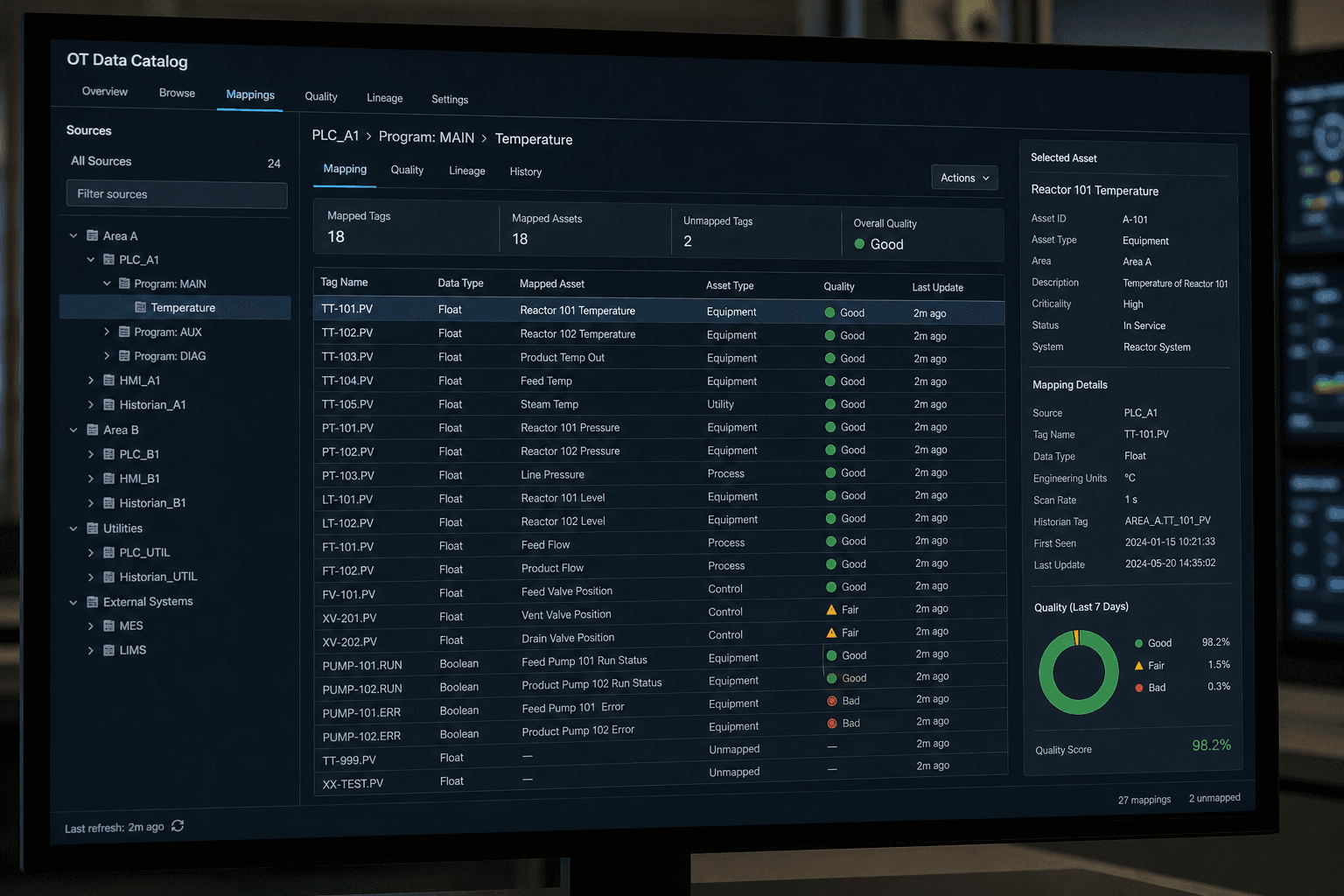
The first “AI failure” was not the model. It was an agent that closed a valve on the wrong train because two historians used the same tag mnemonic for different loops, and the semantic layer was a spreadsheet last updated before the turnaround. Production blamed the vendor. IT blamed OT. OT blamed “bad AI.” Nobody owned the living map from signal → meaning → asset → allowed action.
Semantic context sits in ownership fog. Controls owns tags in the PLC. IT owns the lake. Data science owns the model. Reliability owns the asset hierarchy. Nobody owns the governed product that makes agentic workflows safe: definitions, units, quality flags, lineage, and who may bind an action to a tag.
This brief is that ownership map—not another UNS slogan piece, and not a chatbot-on-SCADA demo.
Symptom → likely owner (before you blame the model)
| What you see | Often not “the LLM” | First place to look | | --- | --- | --- | | Agent acts on wrong asset | “Hallucination” | Duplicate tag names, missing asset bind | | KPI dashboard disagrees with board | “BI bug” | Unit mismatch, aggregate definitions | | Model works in pilot, dies in plant B | “Data drift” | Catalog not cloned, tribal synonyms | | Unsafe write proposed | “Prompt issue” | Missing action policy in catalog | | “We have UNS already” still fails | “Vendor gap” | Namespace ≠ governed meaning |
The point of the table is ownership: OT owns signal truth; IT owns platforms; AI owns models—but only a named OT semantic catalog owner connects them before agents inherit tribal folklore.
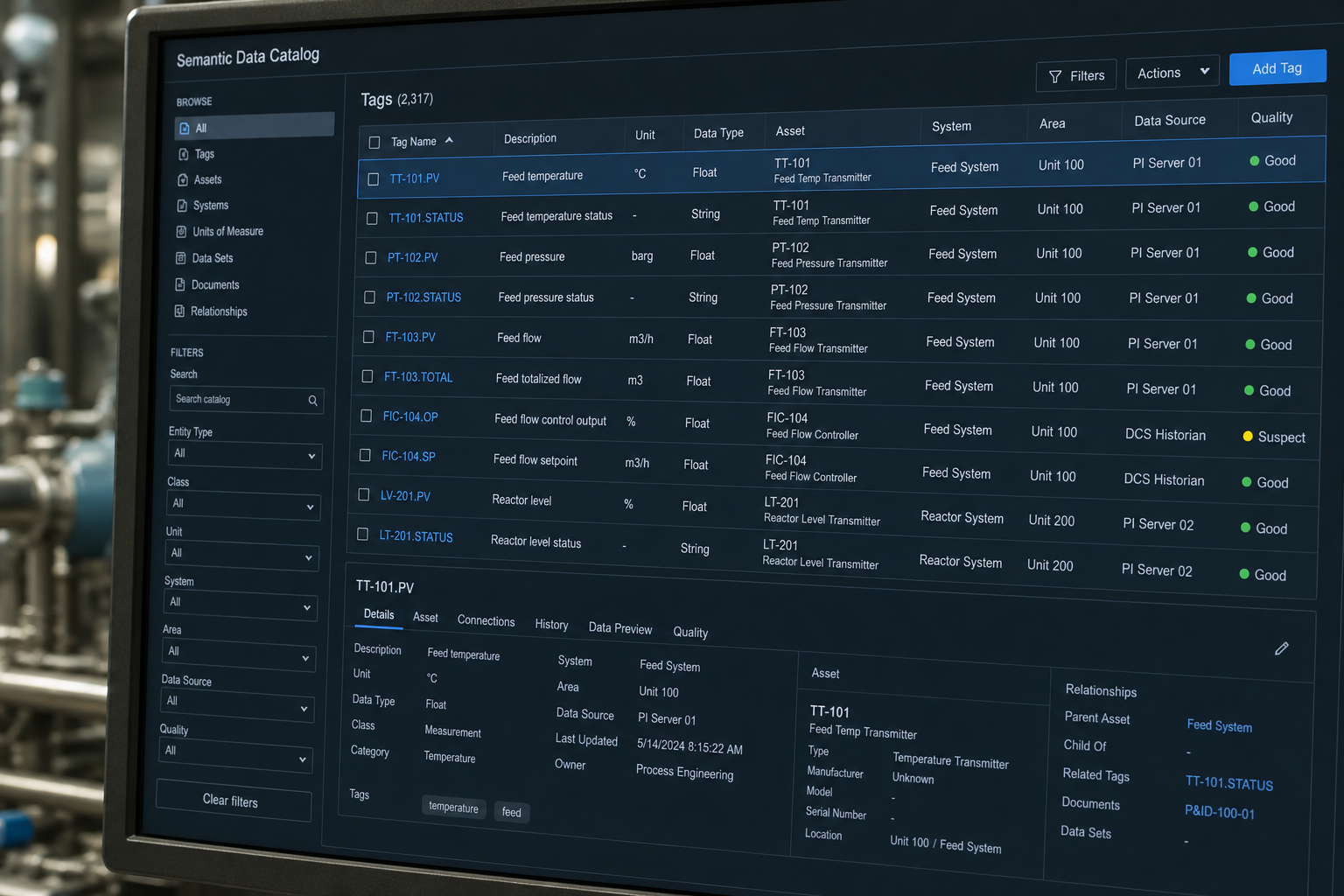
A published MQTT topic is not a semantic definition.
What a semantic catalog actually controls
A catalog is not a data lake folder. It is a product: canonical tag identities, engineering units, quality/stale flags, asset and process-segment links (think ISA-95 without religion), lineage to source PLC/DCS, and policy bindings for read vs advise vs act. Mature sites version the catalog like a P&ID change, reject undeclared synonyms, and refuse agent write-paths that lack an approved action class.
Hannover-era agentic demos skip this because booth Wi-Fi is not a turnaround. Plants that buy copilots without a catalog buy impressive pilots and silent wrong-train risk. Semantic layers from industrial DataOps vendors only help if someone owns curation cadence—the same way calibration owns instrument truth.
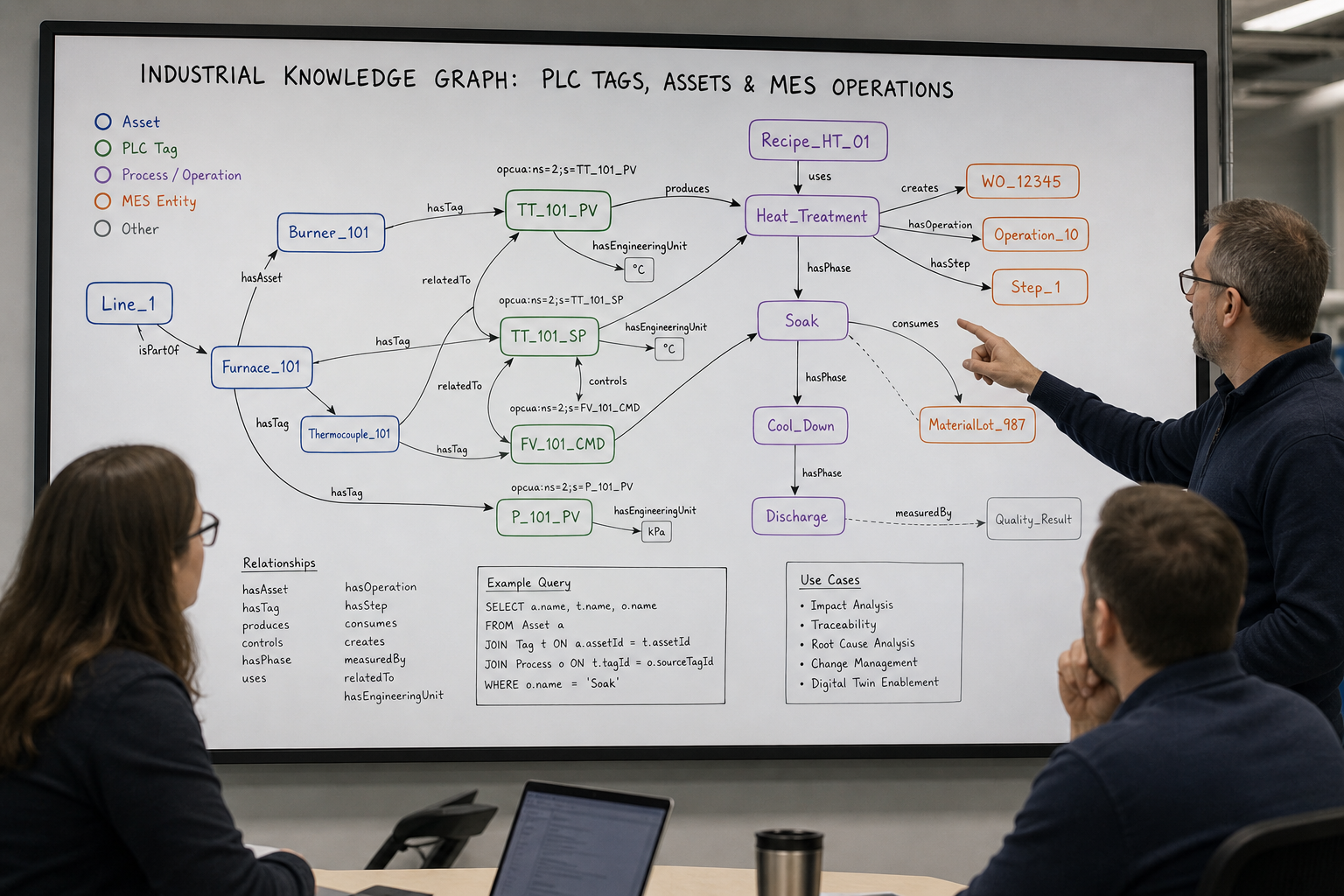
Context without curation is another tribal language.
An anonymized pilot that should have been a catalog freeze
A chemicals site paused an agentic advisory after it recommended reducing feed on the wrong reactor family during a grade change. Ticket trail: identical tag short-names across two units, historian aliases never reconciled, and a “semantic” spreadsheet with no owner after the integrator left. Post-mortem was not model temperature. It was a missing rule: no agent may bind actions until catalog freeze for that unit—named owner, versioned definitions, same MoC as SIS logic changes.
Magnitudes without brochure theater
Exact ontology tools belong to your stack. Ordering is portable: prevented wrong-asset actions outrank demo accuracy scores; versioned definitions outrank lake volume; action policy outranks prompt engineering. Sites that only celebrate “connected data” will keep celebrating pipelines while agents quietly inherit the wrong loop.
Adjacent topics that stop here
Unified namespace posts own connectivity patterns. On-prem PLC/SCADA copilots own chat UX on the edge. Industrial RAG owns maintenance document retrieval. OT model change control owns MLOps for soft sensors. None of them own governed tag meaning, asset binding, or action-class policy in a catalog. Do not buy an agent platform and expect semantic safety.
Questions that replace hope
Who can add a tag synonym without catalog revision? When did you last reconcile historian aliases across twin units? Can an agent write without an approved action class in the catalog? If the integrator disappeared for a month, would your MoC still know which definitions are frozen for which unit?
Agentic shop-floor AI is not a model upgrade. It is a meaning upgrade. Publish the catalog, name the owner, and treat semantics as safety-adjacent data—because the valve already does.