

Industrial RAG answers SOP and CMMS questions from text. PLC copilots draft logic. Digital MOC gates whether a change is allowed. What still slows engineers and operators is the drawing: finding the right P&ID sheet, tracing a line across revisions, and confirming what the field should look like before a walkdown or turnaround.
Multimodal models that ingest P&IDs, one-lines, and marked-up PDFs—then return cited sheet locations and equipment callouts—are entering plant engineering workflows. They matter when they reduce wrong-sheet risk, not when they “chat about piping.”
The industrial point is a cited drawing answer a competent person can verify on the rack. A fluent summary that invents a valve tag is worse than a slow search.
When the binder and the rack disagree
Turnaround and MOC packages still fail on revision control: the PDF on the share drive is R12; the plastic sleeve in the field is R9; the walkdown finds a spool the drawing never showed. Teams piloting multimodal drawing AI typically start with controlled corpora—latest approved sheets only—and require every answer to point at page coordinates or equipment IDs a human can open in under a minute.
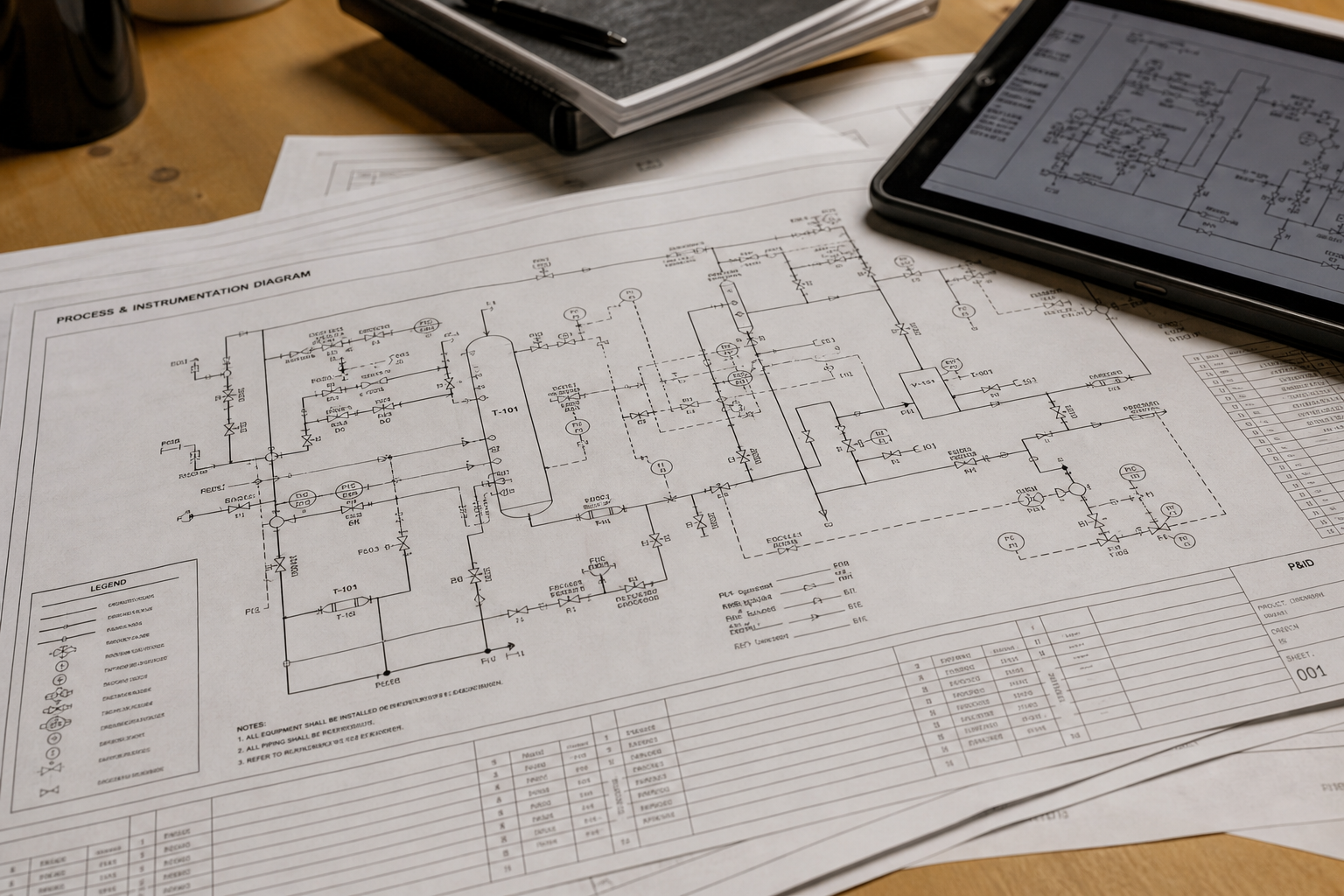
Revision-controlled sheets beat a random PDF dump—models amplify whatever you feed them.
An anonymized refining unit used drawing AI to pre-build MOC impact lists: which P&IDs touched a proposed pump swap. Engineers still owned the hazard review, but the “missed sheet” rate in package audits dropped after answers had to cite sheet IDs. The tool did not replace MOC software; it attacked drawing discovery latency.
What drawing-aware AI actually changes
- Sheet and tag localization — “Where is XV-2103?” with a verifiable page hit.
- Change impact pre-lists — Candidate drawings for a scope before the meeting.
- Walkdown packs — Ordered sheets and callouts for a route, not a chat transcript.

Field value is speed to the right sheet under helmet and gloves—not a desktop demo.
Failures that still look like “AI help”
Training on unmarked, outdated scans. Allowing answers without citations. Confusing this with text RAG over manuals or with MOC approval workflow. Letting a model invent isometric notes that become LOTO assumptions.
This is not PLC code generation, not causal scrap RCA, not PPE cameras, and not OT model promote gates. Those problems live elsewhere.
What to watch before scaling plant-wide
- Citation hit-rate in blind tests against known sheets—not user satisfaction scores alone.
- Whether as-built sync after MOC keeps the corpus honest, or the model learns lies.
- Integration into existing EDMS/MOC tools versus a parallel chat silo.
Buyer checklist (short)
- Corpus rule — Only approved revisions, with owners?
- Citation UX — One tap from answer to sheet coordinates?
- Human gate — Who signs that the pack is field-ready?
- Air-gap — Does inference stay inside the plant boundary?
Search finds documents. Drawing-aware AI earns its keep when it finds the right line on the right revision before someone opens the wrong flange.