
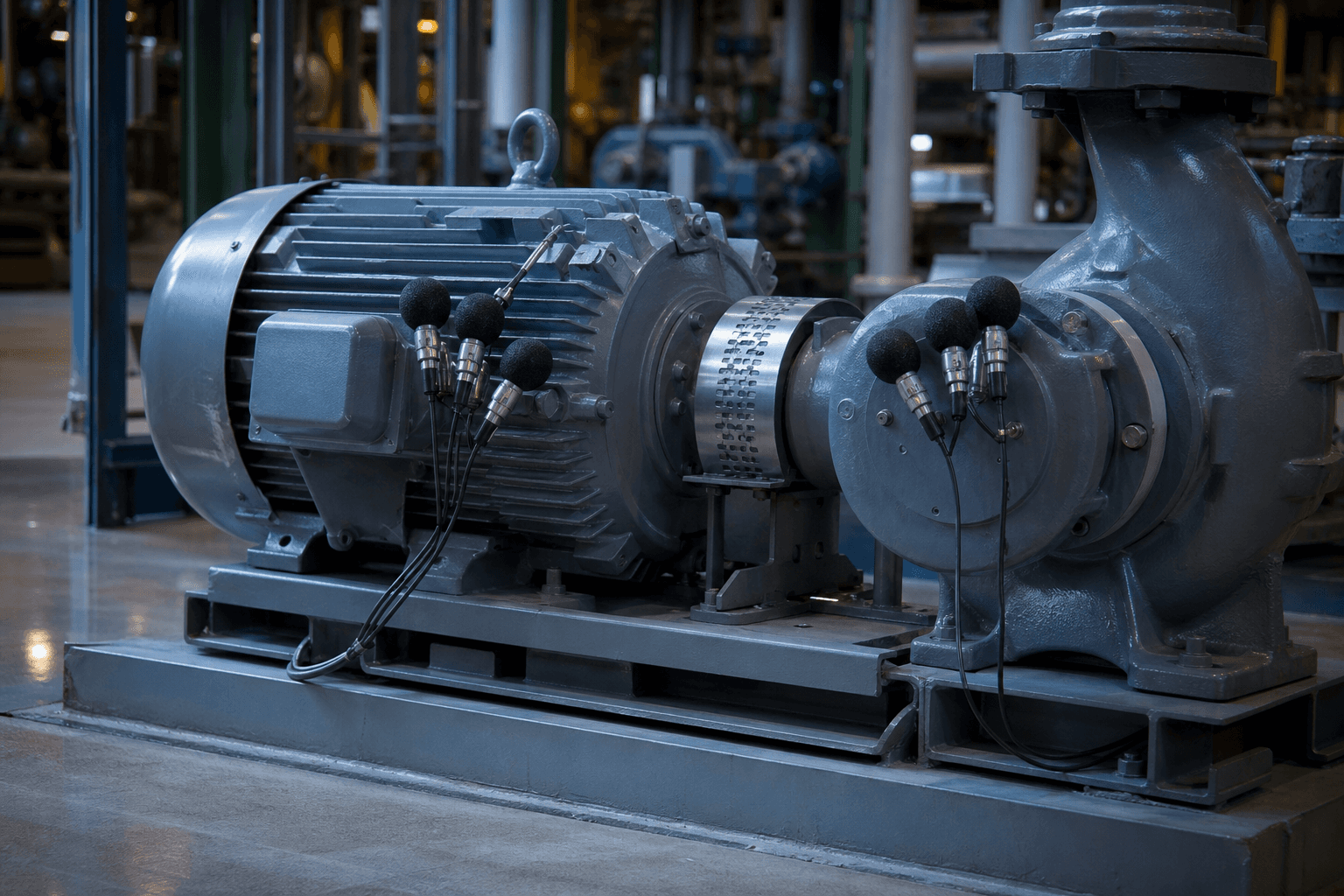
Classic predictive maintenance graduates from dashboards to work orders. Vibration routes and online proximity probes own many high-criticality trains. Historian data quality keeps tags honest. What still misses early faults on pumps, fans, gearboxes, and utilities skids is a sensing mode operators already use unconsciously: sound—airborne ultrasonics for leaks and electrical tracking, structure-borne acoustics for bearing and cavitation signatures—now sampled continuously and scored by models at the edge.
Acoustic machine listening is not a microphone novelty demo. It is a governed sensing layer with mounting discipline, baselines by operating state, and clear escalation into the same maintenance process that vibration and oil analysis already feed.
The industrial point is complementary coverage. Acoustics that ignore load state and duty will cry wolf; vibration-only programs that never listen will miss some leak, arcing, and early-stage faults that show first in sound.
Why sound earns a seat beside vibration
Contact vibration remains the backbone for many rotating assets. Acoustics add value where sensors are hard to mount, where faults radiate strongly in audible or ultrasonic bands, and where a dense fleet of mid-critical pumps cannot justify a full vibration island on every bearing. Plants piloting continuous acoustic nodes often report meaningful alert lead time measured in days to weeks before functional failure on faults such as lubrication starvation, early bearing defects, and valve/leak ultrasonics—provided false-positive rates are managed with state tagging.
Edge inference matters because streaming raw audio off-site collides with OT bandwidth and privacy policies. On-device embeddings or anomaly scores, with snippets retained only on alert, fit plant networks better than “send all WAV files to the cloud.”

Mounting location and mechanical coupling decide whether the model hears the machine or the room.
An anonymized water-utility and process-pump fleet (~220 assets) added ultrasonic and audible acoustic nodes on the highest-spare-cost pumps after vibration coverage plateaued. Over a year they documented multiple catch positives—lubrication and early bearing faults—where route vibration had been quarterly and too coarse. The program’s credibility came from tying each acoustic alert to a confirmed as-found, not from a glossy anomaly graph.
What acoustic listening actually controls
- Sensor placement and type — Airborne vs contact, magnet vs stud, distance to noise sources.
- Operating-state context — Speed, load, valve position; anomalies without context are noise.
- Model governance — Baseline refresh after overhaul, versioned detectors, OT change control.
- Workflow — Alert → inspection → vibration/oil confirm → WO, with ownership on shift.
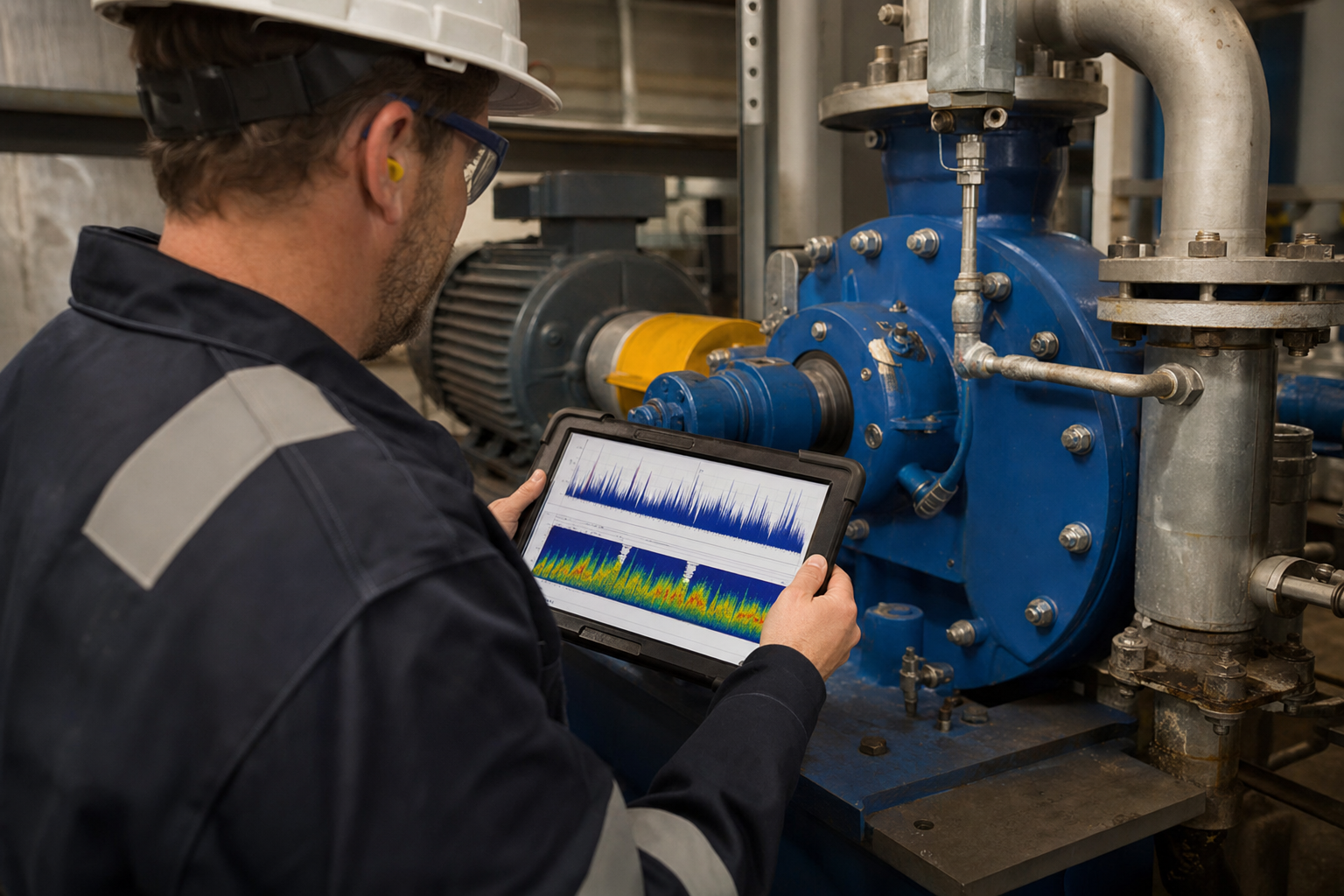
Spectra convince reliability engineers; unexplained red dots convince no one.
Situation: the always-alarming blower gallery
A site mounted mics in a reverberant blower room without state tags. Every rainstorm and every adjacent machine start spiked anomaly scores. Operators muted the channel in a month. Recovery required contact sensors on bearings, suppression windows during known starts, and a rule that acoustic alerts must show a confirming trend or ultrasonic pattern before paging the on-call tech.
What this is not
This is not dashboard-only predictive maintenance marketing, not historian tag data-quality programs, not vision PPE cameras, not soft sensors for process quality, and not OT model change control as an abstract MLOps topic—though it must obey that control. Acoustic listening specifically owns sound as a condition signal on rotating and fluid assets.
Numbers worth putting on the buyer slide
| Signal | Practical ranges teams discuss | | --- | --- | | Fleet fit | Mid-critical rotating assets under-served by full vibration | | Lead time (when it works) | Often days–weeks before functional failure | | Kill criterion | False positives without state context | | Data path | Edge scores first; raw audio on exception |
If a vendor cannot show confirmed as-founds against your asset class, you are buying headphones.
Failures that still look like AI progress
Cloud-only audio without OT approval. No baseline after maintenance. Alerting without inspection playbooks. Treating acoustics as a replacement for API-style protection systems on turbomachinery that still need proper vibration protection.
Buyer checklist
- Asset selection — Which failure modes are acoustic-first on your fleet?
- State tags — What process signals gate the model?
- Confirm path — Vibration, thermography, oil—what validates before teardown?
- Governance — Who approves model updates on the OT network?
- Mute test — What happens to trust after the first bad pager storm?
Ears were the first PdM instrument. Continuous acoustic listening works when it is engineered like instrumentation—not when it is demoware that never survives a noisy Friday night shift.